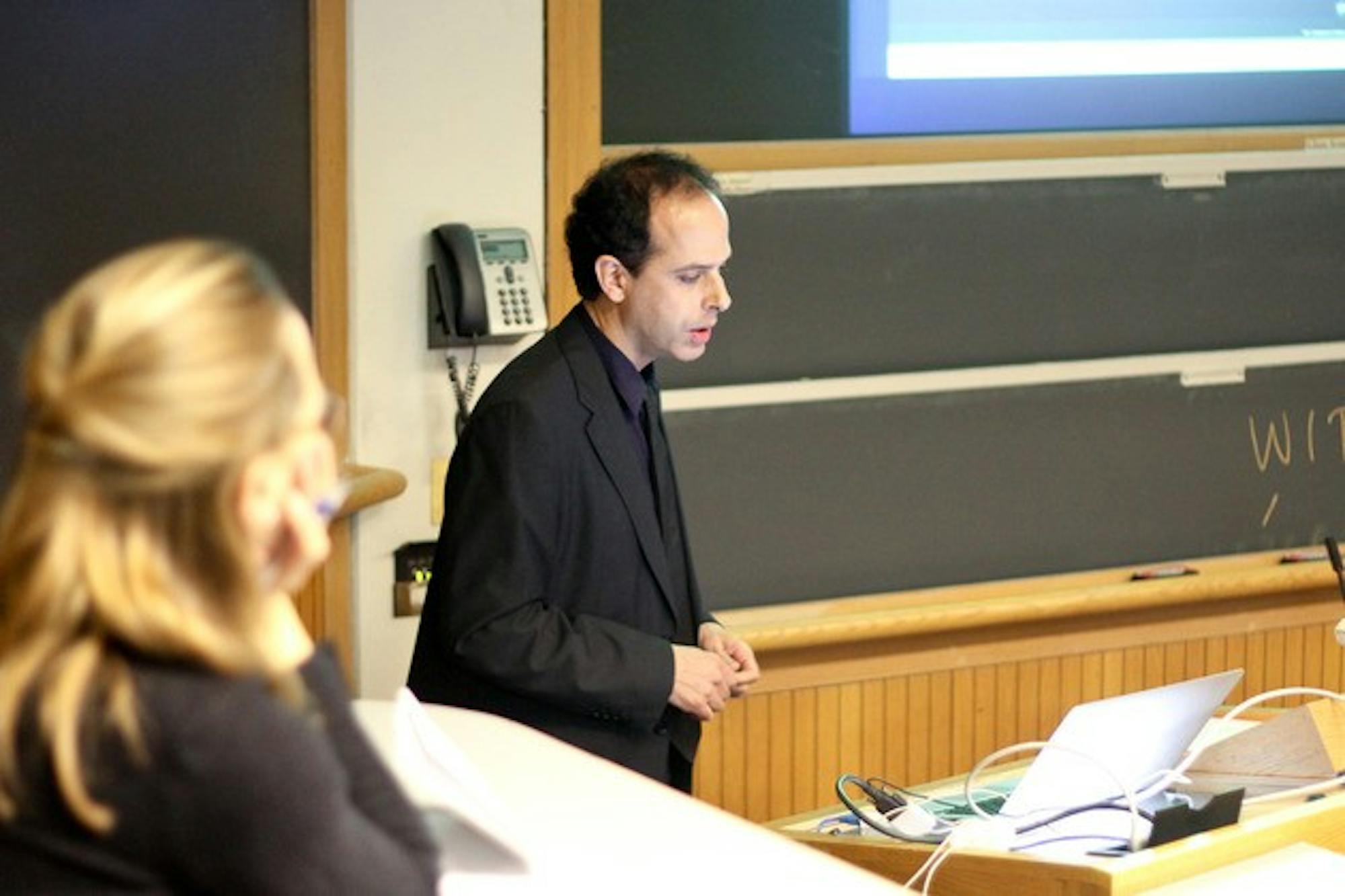
Founded in March 2000 under the direction of the University of Virginia, the library aims to incorporate diverse content written by a community of scholars and library users into an integrated and well-organized interface, according to Germano. "[The library is] an online service where scholars can map out areas of knowledge, not by the geographic sense but by the semantic sense," Germano said. "It has an interface where you can index all categories of information such as essays and images and videos and statistical information so they are semantically bound together."
Germano used visual screencasts of the library website to demonstrate its place dictionary, or gazetteer, which allows users to study the cultural and historical aspects of a Tibetan region by linking different resources such as videos, photos and essays to locations on a map.
The gazeteer, which can be viewed in English, Tibetan or Chinese, uses geographical identifiers to index these resources and make the dictionary a more streamlined interface, according to Germano.
"There might be 30 different photographers and yet, because they all index their photos by this single geographical service, the system automatically binds them together," he said.
Germano also highlighted the library's collection of videos created by local Tibetan community members who contribute oral commentaries, tutorials and skits.
"We've gone across the plateau documenting hundreds of lectures on different places by video to bring that local expertise and knowledge and acts of self-representation out," he said.
The video collection includes clips of everyday Tibetan life, ranging from couples fighting to a woodworking demonstration to a business interview tutorial, according to Germano. These clips provide users with "a peek into the Tibetan world," which is about much more than "just protest and trauma," Germano said.
The library recently began to provide users with time-encoded transcriptions similar to subtitles in standard Tibetan, a written form understood by speakers of multiple Tibetan dialects, Germano said.
"Tibetan is a family of languages Tibetans don't understand each other across different regions very well," he said. "The transcriptions open up these videos to other Tibetans."
Germano also discussed the library's filmmaking training, which provides Tibetan children with equipment to create their own movies for the library.
"The knowledge [from the videos] comes back in the community," he said. "[The videos] are also a tool of self-representation so people from outside can see what's going on in Tibet."
Germano explained other aspects of the library, including its collection of essays written by a diverse set of authors, architectural designs of Tibetan buildings and panoramic pictures of local landmarks.
Dartmouth anthropology professor Sienna Craig, who invited Germano to the College, said the library is a useful tool to contextualize the historical and contemporary data on the region.
"I have known about the project since its inception and use the resource regularly for my own research, writing and teaching," Craig wrote in an e-mail to The Dartmouth. "The lecture expanded my understanding of some of the new projects and directions in which the project has been moving."
Lars Hoger '14, who attended the lecture, said he was impressed by the library's comprehensive content and intuitive interface.
"It's mind-blowing that the cultural, geographical and political aspects of a region can be so smoothly encapsulated in a website," Hoger said. "It would be interesting to see if this project branches out to other countries or regions as well. The potential is enormous."
Germano also gave a guest lecture in Craig's Introduction to Cultural Anthropology class Friday morning.
Matt Garczynski '14, a student in the class, said he has never seen the Internet "used so well" to gather large quantities of information in one location.
"If one does need to research on Tibet and Himalayan areas, [the website] would be a wonderful resource," he said.
Germano's lecture, which occurred at the Rockefeller Center, was sponsored by the Asian and Middle Eastern Studies and anthropology departments.