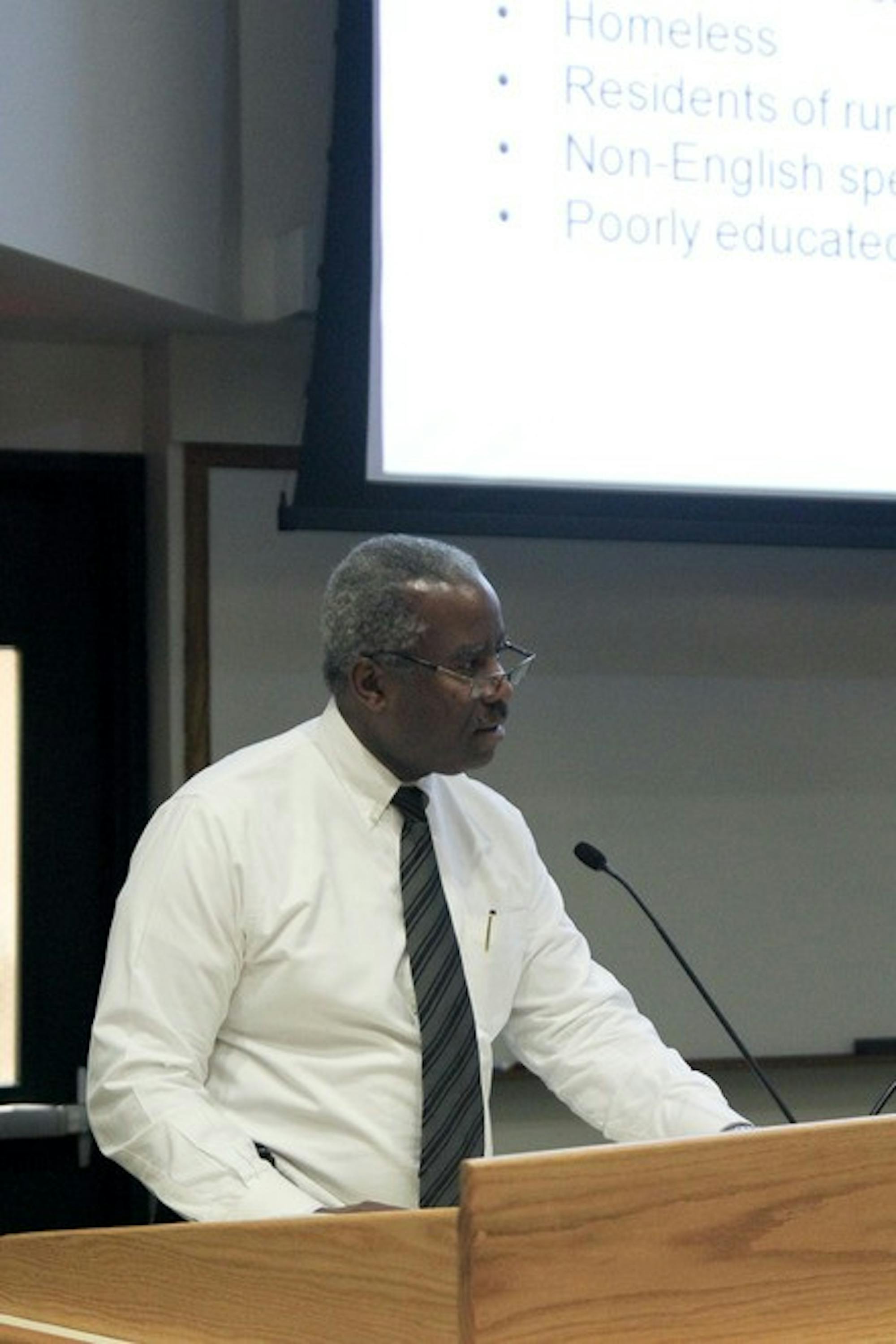
Disparities in health care delivery deserve national attention since the U.S. Census projects that racial minorities will outnumber the white population by 2050, according to Royal.
"Those considered vulnerable will have greater health care needs greater risk of poor physical, mental and emotional health," he said.
Despite gains achieved since the 1964 Civil Rights Act such as increased college graduation rates among minorities minority groups continue to be more susceptible to medical conditions, according to Royal.
"When you look to see what sort of impact education has had on such measures as infant mortality, it's been very little," Royal said. "That suggests that it's not a simple answer when it comes to groups most at risk for poor health and lack of insurance."
Students at Dartmouth and other institutions should use the resources at their disposal to assist underserved individuals, Royal said. He cited the Indian Health Service a federal health care initiative for Native Americans as one way in which Dartmouth students have made a significant impact.
"Here at Dartmouth there is a tradition whereby medical students get involved in programs related to primary care in the Indian Health Service," Royal said. "It has been found that individuals who join those programs tend to stay in the communities they train in."
Recent government initiatives have aimed to close the health care access gap, Royal said. The Department of Health and Human Services' "Healthy People 2020" initiative targets individuals with inadequate or no access to health care in an attempt to address racial disparities.
The health care law enacted last year by President Barack Obama aligns with the "Healthy People 2020" plan by preventing insurance companies from denying care to patients with preexisting health conditions, Royal said.
Although health care disparities are often more visible in urban settings, rural regions are in desperate need of community health programs that reach out directly to patients, Royal said.
Two current DMS students whose original medical school in Haiti was destroyed by last year's earthquake attended the discussion. They both said they plan to learn from their experiences at DMS and use that knowledge to help reinvigorate health care in their home country.
"We have a lot of not only health-related but also social disparities [in Haiti]," Regina Duperval DMS '14 said. "I want to work in public health and serve the underserved."
Yamile Blain DMS '14, also from Haiti, said she plans to return to study medicine in Haiti once her medical school is rebuilt.
"I'm hoping to be working in reducing disparities wherever they are," Blain said.
Royal's lecture is part of a broader student commitment at DMS to address national health care issues, according to DMS Chief Diversity Officer Susan Pepin. Students requested that DMS invite a speaker who could discuss health care disparities within the United States population, she said.
While attending Dartmouth Medical School, Royal served in the National Health Service Corps, a government program that offers scholarships for medical students who deliver health care to underserved communities. That opportunity enabled him to pursue his interests in both research and service, he said.
The lecture took place in Chilcott Auditorium as part of DMS's Martin Luther King, Jr. panel series.