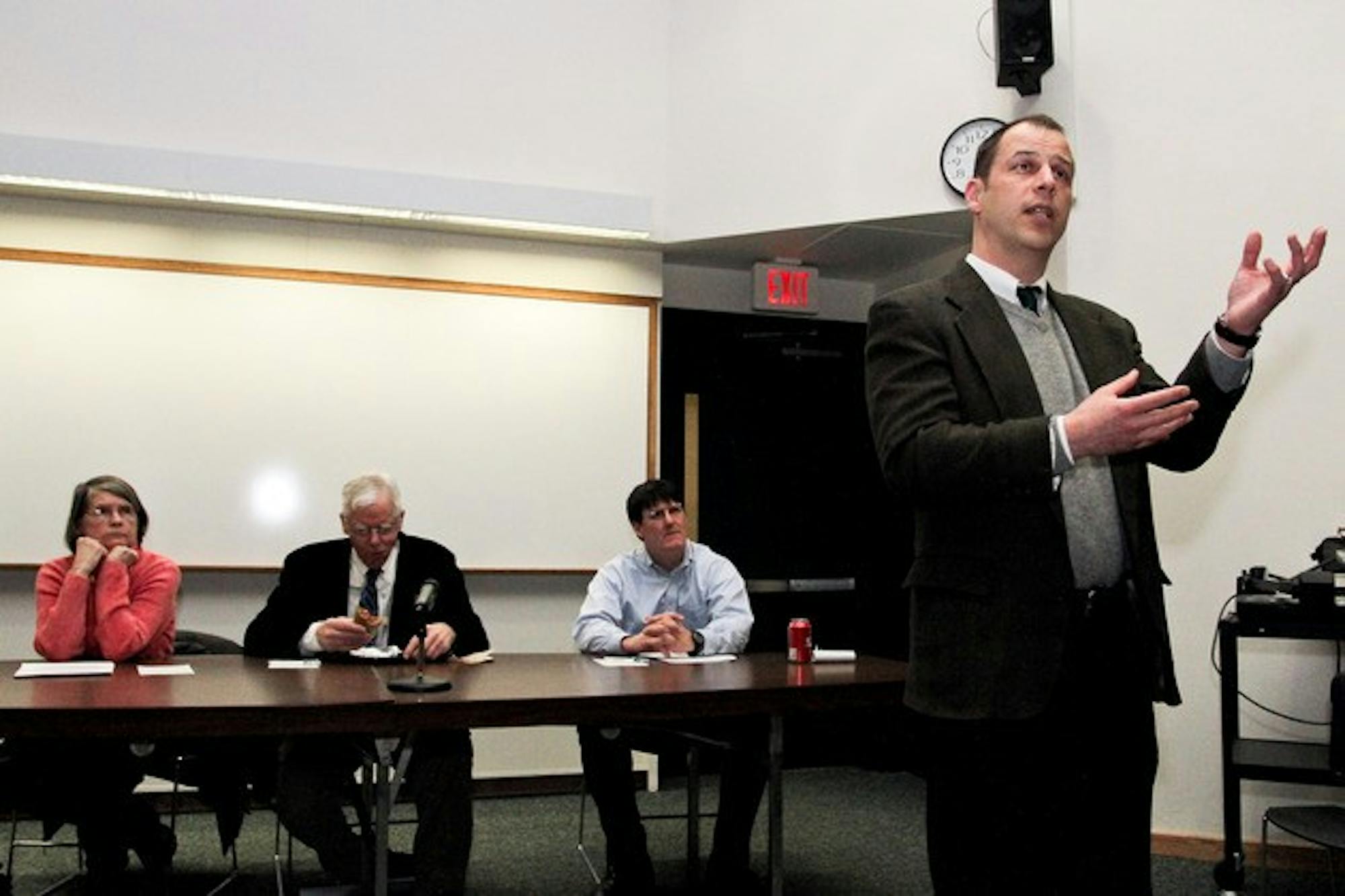
Panelist Erik Esselstyn said that doctors are at least partially to blame for not adequately addressing these less tangible aspects of patient care. Esselstyn offered advice to the small audience composed mainly of DMS students suggesting that simple measures, such as addressing patients by their first names when appropriate, go a long way in assuring the patient and the family that they are receiving high-quality care.
"Personal warmth is worth a ton of penicillin," Esselstyn said. "Be as personal and warm and touching as you feel comfortable."
Emphasizing the need for positive communication between doctors and their patients, panelist Anne Stephens recounted her husband's battle with Lewy body dementia, a degenerative brain disease that causes dementia. While Stephens said the quality of care her husband received was excellent, doctors failed to address their emotional response to the trauma until she began crying in the hospital room.
"Because I showed some emotion, I got a response to how I was feeling," she said. "But before that I had not received any responses to what anything was like for me."
During an informal dialogue between the moderator and the audience, students said that DMS courses address the importance of professional and empathetic bedside manner.
Despite some recent improvements, quality health care is not distributed evenly in America, according to the event's moderator Thom Walsh, a PhD candidate at The Dartmouth Institute for Health Policy and Clinical Practice.
Statistics suggesting that this inequality is a result of racial or socioeconomic status can be misleading, he said. Walsh said that blacks throughout the country with diabetes are four times as likely to have a leg amputated as white patients. Black patients at high-quality hospitals are also less likely to undergo leg amputation than whites at low-quality hospitals, Walsh said.
"It's not just black or white, high-income or low-income it's quality of care," Walsh said.
Panelist Shawn O'Leary, director of Multicultural Affairs at DMS, shared the experiences of his Native American father, which he said reveal that U.S. hospitals' treatment of minorities depends heavily on individual facilities.
At one urgent care center in Minnesota, O'Leary's father felt that his Native American contract health card "put him at risk for poor treatment," he said. This feeling was exacerbated when the doctor laughed while telling O'Leary's father that he was having a heart attack, O'Leary said.
His father proceeded to drive himself to another facility five hours away, where he was treated with more professionalism, according to O'Leary. Even at this new facility, however, the hospital staff refused to consider his concerns about non-homeopathic medications and it was not until he visited a third facility that O'Leary's father was finally taken seriously, O'Leary said.
"We are all different different backgrounds and different experiences throughout our lives and that needs to be considered based on who the patient is," O'Leary said, quoting his father.
The panel was part of a larger series of lectures organized to commemorate Martin Luther King, Jr., addressing his call to put an end to injustice in all areas of modern society.