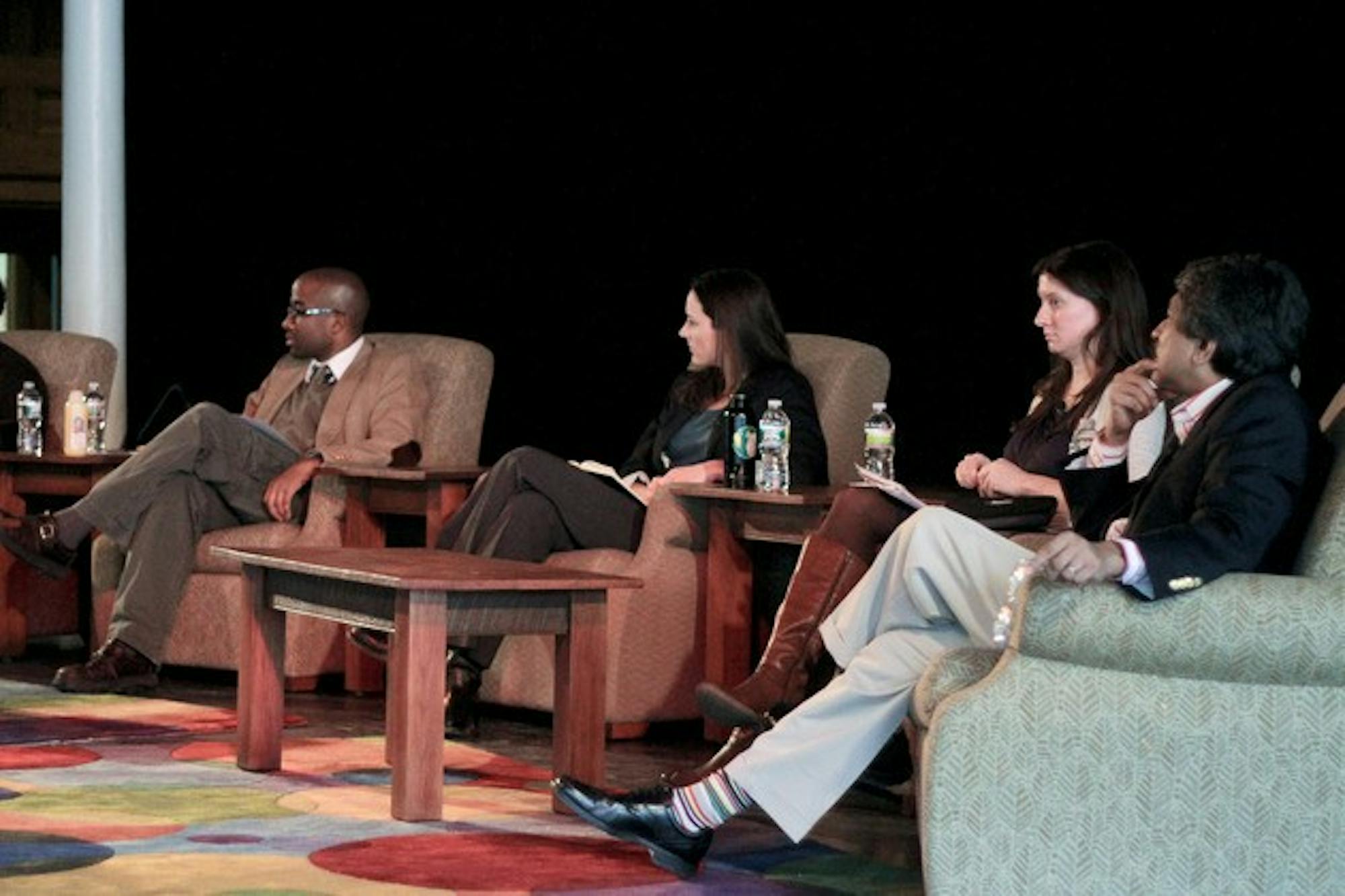
As one example of injustice, panelist Lauren Culler, a PhD student in the ecology and evolutionary biology program and a fellow in the National Science Foundation's Integrative Graduate Education and Research Traineeship Program, described her experience working with individuals in Greenland who already experience the impact of climate change on their food supply. Those individuals produce very little of the damaging carbon dioxide emissions, she said.
When addressing the social justice challenges posed by climate change, it is also important to think about the potential for unfairly burdening certain populations with the cost of the solution, Anant Sundaram, panelist and professor of business administration at Tuck School of Business, said.
A policy intended to address climate change that is also "geared towards constraining the abilities of these countries to achieve some reasonable levels of health and wellness" by significantly impeding development is also a social injustice, he said.
It is crucial to keep the issue of social justice in mind when discussing sustainability and addressing climate change, panelist Rosi Kerr, sustainability director for the College, said.
To effectively address the issues of sustainability and social justice, society must adopt Martin Luther King's charge that we "make the shift from a thing-oriented society to a person-oriented society," Kerr said.
While the well-informed scientific community agrees that carbon dioxide emissions influence climate change, the real debate concerns the magnitude of the damage and the best way to address the threat, panelists said.
"The T.V. debate is, Is climate change happening?'" panelist Michael Dorsey, an environmental studies professor, said. "That's garbage."
Dorsey said the effects of climate change are "catastrophic" and often disproportionately affect populations that contribute little to the problem. Some of the panelists disagreed over the magnitude of climate change, how it is being addressed and the means by which it should be solved.
Sundaram said he disagreed that climate change and environmental degradation have reached a catastrophic level. He argued that overexaggerating and using fear tactics are not effective ways to deal with the issue. Because corporations play such a significant role in contributing to carbon dioxide emissions, they must play a significant role in any proposed solution, Sundaram said. Many corporations are already in the process of reducing their environmental impact by looking into ways to improve efficiency, according to Sundatam.
Dorsey disagreed that corporations are effectively addressing this problem.
During a question and answer session after the event, Dawood Yasin, Muslim life and service trips coordinator at the Tucker Foundation, challenged Sundaram's statement that corporations will be an effective part of any solution to climate change.
In response to Yasin, Sundaram said he does not expect most corporations to act outside their own interests in order to deal with climate change. The government needs to create policies that not only punish corporations for emissions but also reward corporations who are actively taking measures to reduce their impact, according to Sundaram.
Dia Draper, Tuck admissions associate director for strategic initiatives, moderated the panel.