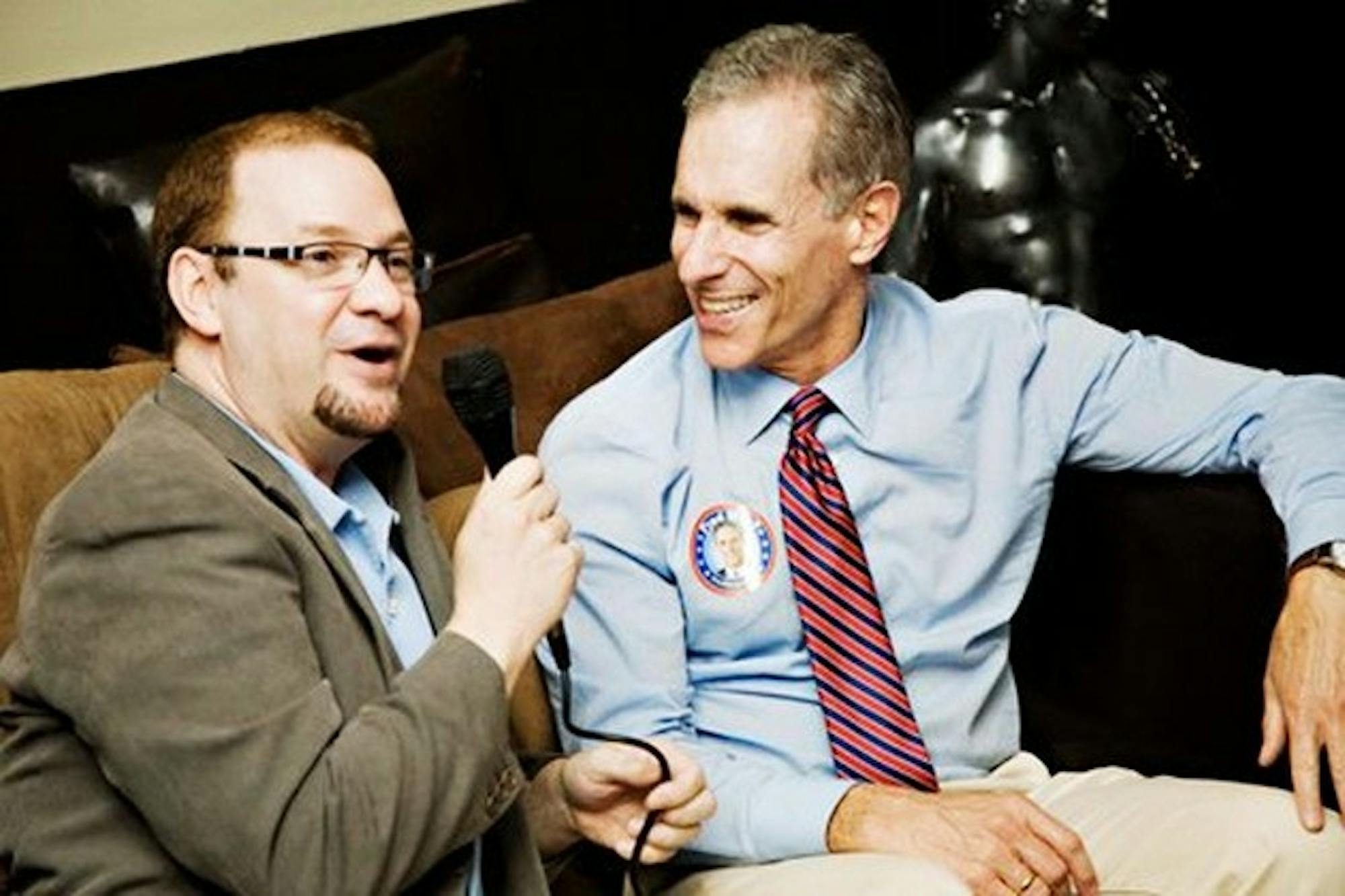
"What I want to do is encourage participation not take away rights but extend to 16 or 17-year-olds the right to vote," Karger said. "I would like to help lead that crusade because I have great faith in younger people."
Karger said that lowering the voting age would require high school principals and teachers to incorporate politics into their education plans.
Kevin Miniter, Karger's research director, said one of Karger's most notable strengths is how he engages with young voters.
"Other politicians are apprehensive and afraid of this 18 to 29 age group," Miniter said in an interview with The Dartmouth. "Fred wants to get everyone involved in the political process."
Will Bishop '12, who attended the talk, said in an interview with The Dartmouth that young people may not fully grasp key political issues until they take college courses on economics and government.
"I followed the [2008] campaign very closely, but since I came to Dartmouth, I've learned stuff about economics and policy that I didn't know back then," Bishop said. "I don't know whether all 16 and 17-year-olds have the kind of knowledge to make them informed voters."
Karger said that since leaving political consulting, he has devoted his life to gay rights advocacy.
During the Proposition 8 campaign to ban gay marriage in California, Karger led a boycott of hotels owned by real estate tycoon Doug Manchester, who had donated $125,000 in support of Proposition 8.
Karger said his campaign was successful in forcing Manchester to stop donating to the Proposition 8 cause.
"By his own admission, [Manchester's] public relations director told me that they were losing $1 million a month," Karger said. "While I don't wish ill on anyone, I want to send a message to Doug Manchester."
Karger encoutered homophobia while touring the country as a gay rights activist, discussing the ideas he said later formed the foundation of his potential presidential campaign.
Iowa's Republican National Committee member Steve Scheffler, who organizes the Republican Party's public forums in Iowa, threatened Karger in an e-mail, saying, "You and the radical homosexual community are not welcome in Iowa, and I'm going to work overtime to abort your candidacy," according to Karger.
If Karger makes a bid for the presidency, he will be the first openly gay presidential candidate.
President Barack Obama's election campaign set an example for future candidates, Karger said in an interview with The Dartmouth.
"My first takeaway was how he used the Internet to really organize and work with younger voters," Karger said. "[Former presidential candidate] Howard Dean was the first, but Obama perfected it. "
Karger said Obama's campaign manager, David Plouffe, emphasized a strategy that resonated with Karger personally.
"Plouffe kept saying, We have to take chances. What do we have to lose?'" Karger said. "In a political campaign, everything you do is a risk."
Plouffe's mentality stood in stark contrast to the tendency of the lesbian, gay, bisexual and transgender community's tendency to be overly cautious in political campaigns, Karger said.
As an example of his attempt to defy such cautiousness, Karger held a press conference at the Southern Republican Leadership Conference, an atmosphere that Karger said was inhospitable to a gay man with political aspirations.
Before becoming an activist, Karger spent 27 years in political consulting, working on the presidential campaigns of Gerald Ford, Ronald Reagan and George H. W. Bush. Karger, whose job was to tailor campaign messages at any given moment when public perception shifted, said he was branded as a "dark arts operator," or a specialist in convincing the public to vote against the opposing campaign.
Karger said he played a role in altering the narrative of the 1988 presidential campaign to favor Republican candidate George H. W. Bush.
When Democratic nominee Geraldine Ferraro outperformed Republican nominee Dan Quayle in the vice presidential debate, the momentum appeared to be swinging in the direction of Democratic presidential nominee and Massachusetts Governor Michael Dukakis, he said.
On the Friday following the debate, however, Karger's political consulting firm, the Dolphin Group, aired one of the famous "Willie Horton" advertisements that are regarded as among the most effective political campaign advertisements in history.
Dukakis had supported a furlough program, which allowed criminal Willie Horton to leave prison for a weekend. Horton proceeded to murder and rape civilians when out of prison.
The advertisement aimed to cast Dukakis as weak, and featured Horton's victims recounting their experiences.
"Attention turned back to Willie Horton and away from Dan Quayle," Karger said. "It was a very crucial tide."
College Republicans president Richard Sunderland '11 said New Hampshire's influence in the primary campaign in 2012 means that students will have plenty of opportunities to meet with political figures such as Karger.
"Because New Hampshire is an important stop in the road to the White House, it's almost a necessity for these people," Sunderland said.
The discussion was co-sponsored by the College Republicans and the Rockefeller Center.
Karger will host a town hall meeting in Manchester on Thursday.