The Life Sciences Building, located near the College's Vail Medical School building on the northern end of campus, is scheduled to be completed by May 10, 2011, but will not open for full occupancy until Sept. 1, 2011, senior project manager Joseph Broemel said. Between May and September, faculty will test the new technology offered in the building.
Several flat-screen televisions will be mounted around the public areas of the building, and new digital directories will assist visitors in finding their way among the building's rooms, according to Broemel.
"The building directories will use digital signage with interactive screens, where you'll go up to the screen and touch on, for example, biology department,' and then a faculty member, and it will show a map of how to get to his room," Broemel said.
The directories may exhibit which projects professors are currently working on, he said.
The building will also feature a new classroom equipped with 10 flat-screen televisions and room for 80 students.
"Students can break out of the lecture format and move over to work in groups with one of the flat screens," Broemel said. "The instructor at the front of the room can hit a button and it will project whatever the students are working on onto the main screen at the front of the room."
A new 200-person auditorium will function as a large classroom to be used for both science and non-science courses, according to Broemel.
The building will also feature large public gallery spaces with a seating room and a graduate student lounge. Students will have the option of connecting their computers to special outlets, projecting their content onto large televisions mounted on the wall and creating a work area, Broemel said.
Flat-screens in this area will also be used to simultaneously broadcast presentations given by speakers in the auditorium.
The Life Sciences Building is "intended to be the most energy efficient building of its kind in the country," and is on track to achieve Leadership in Energy and Environmental Design platinum certification, according to Broemel. Stations placed around the building will display the current energy usage of the building.
Winter construction remains on schedule thanks to the building's efficiency, Broemel said.
"Because [the building] has such a tight energy-efficient envelope around it, it's pretty easy to keep warm," he said. "The one thing we were worried about was getting the walls up on the greenhouse on the roof, and we did get it done before the first big snowstorm around Christmas."
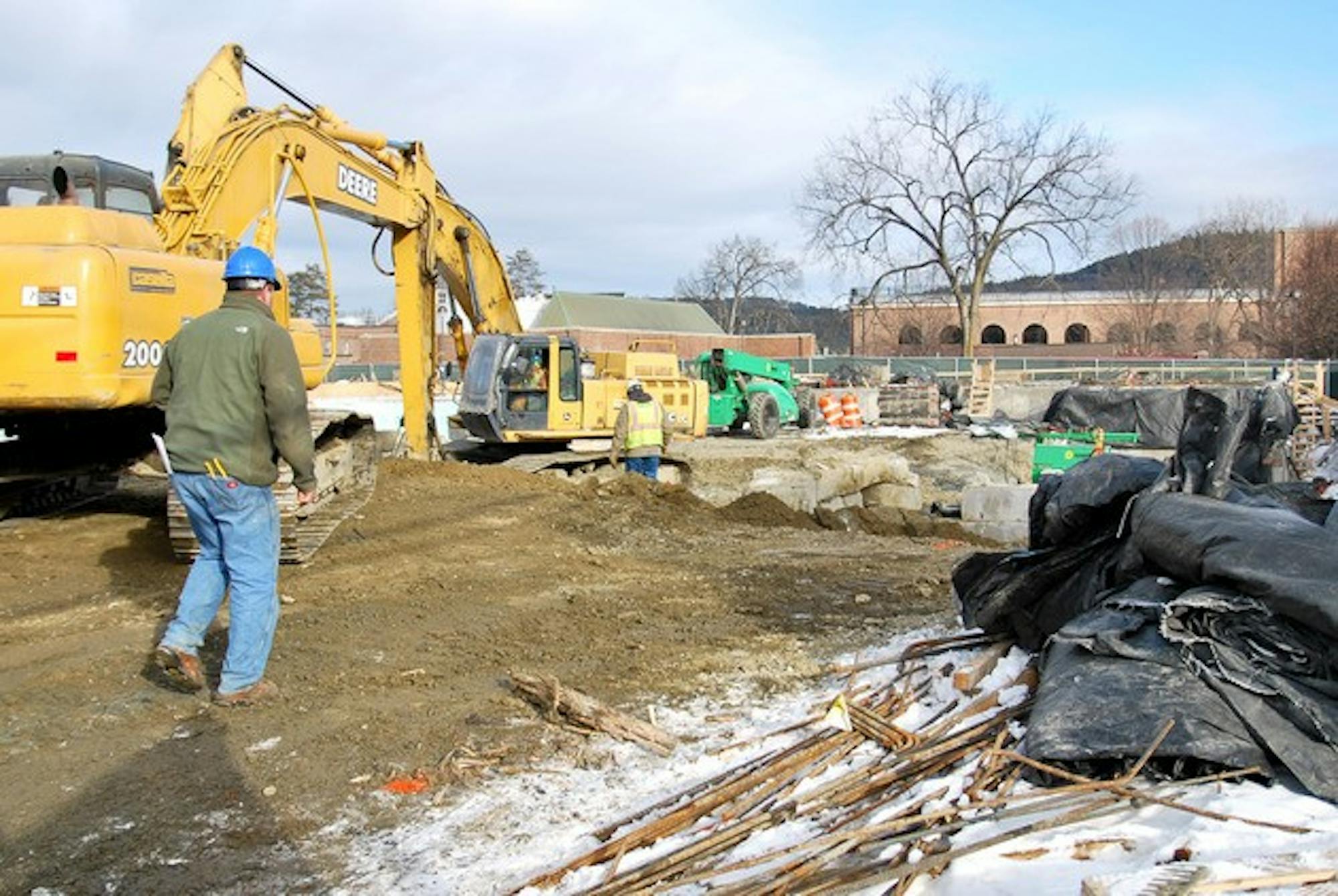
Despite a difficult start with breaking ground for the Visual Arts Center, construction is now on schedule for successful completion by June 2012, according to Matt Purcell, director of project management, campus planning and facilities.
"We've had struggles getting out of the ground," Purcell said. "There's been a lot of rock, more extensive rock than we had anticipated by about 15,000 cubic yards. Where we need rock, there isn't any rock."
The snowy weather this winter has proven less disruptive to construction than the team expected, Purcell said, and the project has not faced any budget changes since it was initiated.
"It's a working building, hopefully it will provide the Dartmouth community with a vibrant place to create," Purcell said. "We should start seeing steel coming out of the ground in the next few weeks."
Plans for the Visual Arts Center include a large auditorium and an arts forum which will contain seating and function as a gathering place on the main floor of the building.
"The exterior faade of the building will be beautiful slate stone," Purcell said.
The construction budget for the Life Sciences Building was cut by $7.5 million as a result of overall budget cuts, according to Broemel.
"We lost a couple things like a big media wall and a bio wall, which was a fake stone wall and waterfall with little plant pockets [and a] pool at the bottom that could be used for educational aquatic displays," Broemel said. "In general, it hasn't effected the overall basic needs of the people in the building."
Broemel said he does not foresee any additional cuts in the future.
The building was originally expected to cost $93 million, The Dartmouth previously reported.