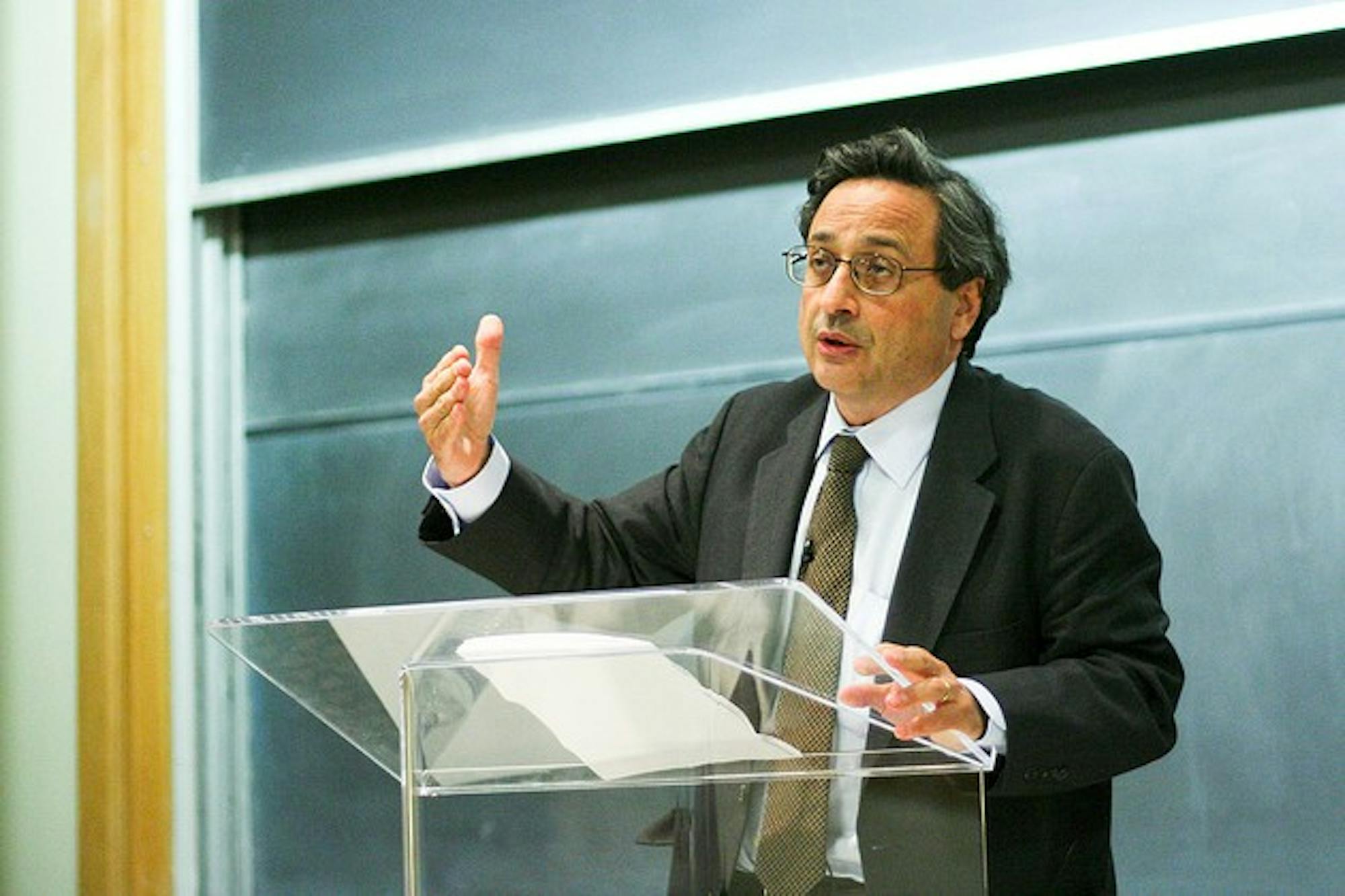
Delbanco also focused on the trend among many small colleges to grow into large research institutions, also exploring the ethical obligations of undergraduate institutions, including making higher education available to low-income students.
"College is for equipping young people with a functioning bullshit meter," Delbanco said.
In his discussion of undergraduate institutions' ethical obligations, Delbanco explored the concepts of the "past college" and the "future college."
Delbanco cited the foundations of America's first colleges including Harvard University and its peer institutions as examples of the "past college."
In the past, education was "centered on the will of God," Delbanco said, adding that interdisciplinary studies were the status quo.
"All branches of knowledge are connected together, because the subject matter of knowledge is intimately united in itself as being the acts and the work of the Creator,'" Delbanco said, quoting Cardinal John Henry Newman's "The Idea of a University," a series of essays that Newman published in 1873.
Delbanco introduced the concept of the university as a "comprehensive knowledge enterprise," a term coined by Michael Crow, president of Arizona State University.
The enterprise is a network in which companies and universities work together to pursue common interests with the potential of large financial gain, Delbanco said.
"The project of undergraduate education, in anything like the way it was formerly understood, is marginal, sometimes subsidiary and more or less extinct," Delbanco said.
Delbanco praised the College's and Princeton University's abilities to preserve the undergraduate focus of their institutions.
"I think Dartmouth and Princeton, of the oldest, most venerable and wealthiest institutions in this country, are the ones that have held the line the most ferociously against becoming research universities," Delbanco said.
Although Delbanco praised the College for its unique hybrid of undergraduate and graduate programs, audience member Frank Gado '58 stated his opposition against the particular brand of education that has developed at Dartmouth over the years.
"Everywhere, graduate education is parasitic on undergraduate education, and there is no way you can avoid that," Gado said. "And [College President Jim Yong] Kim is taking us in that direction."
Delbanco also discussed the availability of undergraduate-focused educataion and the ethical implications of this type of education. He praised society's progress in democratizing and universalizing higher education to include more than the wealthy, Protestant white male.
Yet this progress has slowed, Delbanco said, criticizing the inaccessibility of a higher education for students whose family incomes fall below $35,000.
"The story of American higher education is a story of progress," Delbanco said. "It's a story of opening, and nobody would want to turn the clock back on that."
Delbanco also discussed the "individual economic viability" that accompanies a college degree, the nation's need for more college-educated citizens and the idea propounded by Thomas Jefferson that a functioning democracy is not capable without educated citizens.