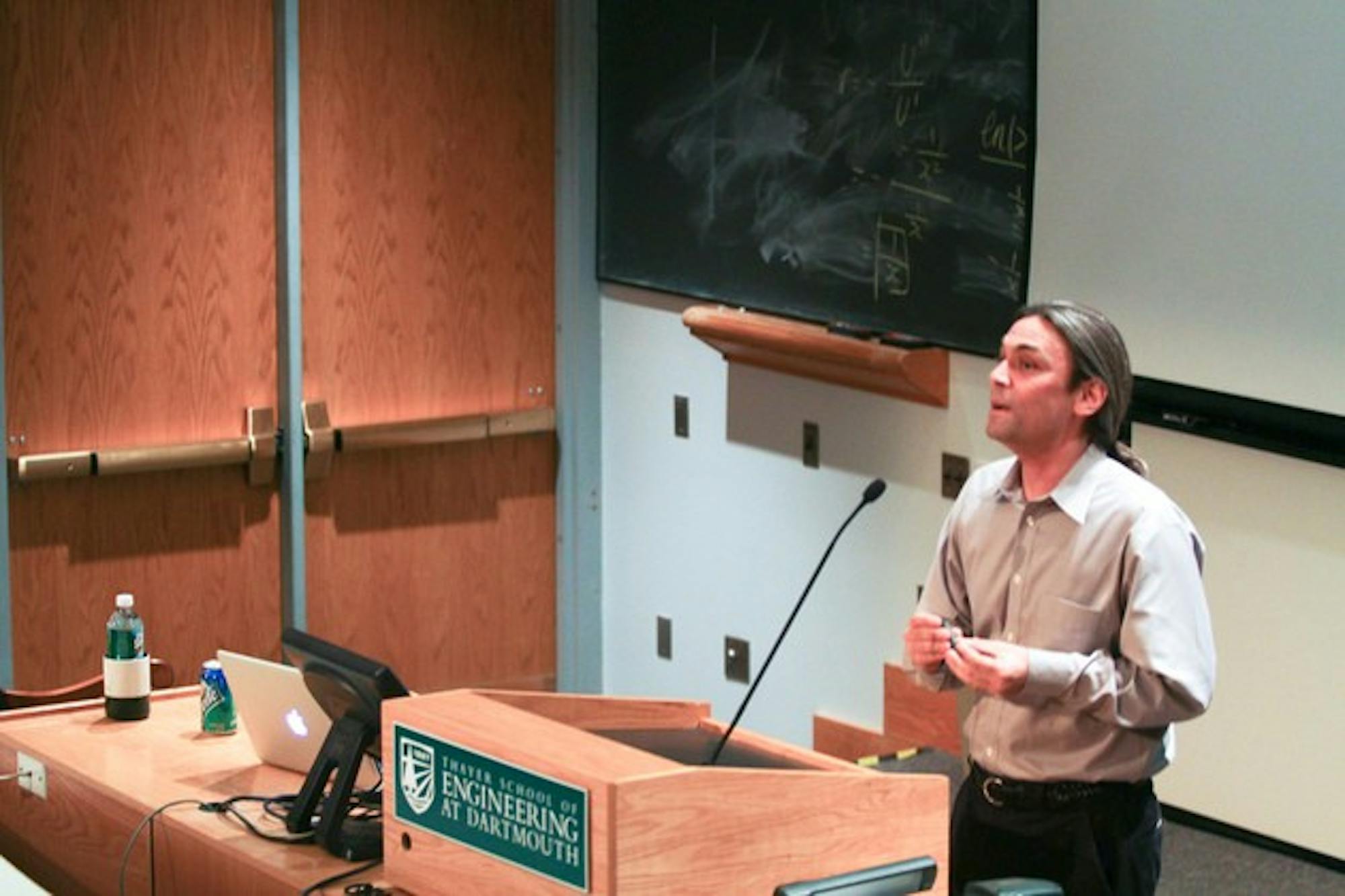
Pappalardo, who has worked at the NASA Jet Propulsion Lab since 2006, considered the presence of water one of the factors needed for potential life. Water is one of "four ingredients of habitability," along with chemical energy, a stable environment and essential elements including carbon, hydrogen and oxygen, he said,
Pappalardo focused his talk on Europa, Jupiter's sixth moon, which possesses ideal qualities for habitability, he said.
Europa has a "chaotic terrain," with many deep ridges and fractures, and has a high ice content, according to Pappalardo.
Europa's tidal forces flex its exterior, Pappalardo said, a process that can generate enough heat to create an ocean under the 60 million-year-old moon's surface of ice.
The moon also exerts an induced magnetic field, which suggests the presence of a liquid conductive layer beneath Europa's surface, Pappalardo said. Europa's ridge patterns also indicate tidal movement beneath the surface of the moon, according to data from the Galileo spacecraft launched in 1989.
"The cycloidal fractures tell us that there is an ocean down there," Papparlardo said. "They fit the pattern of the tidal stressing."
Evidence from the Galileo spacecraft shows that Europa also possesses the other necessary ingredients for habitability, Pappalardo said, citing the accretion of carbon dioxide and the period impact of comets as influences that add essential elements to Europa's surface.
Europa could also be suited for life because radiation from Jupiter creates chemical energy, which leads to the oxidation of reactions within the ice, Pappalardo said.
Like most other large extraterrestrial bodies, Europa also has a relatively stable environment, Pappalardo said.
"Europa is a very promising place for life," he said.
Pappalardo also spoke about other moons of Jupiter with life-supporting potential Ganymede and Callisto. But although both moons have evidence of a liquid sub-layer, the water is sandwiched between ice, which is an unfavorable environment for the development of microbes, Pappalardo said.
Jupiter is not the only planet with moons that show potential for habitability. Saturn's moons Titan and Enceladus both possess a richly organic atmosphere saturated with methane and ethane, although there are greater barriers to the development there, Pappalardo said.
On Titan, microbes can potentially develop in its liquid methane lakes, but life is difficult to maintain due to Titan's frigid temperatures, Pappalardo said.
Similarly, the water vapor geysers near Enceladus' south pole harbor enormous potential for microbial development, but the inconstant level of activity makes the environment on the moon unstable, he said.
"[Enceladus] is going through a very interesting time," Pappalado said. "The whole south pole is showing very active geological activity."
Pappalardo, a scientist on the team organizing the launch of the Jupiter Europa Orbiter in 2020, has also planned observations of the Galileo spacecraft through his work on the Galileo Imaging Team at Brown University.
The seminar was one of the Thayer School of Engineering's Jones Seminars, which cover a wide range of topics for "lively discussion in the curious-minded community," according to the Thayer School's website.