Kim said his study of the humanities at Harvard University as a graduate student changed his perspective, both as a scholar and as a global health leader, for the better.
"I made the mistake of not being properly introduced to the humanities and the lifelong task of becoming a better writer until graduate school, when I studied for my Ph.D. for anthropology," he said. "It is not an exaggeration to say that studying new languages, philosophy and literature as a graduate student fundamentally altered the course of my life."
Although Kim had previously outlined his belief in the importance of the humanities in his inaugural address last September, his view on the subject came into question following a video interview with The Washington Post in March, in which he appeared to argue that the study of the humanities would not result in the practical skills necessary for success in the professional world.
"You are not going to make it in this world if you study philosophy," Kim said in the video, referring to his father's response when Kim told him he thought he was going to be a philosophy major. "If you think this country owes you anything, you're crazy you have to get a skill."
Kim said that he found his father's advice to approach education pragmatically "very important," and added that he found himself sharing this advice with his students.
"When you go to Haiti, when you go to Africa, they don't ask you, How much do you feel for my people?' or, How much have you studied my people?'" Kim said in the interview, drawing on an anecdote from his personal experiences in global health. "They say, Have you brought anything?'"
Kim's interview with The Washington Post came at a time when the College was finalizing its plans for budget cuts, and worsened fears that the humanities departments at the College would face heftier budget cuts compared to their science and social science counterparts. Critics such as former music professor Jon Appleton charged that Kim had begun investing heavily in medicine and research, making the College a "satellite of the medical establishment" to the detriment of the liberal arts, Appleton previously told The Dartmuth.
Kim's comments in the interview on the humanities also drew criticisms from the wider public, notably by former Board of Trustees petition candidate Joseph Asch '79.
Although members of Kim's administration have said the Dartmouth community would be involved in campus dialogues to generate new initiatives driving the College's future direction, officials have made little publicly visible progress toward initiating such discussions.
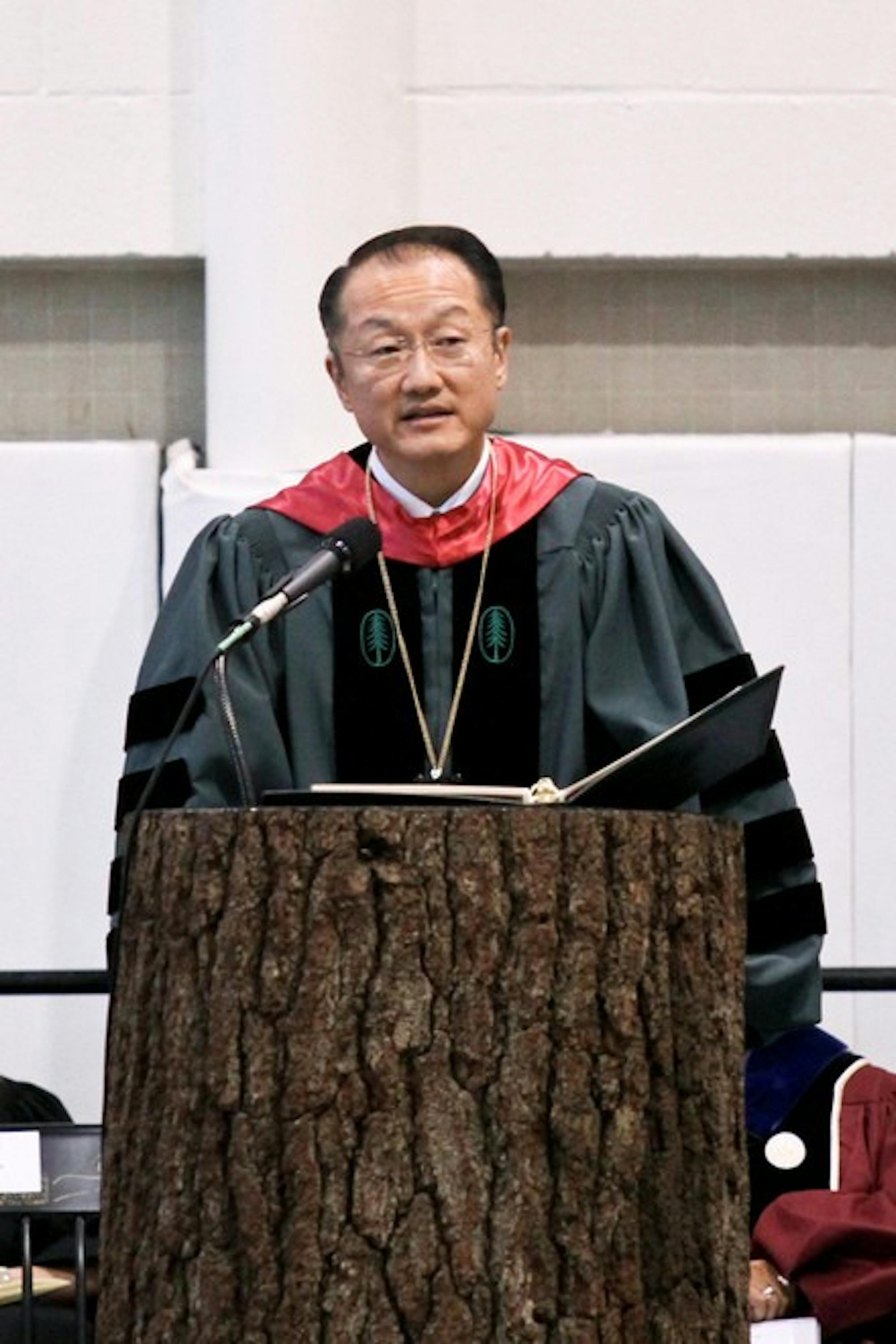
In his Convocation address, Kim encouraged the Class of 2014 to make the study of the humanities a priority.
"Don't make my mistake of not engaging in [the study of the humanities] until after you graduate," he said.
In addition, Kim also stressed the importance of competent and persuasive writing.
"The ability to write clearly, effectively and creatively may very well be the most important skill you will be taught in your time here," Kim said. "For you to succeed in your world-changing mission, you must leave Dartmouth with the ability to think clearly, imaginatively and critically and then render your thoughts in the written word."
Kim said he expects each member of the Class of 2014 to achieve great things after graduation, adding that the study of the humanities would complement the study of the sciences, both of which he said are important to the development of a leader.
"The underlying assumption I brought into medical and graduate school was that science and technology were the keys to tackling the most important human problems," Kim said. "I'm still a wildly enthusiastic believer in the power of science, technology, engineering and mathematics to help us solve problems, but it was in graduate school that I realized changing the world required the ability as one of your professors put it to me just the other day to see the world as it is, imagine the world you want to create, and then render that vision in a way that convinces others that it is attainable and desirable.'"
Kim's message at this year's Convocation on the role of the humanities also resonate with comments he made in a Presidential Lecture in July, in which he stressed that the study of the humanities and the arts is "absolutely critical" for professional success.
"You can map many of these traits, habits of the mind, on the course work that we are already doing, especially in the humanities and arts others as well but especially I think in courses in the humanities," he said in the previous lecture.