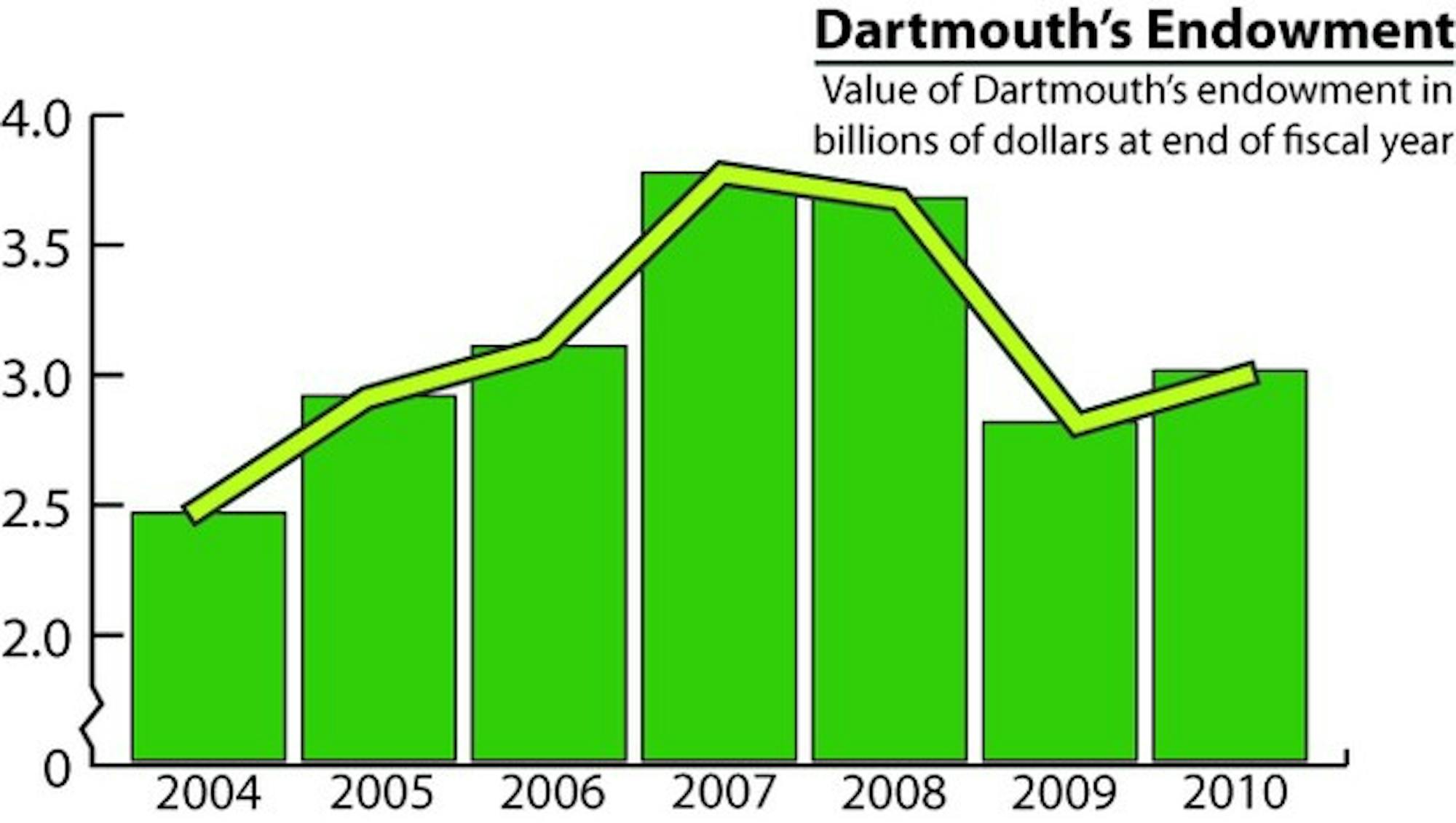
The endowment showed a 10 percent return on the fiscal year with a net increase of $173 million after increases in the value of investments, new donations and disbursements for operating expenses, according to the release.
This year's return was 2.1 percent higher than the 7.9 percent policy portfolio benchmark, a figure of expected performance based on the performance of the respective sectors in which endowment income is allocated, according to College Chief of Staff David Spalding.
The increase follows fiscal year 2009's 23 percent endowment loss, in which the value of the endowment decline to $2.8 billion from a height of $3.66 billion.
In response to the heavy loss in fiscal year 2009, the College has pursued a review of the endowment, including potential changes to endowment allocations and fund managers, according to Spalding. A College investment committee meets regularly to discuss asset allocation and investment policies, he said.
"To some extent, it's a slow process," Spalding said. "We still have a large part of the endowment that's invested in areas where it's harder to shift, such as in private equity and real-estate transactions."
The College plans to reduce the distribution of the endowment to "bring it down to a more manageable level," Spalding said. Planners also intend to shift allocation toward a more "traditional mix," away from real estate and private equities, that invests more heavily U.S. public equities, Spalding said.
Over the past two fiscal years, College administrators have worked to reduce outlays in order to limit spending and deficits created by the endowment loss, and to reduce the portion of the endowment that goes toward operating expenses, according to the press release.
The College withdrew an estimated $205 million from the endowment for this year's annual operating expenses, Spalding said. Charitable donations to the endowment totaled approximately $80 million during the fiscal year.
College President Jim Yong Kim said in January that the administration would organize its budget in expectation of a 5 percent return on the endowment for fiscal year 2010.
College officials were "pleased" by the return, since endowment managers had attempted to manage the endowment to "provide ample liquidity and maintain a prudent level of risk," Executive Vice President Steven Kadish said in the press release.
Budget officials do not plan to increase spending or make changes to the College budget in response to the endowment's unanticipated growth, according to Spalding. One of their priorities is to reduce the amount drawn from the endowment to cover operating expenses.
"We've set our budget plan based on a five-year plan that assumes positive endowment performance for all of those five years," he said. "[The increased performance] gives us greater confidence that at the end of the five years, we will overall have achieved the performance we expected to achieve from the endowment."
Spalding said he expects the endowment growth seen in the fiscal year 2010 to continue over the next five years. At the same time, Spalding noted that the endowment's growth will still rely on the market's state.
"The question is, how will the markets perform?" Spalding said. "This will have a major part on how we perform."
Although spending from the general endowment will not increase, Spalding said some individual endowment funds may begin producing funds available for use.
When the endowment declined in fiscal years 2008 and 2009, the drop placed many of the College's recently-created endowments "underwater," meaning their face values were less than the amount originally invested. The funds were considered off-limits to spending because drawing on them would reduce the principal on which the funds generate interest.
Spalding was unable to provide exact figures for the number of funds that may return to productivity or the amount they would generate.
The College's endowment performance has been in line with returns reported by peer institutions. Yale University reported an 8.9 percent return on its investments, while Harvard University's endowment enjoyed a return of 11 percent, The New York Times reported Sept. 24. The College's relatively strong performance in comparison to other schools stems from the "strong team managing the endowment and the equally strong group of managers," according to Spalding. Although Harvard's return was higher than Dartmouth's, it performed 1.6 percent over its benchmark, he said.