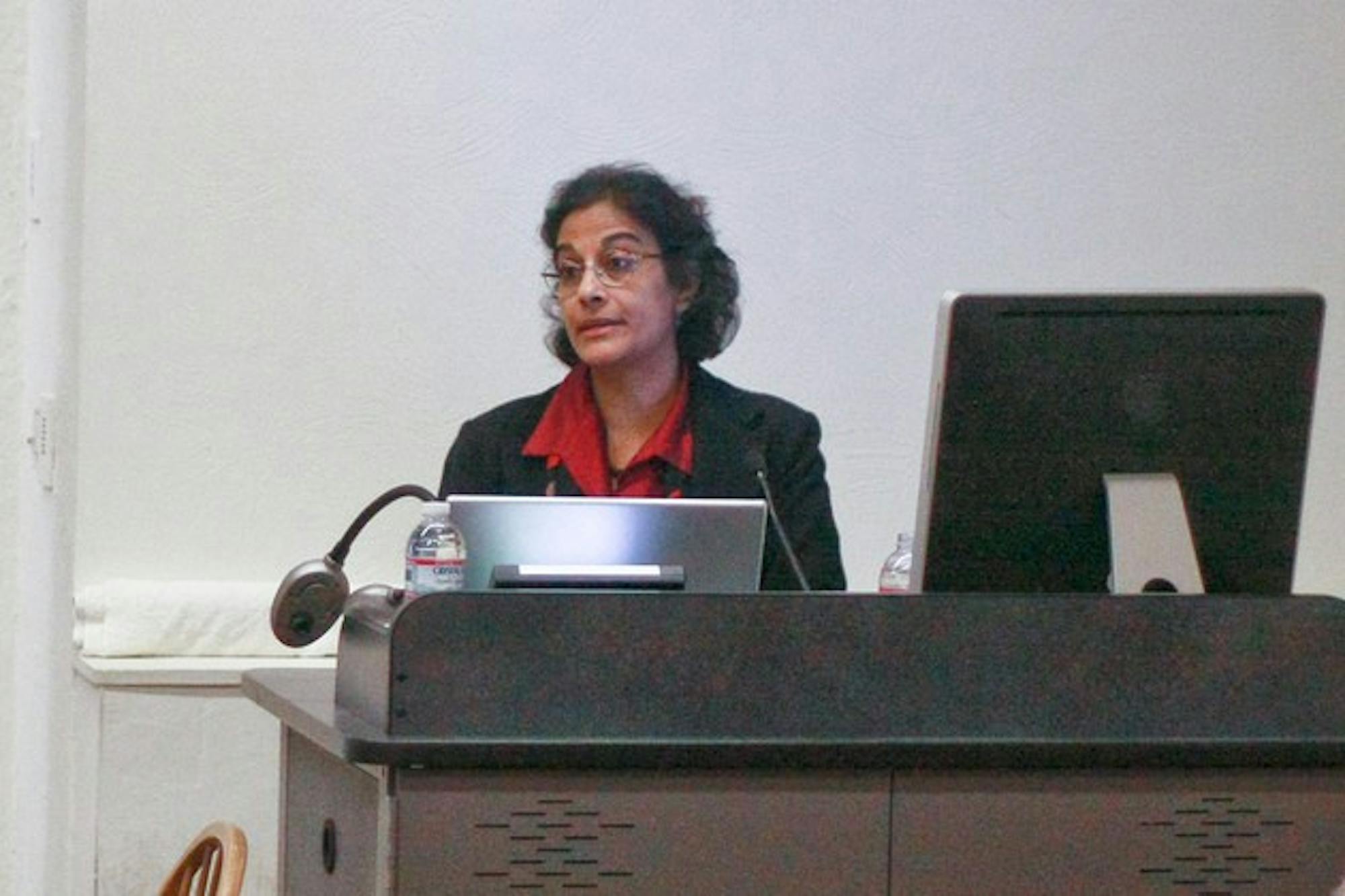
The Hindu goddess has remained a symbol of nationalism in India even as the country "strives to be secular, diverse and modern," according to Ramaswamy.
The maternal and geographical aspects of popular artwork featuring Mother India holding a nationalist flag fostered a visual collective identity for Indian patriots under British colonial rule, according to Ramaswamy. Appealing to a vast population of a largely heterogeneous population, the image of Mother India is a fair-skinned, "ethnically indeterminate" and "desexualized" woman wearing a sari, she said.
Images of Hindu deities were often included in works with Mother India as part of the movement against British colonialism, Ramaswamy said. Prominent political figures, including Mahatma Gandhi and Jawaharlal Nehru, were often depicted as mature adults sitting in the lap of Mother India.
Men included in the artwork are frequently seen literally "offering their head" to the mother nation, according to Ramaswamy.
Mother India's maternity offers a sense of security and protection to her children, according to Ramaswamy, while her status as a goddess appeals to the burgeoning Hindu nationalist movement.
The outline of the Indian map was also featured in the artwork, which both distinguishes Mother India from other goddesses and guarantees her status as an embodiment of the British-determined national territory, according to Ramaswamy.
The combination of the "inanimate geo-body" of the Indian nation with the "anthropomorphic" form of the mother and goddess elicited an emotional response from viewers, Ramaswamy said.
"[It] converts the citizen-subject from a detached observer to a worshipful patriot, so that its territory is not just lines and contours on a map but a mother and motherland worth dying for," Ramaswamy said.
Members of the Dalit community historically the lowest caste in India have also adopted a goddess figure for their political movement, according to Ramaswamy.
Dalit journalist Chandrabhan Prasad and artist Shant Swaroop Baudh appropriated the image of the Statue of Liberty in their depiction of a new deity known as "English the Dalit Goddess," Ramaswamy said.
The new image demonstrated the mutually constructive relationship between the West and East, according to Ramaswamy.
Visual art, Ramaswamy added, conveys a moment of "panic" to the observer and offers a history not readily available in state archives.
"It is this sense of urgency of attempting to recover images that have been too quickly dismissed as vulgar, crass, repetitive or unoriginal that has motivated several of us working in the field of popular visual culture in modern South Asian studies," she said.
The Rudelson lecture series typically focuses on Asian art history, history professor Douglas Haynes said in an interview. The speaker's interdisciplinary work also ties to the new foreign study program offered by the College in Hyderabad, India, which will launch next Winter.
"She herself speaks to history, art history, Asian and Middle Eastern studies, geography, and women and gender studies," Haynes said. "It pulls in a wide and diverse audience."
The namesake of the lecture series, Chinese professor Justin Rudelson '83, began the series as a way to thank Dartmouth for its support during his undergraduate education and to "accommodate and facilitate the development of the Asian and Middle Eastern studies program at the College," he said in an interview.
"Our speakers are a veritable Who's Who' of Asian and Middle Eastern studies," Rudelson said. "The ideas was to help the focus of the Asian studies department at the College to expand beyond Chinese."
Rudelson, an Asian Studies program graduate who spent seven terms abroad during his time at Dartmouth, pooled the money earned from his position as a Chinese drill instructor and teacher's assistant, along with College funds, to launch the 26-year-old series, which is the only endowed series program in Asian and Middle Eastern studies at the College, he said.