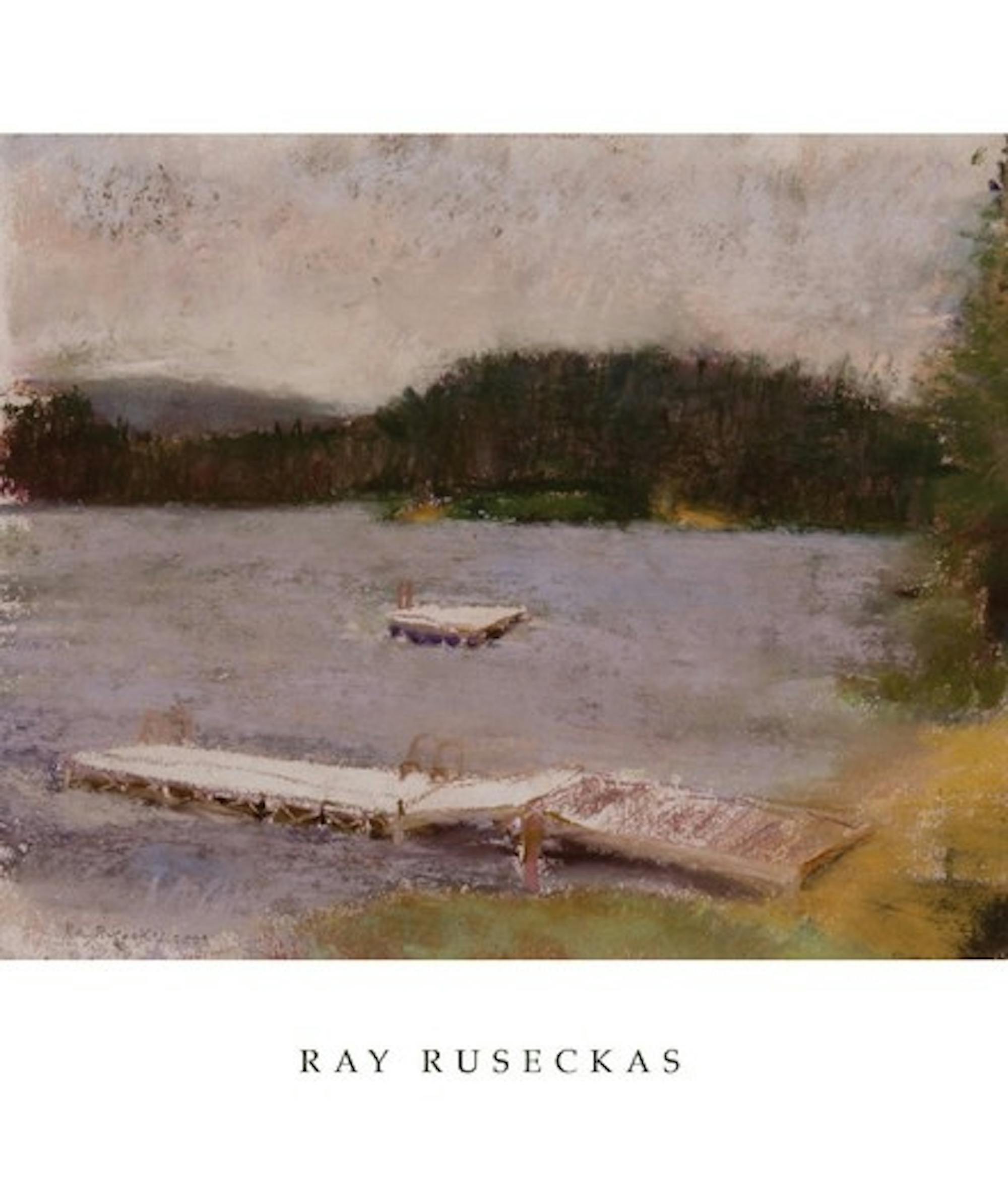
Ruseckas, in contrast, describes his pieces as "dark and moody and deep and crusty." Instead of using tickle-me-pink or robin's-egg-blue, "he routinely uses gentle mauve, peach and warm ochre colors, complimented by quiet green and gray hues," according to a Spheris press release.
Ruseckas, who said he has never had any formal training, has forged his own artistic path by using both unexpected colors and innovative techniques.
His pieces evolve organically, with Ruseckas building layers of pastel "by literally grinding the pigment into the paper and building off the surface," according to the press release. The layers combine to create a textured, almost three-dimensional effect.
In the piece "South Pond," for example, layers of pastel converge at the top of the page to depict a vivid, blue-gray sky. Deep hues are layered so thickly that cracks are visible in the surface. The somber sky immediately draws the viewer into the piece, the rest of which includes a well-wrought representation of a small wooden dock leading into a still pond.
Aside from Ruseckas' signature layering technique, Spheris Gallery associate director Azariah Aker praised the artist's eye for texture and use of a "dragging technique." To add texture and depth to his pieces, Ruseckas often goes over the work a second time, making strategic scratches with his fingernails or a sharp object, Aker explained. Similarly, to add highlights to the work, Ruseckas drags a piece of chalk across the surface of his pieces.
In keeping with his freeform artistic methods, Ruseckas' pieces are always works in progress. According to the artist, he will often finish a piece, let it sit for a while and then become dissatisfied. In these cases, Ruseckas builds more layers over the surface of the original piece to create a completely new work.
"Sometimes I have even made a piece and shown it before [at a gallery], and made it something entirely different," Ruseckas said. "So often things have had two or three different incarnations."
In the Spheris exhibit, for example, the piece "Sentimental Mood" has been shown before in a different form, Ruseckas said.
Although Ruseckas said he works constantly, he and Aker shared the opinion that the artist is not "prolific." Rather, he focuses intently on each individual piece he creates, constantly revamping and reimagining his work. This inventive process stems from Ruseckas' beliefs that he always has more to learn about pastels and that there is room for improvement in every piece he creates.
From the beginning of his career, this constant desire to develop and improve has been evident in Ruseckas' artistic process, he said in the interview.
"A picture framer by trade," Ruseckas said he had been observing the work of his friend Wolf Kahn a prominent artist who works in pastels and oil paints and has won prestigious awards such as a Guggenheim Fellowship for years when he decided to try his own hand at pastels while working a carpentry job in Hawaii.
"I just found Hawaii so beautiful that I wanted to put it down," Ruseckas said.
Armed with this desire, Ruseckas headed to a local art supply store, purchased several pastels and began working. He hasn't stopped since.
"I thought, I can do better than this, I just need more colors.' I just kept doing it, trying to make them better," Ruseckas said. "I still find myself doing that, often not liking them. That's why I keep using pastels, because I feel like I haven't figured them out yet."
Ruseckas' dedication to each individual piece adds greater depth to his work. While the colors in Ruseckas' work, for example, appear dark and muted at first glance, flecks of what he calls "happy colors" oranges, pinks and lime green emerge from underneath layers of deep blues, grays and greens. In fact, Ruseckas said he begins many of his pieces with bright colors, but then adds more muted layers on top.
"Some people paint with brash colors and the pieces will jump out at you," Ruseckas said. "I'd rather have something where people have to approach it or look into it rather than have it be obvious."
Ruseckas also said he hopes that searching for flecks of color will serve as an incentive for viewers to "engage" with his work on more than a surface level, examining each piece with greater care.
"I like to make people work for the color," he explained.
For Dartmouth students, the chance to see local landscapes rendered artistically may serve as an incentive to engage with Ruseckas' work. A native of Brattleboro, Vt. and current resident of Walpole, N.H., Ruseckas said he is well acquainted with New England's natural beauty and rusticity. Many of the pieces in his exhibit depict landscapes that are just a short drive away from Hanover (in Marlboro, Vt., for instance), and Ruseckas has matted each piece and created each wooden frame himself.
"He's a quintessential New England artist he's talented at many things, he knows his New England history and he knows his New England landscapes," Aker said.
"Ray Ruseckas" opened April 17 at the Spheris Gallery in downtown Hanover and will remain on display through May 25.