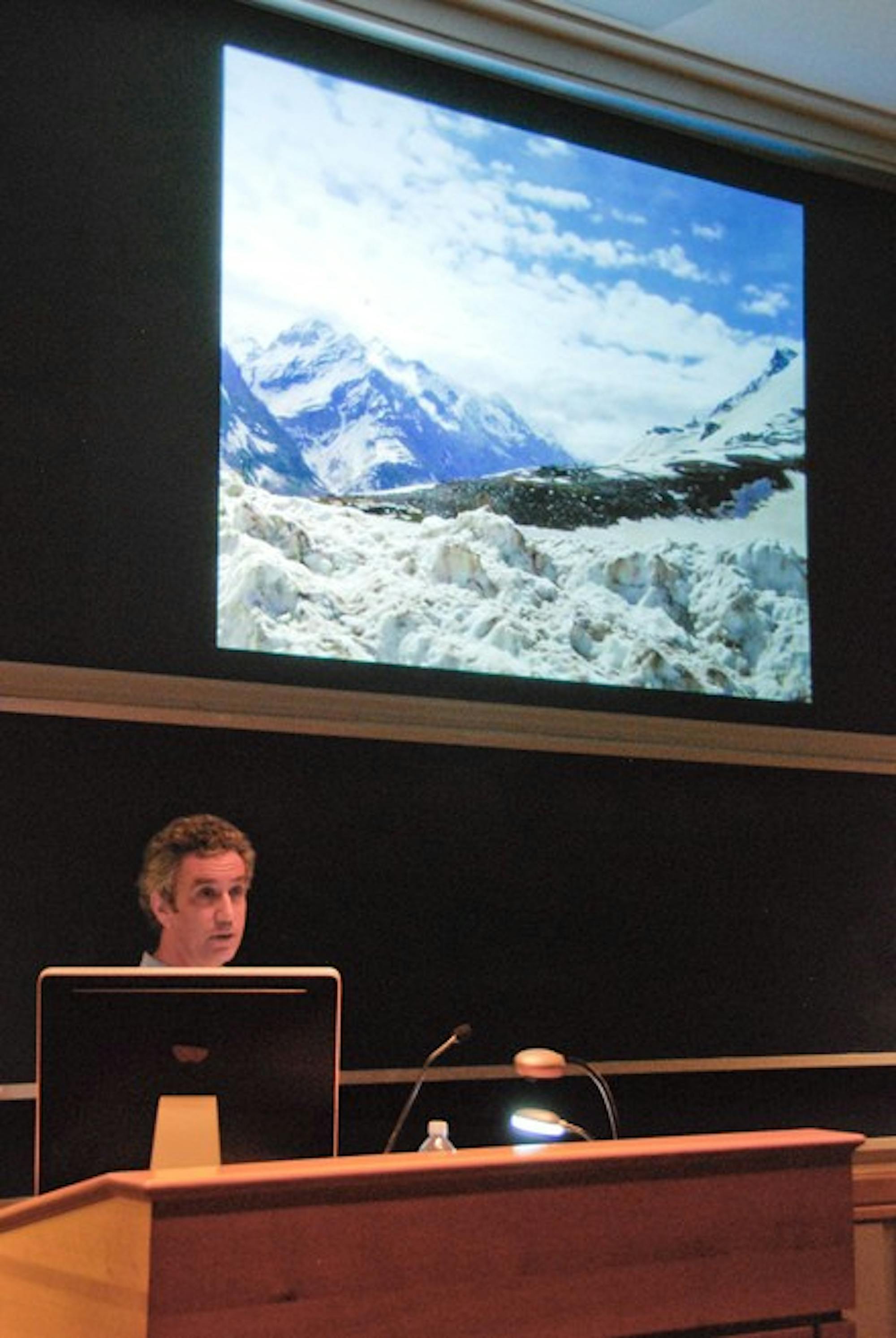
In his lecture, "A Crack in the World: The True Story of a Journey to a Land of Immortality," Shor described the book he is currently working on and his own journey to uncover the story of Tulshuk Lingpa, an eccentric Buddhist lama who in the 1960s lead an expedition to find a land of immortality.
While living in the Sikkim region of Northern India, nestled in the heart of the Himalayas and bordering Tibet, Shor first encountered the story of the lama Tulshuk Lingpa's journey through a conversation with a street painter.
"My mother-in-law has a story that you won't believe and will make you question your view of reality," the street painter told Shor, Shor said.
The account that Shor ultimately discovered was that of a Tibetan lama who, in the face of ever-increasing encroachment into his native land by the forces of communist China, led an expedition to find the mysterious valley of Beyul, the Tibetan land of immortality hidden by the Buddhist sage Padmasambhava in the eighth century. Beyul was seen as a place of refuge for the Tibetan people "when there was no other place to run," Shor said.
After learning the story, Shor directed his efforts to finding all of those who had come into contact with the lama during his search for the "crack in the universe."
Shor eventually found Tulshuk Lingpa's son Kunsang, who was 18 years old at the time of his father's journey to Beyul and who provided Shor with over 50 hours of taped interviews.
Despite the fantastic nature of many of Kunsang's tales, Shor continuously found "an uncanny concurrence of facts even in the most outlandish stories," he said.
"[Kunsang] wasn't so much confounding truth and fiction as he was forging a new synthesis of the two," Shor said.
At the lecture, Shor described the life of Tulshuk Lingpa, starting with the name Tulshuk, which means "crazy, changeable or mutable" and was considered to be indicative of his character, according to Shor.
One lama Shor interviewed, who had known Tulshuk Lingpa, described him as someone who would "say one thing in the morning, something different in the afternoon, and then contradict both in the evening."
As a young man, Tulshuk Lingpa became known as a "healer and spiritual man" and word of his exploits spread throughout Tibet. Shor found several well-known accounts of the lama that ranged from him healing an entire village ravaged by leprosy to curing the wife of legendary sherpa Tanzing Norgay who first climbed Mount Everest with Edmund Hillary as she was battling a terminal illness, Shor said.
Shor described the 1950s, when the Dalai Lama fled Tibet, as the moment when Tulshuk Lingpa made the transition from being an eccentric Buddhist healer and holy man to the leader of an expedition to find the land of immortality.
After receiving a series of visions and dreams in which Buddhist deities told him he was the lama who would open up the hidden valley, Tulshuk Lingpa began to tell his followers they were going to the "valley of immortality," Shor said.
Shor turned to excerpts from his book to describe the final ascent of Tulshuk Lingpa and his small group of disciples in their attempt to open the gate to the hidden valley of Beyul on the harsh slopes of Mount Kanchenjunga.
"They dissolved into white and disappeared," Shor said, describing the flash avalanche that engulfed the group and killed Tulshuk Lingpa. The lama and his followers entered "a world of profound darkness, a world of silence," Shor said.
Lamas today feel that Tulshuk Lingpa was engaged in a risky venture where the timing was not right, Shor said.
"He was told slow down, this is too fast, you have too many people and the karma is not right,'" Shor said.
Tulshuk Lingpa's story has not been completely extinguished, according to Shor, who says today there exists a lama who is thought to be the reincarnation of Tulshuk Lingpa.
Although the lama was considered a fallen holy man, having developed a drug habit, Shor said he visited him and found him surprisingly similar to the eccentric lama hinting that the man might indeed be Tulshuk Lingpa reincarnated.