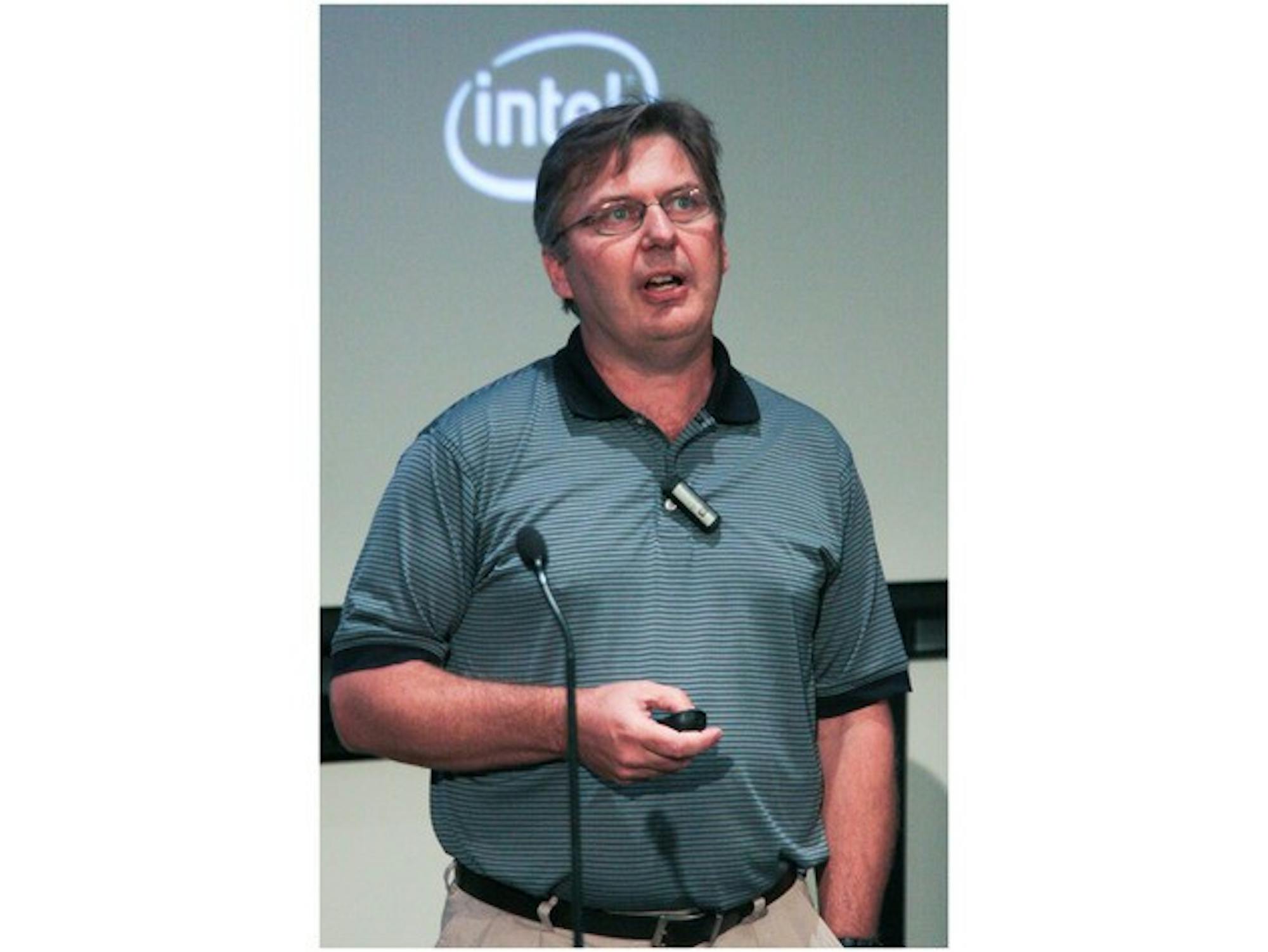
The lecture highlighted Intel's leading role in developing new microprocessor technology and its recent efforts to enhance local and global communities in an attempt to "give back in order to make the world a better place."
Intel orients its corporate goals around the hypothesis outlined in Moore's Law, a prediction made by Intel cofounder Gordon Moore in 1965 that the number of transistors on a chip will double approximately every two years, Megli said. Intel is able to aggressively make bets on new innovation with the knowledge that technology will enable the number of transistors on a microchip to double, Megli explained.
Megli described Intel's "Tick-Tock Development Model," which is also based on Moore's law, as key to Intel's "sustained microprocessor leadership."
The "Tick-Tock Model" is designed to create the next-generation of processor technology during the first year and then produce the corresponding microarchitecture for that processor the following year, Megli said. This process enables advancements in architecture to follow advancements in technology in a predictable two-year cycle.
Intel also maintains its edge over other microprocessor companies through a streamlined approach to the traditional research process, Megli said. While most companies separate research, development and manufacturing into separate processes, Megli said Intel integrates the three to develop better the necessary technology to bring large quantities of their products to the market "almost instantaneously."
"The research is not done until you can show the practicality of manufacturing at a high level," Megli said.
He also stressed Intel's leadership role in encouraging social responsibility among corporations.
"Social responsibility has moved from something driven by [nongovernmental organizations] to now being necessary for any good and viable business, and it is something demanded by shareholders," Megli said.
In rural India, Intel developed kiosks that distribute car batteries and other sources of power that are scarce in the region. Intel, the single largest purchaser of green power in the U.S., sponsors the world's oldest international science fair and completed one million hours of volunteer service over the past year, Megli said.
Investment in education is another key component of Intel's commitment to social responsibility, according to Megli. Intel invests over $100 million annually to support global education and instructs teachers on how to best integrate technology into their classrooms.
"Education is what got us to where we are as a company and we have to have that available for the next generation," Megli said.