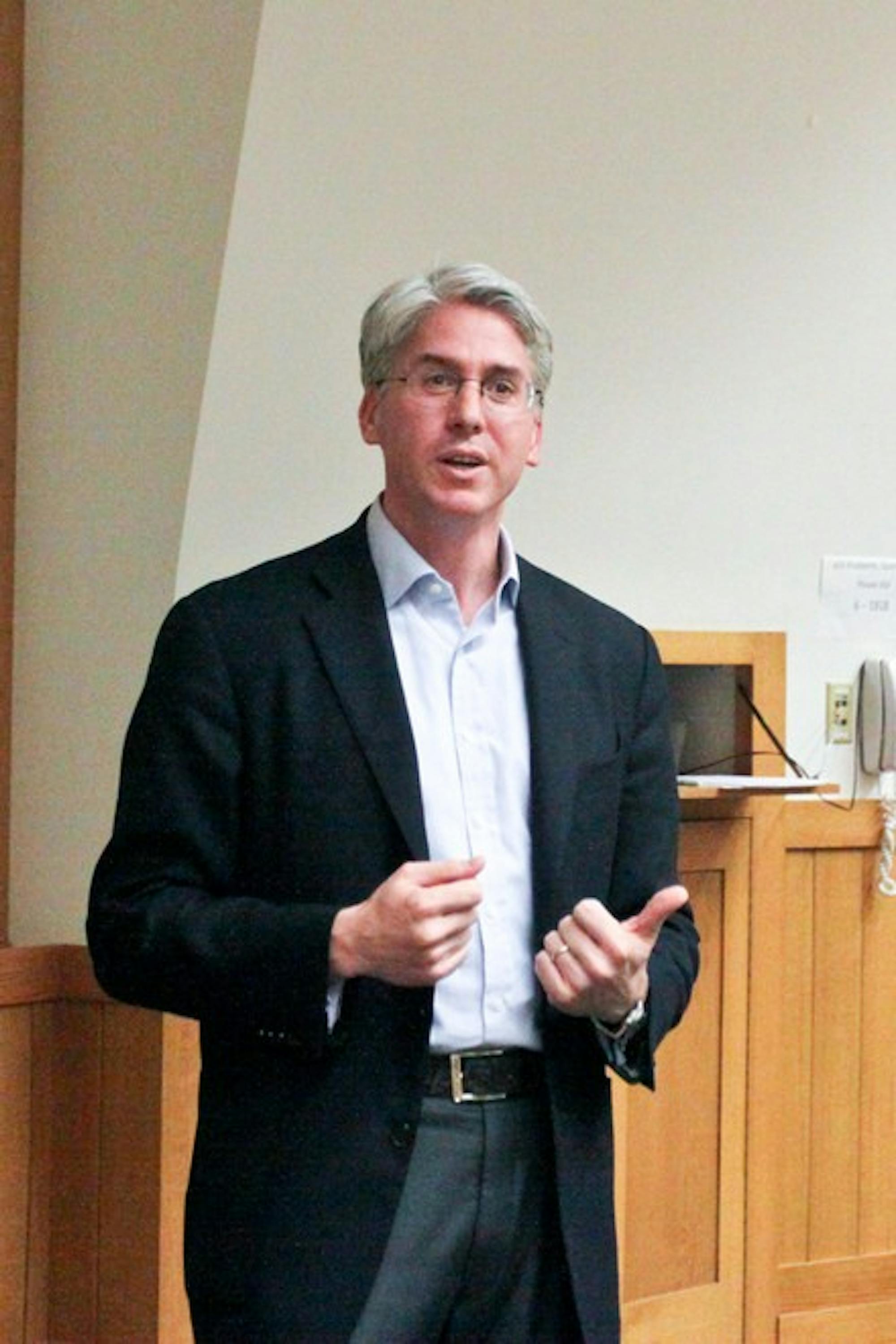
Despite the initial failure of several business ventures in the harsh economic climate of the 1990s, Greer was able to find a commodity in high demand scrap metal developing a trading company that made him a multimillionaire by the age of 28. Greer, author of "Starting from Scrap: An Entrepreneurial Success Story," spoke at the Tuck School of Business on Monday about his experience starting up a successful trading company in Asia.
"Bad economies are terrible times to find jobs, but they can be great times to start businesses," Greer said.
Greer discussed the importance of exploring business opportunities outside the United States, especially since starting a business in the United States is so competitive, he said.
"It's a global world of opportunities," he said.
Greer decided to look for opportunities outside the United States on the advice of a friend in the early 1990s, he said. His friend stressed the importance of actually traveling to Asia, as simply "sending a resume was not enough," Greer said.
"[The friend] said to me, There's a whirlpool of opportunity, but you have to be there,'" Greer said.
Soon after, Greer got on a plane and flew to Hong Kong in the hopes of finding success in China. Upon arriving, Greer became involved in trading and began to pursue business ventures in a variety of goods including glue, garden tools, canned tuna fish and chicken feet, betting that one would be successful, he said.
"We went on the wild goose chase' phase of development," Greer said.
While these attempts proved to be unsuccessful, Greer soon discovered a high demand in Hong Kong for steel.
When Greer discovered that the United States' largest export by volume is waste in the form of metals, papers and plastics, he decided to act. He began to pursue the scrap metal business, which quickly proved to be extremely lucrative, making him a multimillionaire by the time he was 28 years old, Greer said.
Greer attributed his company's success to the "willingness to work 24 hours a day, seven days a week."
"I used to sleep with a notebook and a calculator next to my bed," he said.
Because Greer began his business during an economic recession, a large number of workers, including engineers, were looking for jobs and were willing to come to a startup scrap metal company, he said. The company's growth trajectory also attracted venture capitalists, which helped the business continue to grow.
However, the immediate success of the business did not last, he said. Within a few years, the company had spent all of its capital and became nearly bankrupt. Overconfidence led the company's managers to make poor business decisions, such as using insufficient equipment and failing to implement systems of financial control, according to Greer. The business also fell victim to fraud.
Despite the business' near-bankruptcy, Greer never thought the business would fail, he said.
"I was probably very naive, but naivete is your friend," he said.
After closing several branches of his company and improving management systems, Greer's was able to turn the business around, returning it to profitability, he said. The company soon expanded into trading other metals in addition to steel, increasing profits 12 times over, according to Greer.
Believing that the company was unlikely to become significantly more profitable, Greer then sold his business to an Australian steel company, he said.
In his talk, Greer encouraged students interested in entrepreneurship to take advantage of their youth and not wait to pursue a business idea.
A lot of people wait to pursue a business opportunity in the hopes of gaining more experience, but older entrepreneurs often have too many responsibilities to be willing to take a risk, Greer said.
"When you don't have anything to lose, that's the time to go out there and take the risks," he said.
Even though young people do not have very much experience, they can learn quickly from their mistakes and be successful, Greer said.
Greer also discussed the advantages of pursuing business interests in the current economic climate.
"You should be sort of thankful for the bad economy for offering up the interesting opportunities you're going to have," he said.
Greer said he believes that successful businesses in the developed world can usually be pursued in emerging markets, noting in particular that businesses already existing in the United States can be pursued in China "with an Asian twist."
Tuck adjunct associate professor of business administration Fred Wainwright, along with the Center for Private Equity and Entrepreneurship, organized the event, which was part of Greer's book tour for "Starting from Scrap."