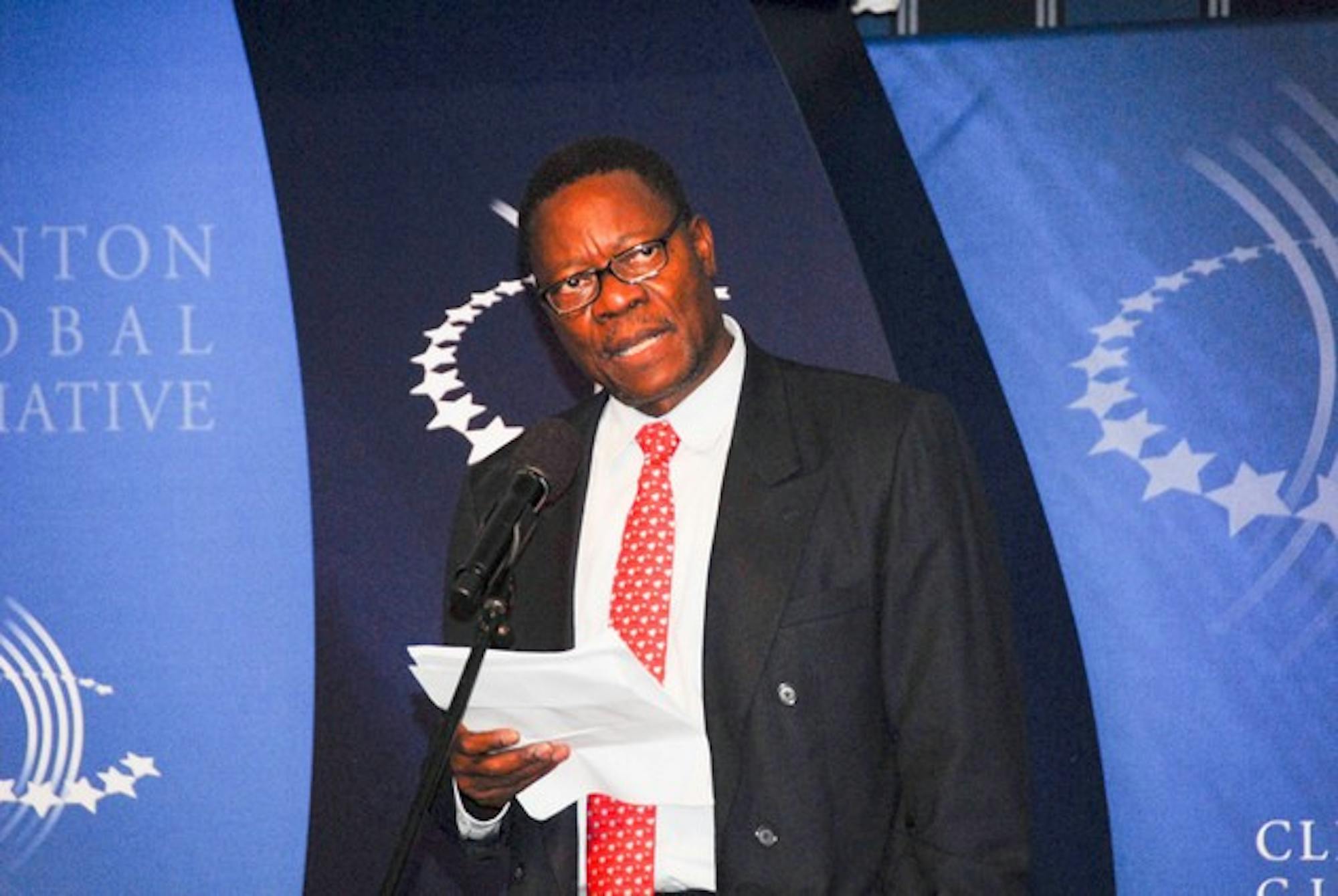
Kadita Tshibaka, president and CEO emeritus of the microfinance organization Opportunity International, gave the keynote address at the conference. In his speech, Tshibaka told listeners that God provided invaluable assistance throughout his career.
"I am in front of you by the grace of God," he said.
Kadita also urged his audience not to be indifferent to the plight of the poor.
"I see each one of us as agents of change," he said.
Andrew Schuman '10 emphasized in his opening remarks that academia and religion can complement one another. Schuman is founding editor-in-chief of The Dartmouth Apologia a journal of Christian thought which organized the conference along with the Eleazar Wheelock Society.
"We hope to suggest and even demonstrate that rigorous academic study is not opposed to faith in God, but rather, the two can and should go together," Schuman said.
The conference consisted of a series of panels focusing on particular vocations, including health care and medicine, academia and social services. There was also a fireside chat with Tshibaka and opportunities for conversation and networking during a catered lunch and concluding mixer.
College Trustee Stephen Smith '88 participated in the panel on integrating faith, government and law. He emphasized that many issues in government and law are fundamentally moral, and that attempts to address them in a secular manner are equivalent to "breathing with one lung."
"We don't want theocracy," Smith said. "But as a matter of constitutional law, we've taken the analogy that Thomas Jefferson made about the separation of church and state really far."
The panel on the academy featured history professor and alumnus Allen Koop '65, retired classics professor Edward Bradley and associate dean for interdisciplinary studies Lindsay Whaley.
The panelists discussed the difficulties of involvement in a profession that is often perceived as antithetical to religious belief, as well as the advantages their faith has brought them.
Bradley said he has never perceived "tension" between religious faith and his role as a professor.
The conference was the first event orchestrated by the Eleazar Wheelock society, an alumni group founded in 2008 to facilitate Christian activities on campus and encourage "the integration of faith and vocation," according to David Allman '76, chair of the Society and one of its founding directors. He added that the group of alumni hopes to use their "financial wherewithal" to support such initiatives.
Members of the Society hoped the conference would facilitate connections between students and mentors in their respective professions who share their faith, according to Tessa Winter '09, founding administrator of the Society.
Winter said the event was a success for her organization, estimating that approximately half of those in attendance were students, the primary target of the conference.
"We were glad that a lot of people came out to hear us," she said.
James Wallace, senior research associate at the Boston University Institute on Culture Religion and World Affairs, said he was drawn by the unique focus of the conference.
"Wherever you go, particularly in top-tier research-type universities, the conflict between faith and reason on campuses, especially for faculty, is pretty challenging," Wallace said.