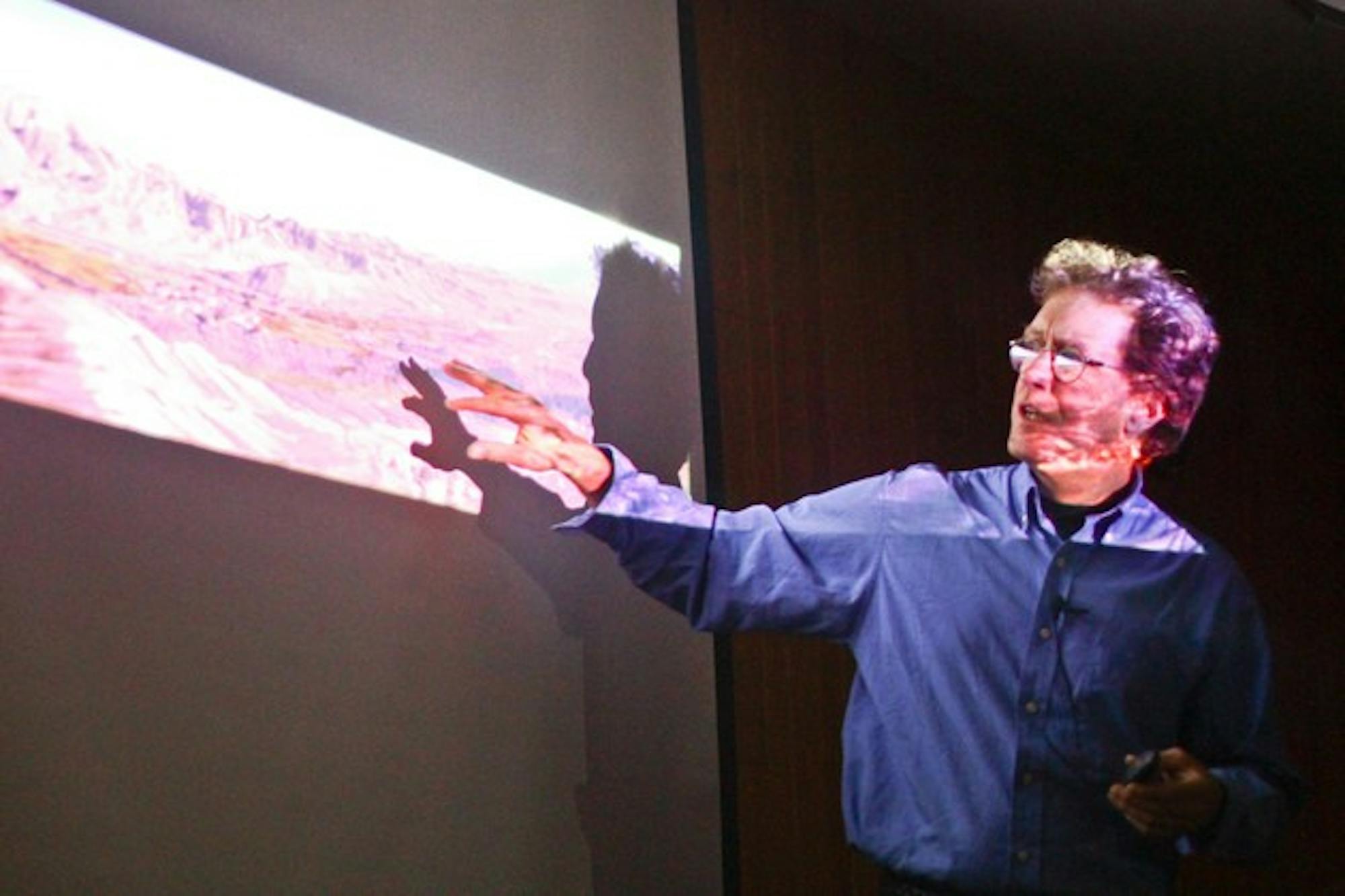
In his lecture, "The Secrets of Shangri-La," Coburn described how he and his team discovered many ancient artifacts in man-made complexes in the Mustang region of Nepal, he said.
Coburn described his research and film expedition as a "scientific, cultural, spiritual, artistic mission."
Coburn and his team discovered pre-Buddhist illuminated manuscripts, ancient shrines and murals depicting mystical yogis, which Coburn showed in a slide show during his talk. His team also found evidence of organic material dating back 6,000 years, Coburn said.
The expedition was sponsored by the National Geographic Society and was made into a film which aired on PBS in fall 2009, according to Coburn's web site.
The Mustang region, located near the Tibetan border, is, "in a way, Shangri-La," a mythical Himalayan utopia, Coburn said.
The reason for the creation of the Mustang region, Coburn said, was so that "Buddhists of the future, during times of hardship, could go and take refuge and discover teachings, hidden treasure teachings."
Before the expedition in August 2008, Coburn was part of another expedition sponsored by the American Himalayan Foundation to restore a chapel in the region, he said.
Coburn urged the audience to consider "what we can learn from these discoveries we've made, or rediscoveries, and what can be done to protect these precious sites."
Conservation is urgent because of the possibility that a motor road may be constructed in the area, which will make the caves potentially accessible to thieves and vandals, he said. Currently, the Annapurna Conservation Area Project and many of the local Loba people are actively working to conserve the treasures contained in these caves, Coburn said.
Coburn is working to establish a charitable foundation to help fund these efforts, he said.
"[The Mustang region] calls upon all of us, and certainly the local people themselves, to care for and protect what they have before it's lost forever," Coburn said.
The discoveries Coburn's team has made about the ancient societies of the Mustang region shed light on modern-day cultural issues, Coburn said. His motivation is to find "a new way of looking at the old world" and to find "some old ways of looking at our new culture," he said.
"I often wonder if our new culture will survive as long as these ones have," he said.
Coburn, who graduated from Harvard University in the Class of 1973, has spent 20 of the past 30 years in the Himalayan mountains. He is the author of several works describing his experiences, including "Nepali Aama: Life Lessons of a Himalayan Woman," and "Touching My Father's Soul: A Sherpa's Journey to the Top of Everest."
Coburn gave a similar presentation in anthropology professor Barbara Gerke's class, "Anthropology of Tibet and the Himalayas."