
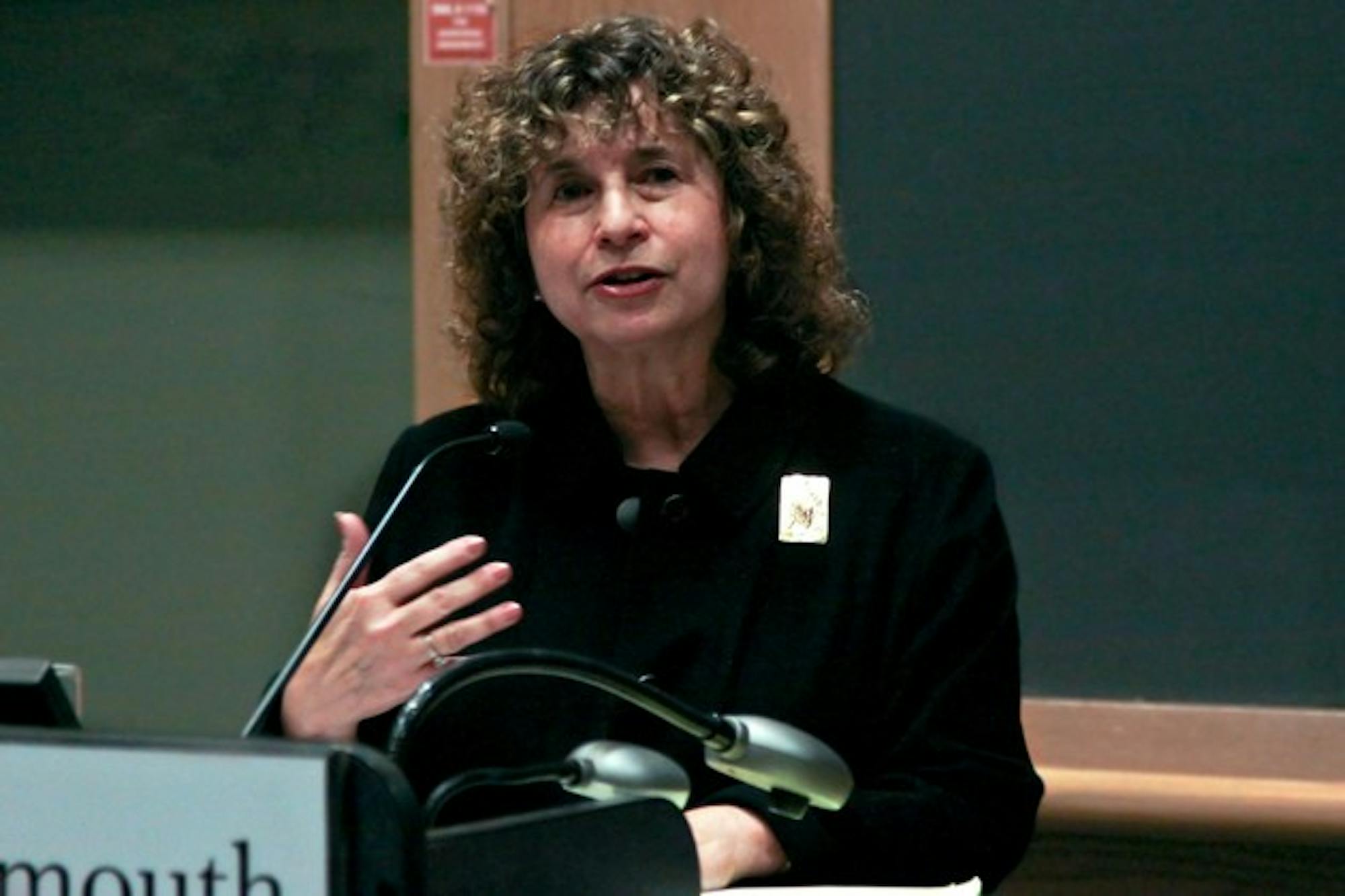
In her lecture titled "The Moral Distinctiveness of Party ID,'" which took place in the Rockefeller Center Thursday evening, Rosenblum said she hopes to "chip away at the moral high ground of independents" by defending the important role that partisanship and party politics play in modern democracies.
Partisanship widens the range of issues the political system is able to address, accommodates a range of ideological views under a single "umbrella" and encourages compromise during the political process, according to Rosenblum.
Rosenblum defined partisanship as a "political identity that doesn't see political pluralism as a glum necessity," and focused on the ways the American party system and the partisanship that accompanies it strengthen the democratic process.
The United States is one of the only modern democracies where large portions of the population see anti-partisanship as a positive feature, and in some cases even a "civic ideal" she said.
"The United States, probably uniquely amongst democracies, has a civic ideal of independence and has preserved its anti-partisan spirit longer and with greater force than most democracies," Rosenblum said in an interview with The Dartmouth. "The party system goes with modern democracy and is as old as modern democracy."
Rosenblum said she does not see recent anti-party and anti-partisanship rhetoric as anything new.
"Anti-partisanship is as old as politics and as old as the dinosaurs," Rosenblum said.
The rivalry between parties facilitates debate among various competing groups and is part of the foundation of a democratic society, she said.
The presence of competing factions that are both pushing for political action also forces compromise between parties, she said.
"Without party rivalry, democracy's theory of trial by discussion cannot be meaningful," Rosenblum said.
Many political party members are also able to consider a large complex of concerns that give them a broad view of the political horizon instead of limiting their focus to a single political issue, Rosenblum said.
Rosenblum disagreed with the idea that people who consider themselves "independent" benefit by being removed from partisan conflict.One of Rosenblum's primary critiques of Independents is their position of being "politically detached and weightless," she said.
"The weightlessness comes from the fact that whatever their numbers, independents are not sending a corroborative message, thus making the independent politically unreliable," Rosenblum said.
Rosenblum said current parties are at fault for their decline not because of polarized or extremist policies, but because of their failure to meet the ethical standards of partisanship that include party inclusiveness, comprehensiveness and a disposition to compromise.
"We don't need independence or post-partisanship, but better partisanship," Rosenblum said.
Creating better partisanship may prove difficult as political parties themselves have declined "and it is not clear that they can be resuscitated," she said.
The popularity of voting for individual politicians and their policies rather than political parties and their platforms, along with the rise of campaign finance restrictions that encourage donating funds to specific politicians, have contributed to this decline, she said in an interview.
Many Americans see the independent voter as the hope for good government, which contributes to negative public opinion of partisanship and political parties, Rosenblum said.
Despite the threats to partisanship, Rosenblum cited the work of President Barack Obama and Democratic National Committee Chairman Howard Dean in the last election as a positive attempt to strengthen the American party system.
"What we saw in the last election was the attempt for the first time in a long time to attend to partisanship and the strength of the party," Rosenblum said.
Roughly 40 people attended the lecture, which was co-sponsored by the Dartmouth Legal Studies Faculty group and the Dartmouth Lawyers Association.


