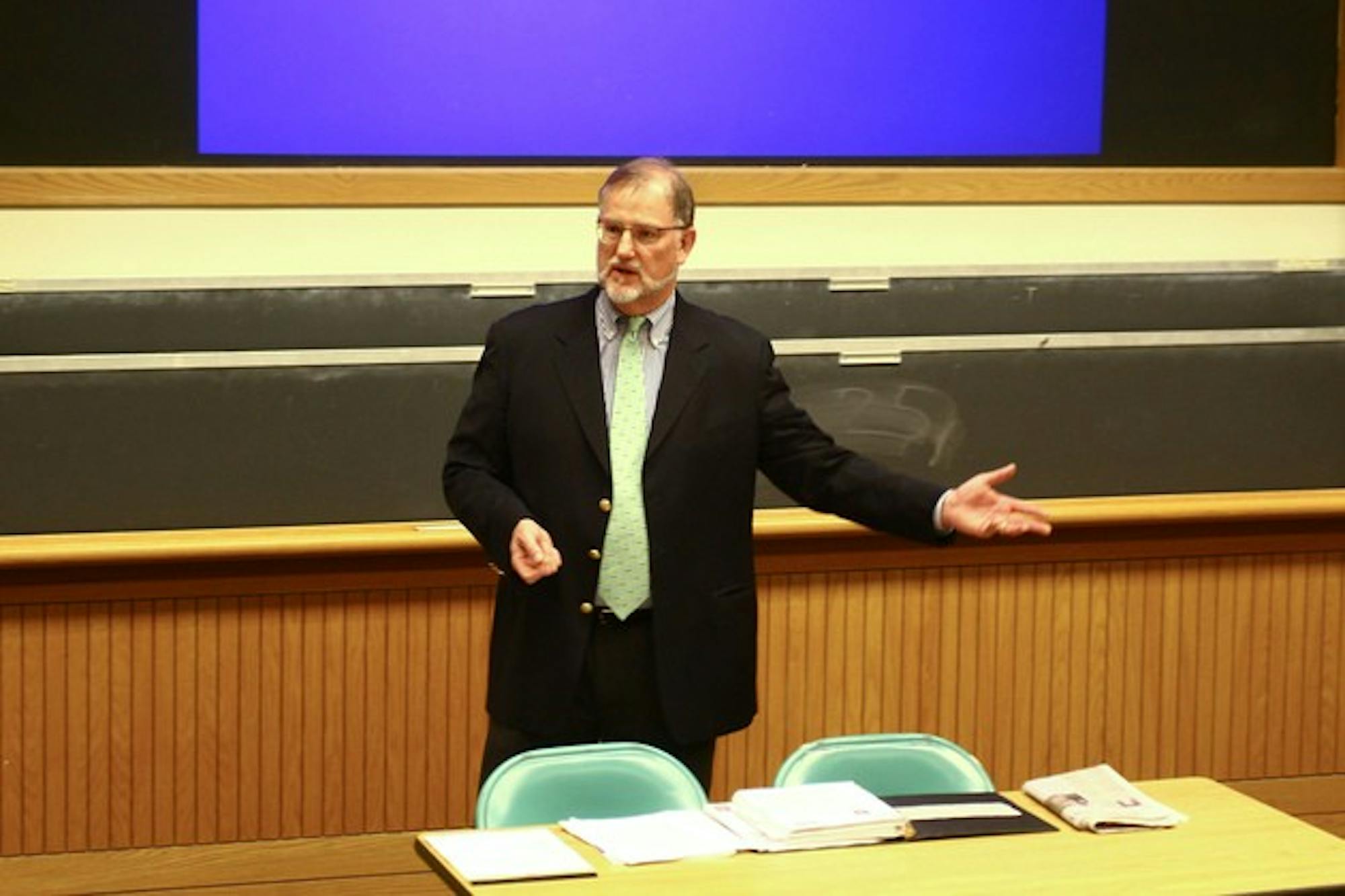
Peabody attributed the recent global recession to sub-prime mortgages and securitized lending, or bundling loans into securities for sale.
"[Securitized lending] had the effect of making the banks not responsible for the loans that they put out because they shifted the risk of loss to people who ultimately bought the securities," he said. "As long as they didn't have to keep the loan on their books, what did they have to care about the credit standings?"
The economy flourished, Peabody said, until individuals began to default on their loans by the millions. This caused a rush to withdraw money from banks money that the banks did not have and bank assets began to plummet.
"The banks did not have enough capital," Peabody said. "The U.S. government had to step in and develop a program called [the Troubled Asset Relief Program]."
This is the most severe recession since the Great Depression, according to Peabody.
The unemployment rate currently stands at 9.7 percent, compared to the rate observed during the Depression, which hovered between 15 percent and 20 percent, he said.
As the government employs stimulus plans, the United States plunges deeper into national debt, "now getting up to 70, 80, 90 percent" of the U.S. gross domestic product, according to Peabody.
"People are buying corporate bonds of American companies for less of a yield than they would pay to own the U.S. Treasury," he said. "The U.S. government is a worse risk than some of the U.S. corporations."
Still, the United States has rebounded after every crisis, according to Peabody. This recession may reverse itself in part because it has caused some businesses to generate more cash, he said.
"Not only do corporations have lots of cash on their balance sheets, but the recession gave them an excuse to lay people off and reduce spending," he said. "Corporate profits are up."
Still, this period of corporate gain will not last for long, according to Peabody.
"Things ought to look decent now for a while," he said. "What worries me is what happens next year? Will we be in a deflationary environment?"
To invest sensibly in today's economy, people must have a "knowledge base," according to Peabody. Individuals should do extensive research before making important financial decisions, Peabody said.
"Trust yourself, verify what other people say, do your homework and understand what you're getting into," he said. "When it starts going wrong against you, cut your losses and get out."
Peabody recalled his own experiences in the venture capital business.
"It's a hard job. You have to go out and find these things that will generate billion-dollar returns," he said. "You have to read. Read everything."
Peabody began investing in computers at 32 years old while working in Silicon Valley, he said.
"It's still a great thrill to be part of something that had a great impact on the way we live," he said, referring to AOL. "Every time I see someone on a computer I think Wow, we had something to do with that.'"
Smart Woman Securities is a national not-for-profit organization that seeks to provide investment education for undergraduate women. Monday's presentation was part of the "soft launch" of the Dartmouth chapter of the group to gauge interest and eventually become College-approved, Alix Peabody '12 said in an e-mail to The Dartmouth.