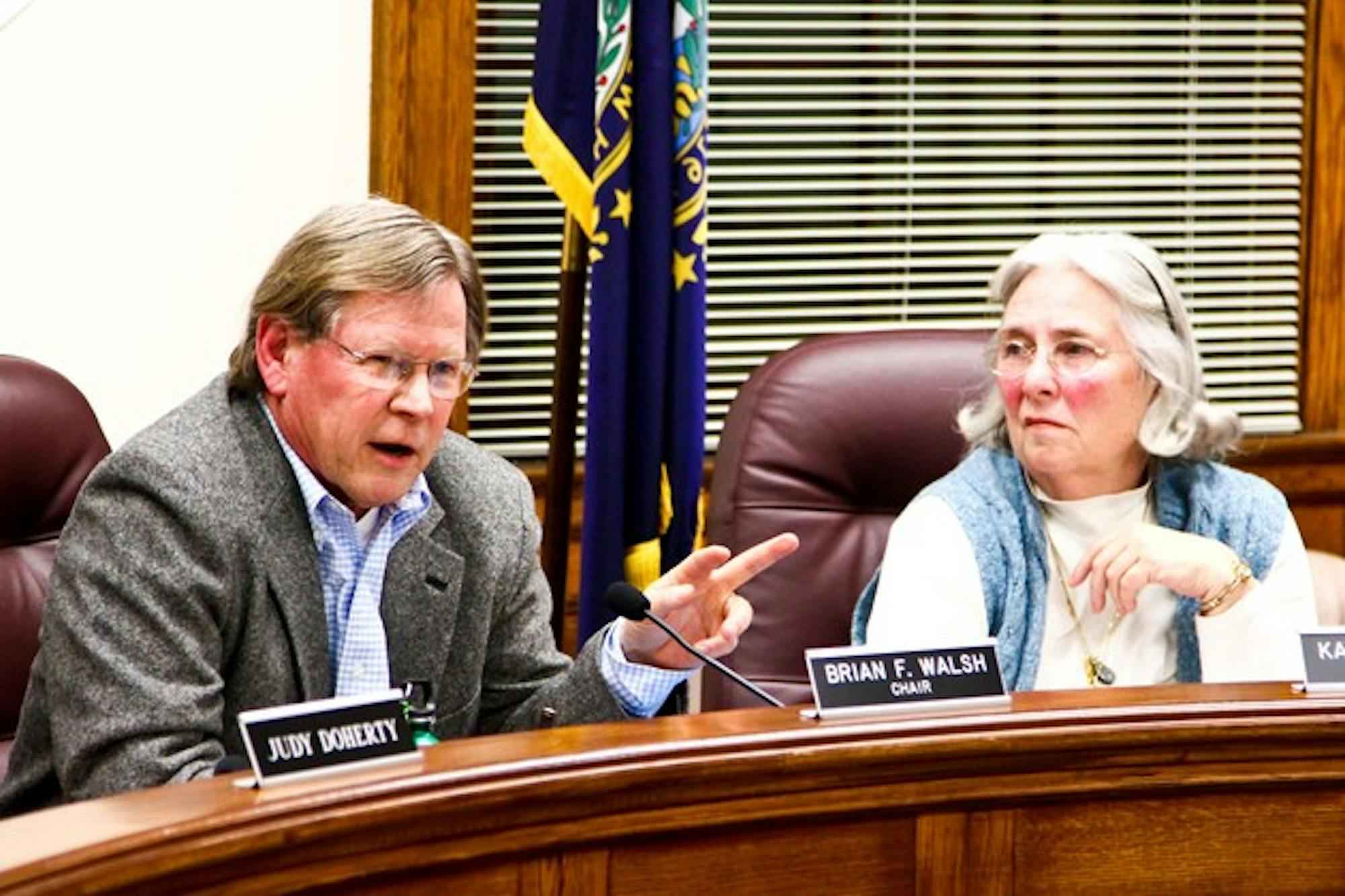
Greek leaders restated their opposition to Hanover Police's new alcohol enforcement policy at Monday night's meeting of the Hanover Board of Selectmen, prompting members of the Board to express concerns that current campus attitudes towards alcohol may lead to alcohol-related deaths. Inter-fraternity Council Vice President David Imamura '10 and Greek Leadership Council public relations chair Eli Mitchell '10 spoke at the meeting, which was held in the Hanover Municipal Building.
Members of the Board of Selectmen, Hanover's executive governing board, cited the perceived increase in the number of alcohol-related arrests as cause for increased vigilance.
"I'm really worried that there are two and a half kids a week who are going to the emergency room because they've had so much to drink that they may die," Board of Selectmen Chair Brian Walsh '65 Th'66 said.
Imamura and Mitchell were the only students to speak at the meeting, although about 20 Dartmouth students were also in attendance.
In his statement to the Board, Imamura said he believes the policy will increase the number of people who drink irresponsibly on campus.
"We believe the new policy is fundamentally wrong and will drive drinking underground and into unregulated and unsafe environments," he said.
The policy will lead to increased consumption of hard alcohol, Imamura said, as students will be more likely to "pre-game" in their dorm rooms.
"We ask that you help us work with Hanover Police so that we not only enforce the law, but enforce the law intelligently," Imamura said.
Mitchell, who is also a Hanover resident, said she believes the policy will hurt the relationship between Dartmouth and the town of Hanover, which are currently both "very trusting" communities, she said.
"Students will be less likely to trust the police, less likely to trust Hanover residents," Mitchell said.
Currently, Dartmouth's social scene is "very regulated" by the Greek system, which greatly reduces the number of off-campus parties, she said.
The implementation of the police policy would result in an increased number of students driving to off-campus parties under the influence of alcohol, Mitchell said.
"I don't think people realize how bad it could be if the Greek system is no longer seen as a social option," she said.
In a press conference on Monday, College President Jim Yong Kim made his first public statement on the issue of alcohol compliance checks, saying that he does not believe that increased criminalization is "an effective or appropriate approach" to dealing with issues of alcohol use.
"The thing that we fear the most is that we will create an environment where alcohol use will go underground and that people will not call for help," Kim said. "Criminalization is not the right approach; harm reduction is the right approach."
In light of recent budget cuts at the state and municipal levels, there may be a better way of using "taxpayer resources" than funding alcohol compliance checks, Mitchell said.
Although the Board of Selectmen has a policy of "not acting" immediately on issues brought up during the public comment session of select board meetings, Walsh said he "appreciates" the effort made by students to discuss this issue.
"We appreciate your thoughts and how clearly you stated them," Walsh said. "We appreciate your offer to work with the police."
Walsh added he does not believe the town of Hanover has a "huge amount of effect" on student drinking and that students themselves have the greatest influence on the alcohol consumption of their peers.
"This is something that you as individuals, with your friends and classmates, can have a huge effect over," Walsh said.
Although the next Board of Selectmen meeting is not until March 15, Walsh said he believes there is a chance for "informal" conversations with town officials in the meantime.
"We may be able to make a huge amount of progress between now and then," Walsh said. "I think there's room to go positive here rather than negative."
Students interested in attending the meeting gathered at the Hopkins Center prior to the event.
GLC moderator Ethan Lubka '10 outlined the goals of attending the Board meeting, but discouraged too many students from attending because of the small size of the meeting room.
"We want them to respect the student body as people who know what they're talking about," Lubka said. "Our goal is to show solidarity, give clear and concise points, and stay calm and respectful."
Imamura, Mitchell and Lubka all said they believe the meeting was "definitely a success."
"We believe that we presented our case in a way that was strong enough for the [Board of Selectmen] to begin a conversation with us," Lubka said. "We hope to be able to have informal conversations with all relevant players."
John Engelman '68, advisor to Alpha Delta fraternity and a Hanover resident, also attended the meeting.
According to Engelman, Hanover Police Chief Nicholas Giaccone said his primary motivation behind the announcement of the policy was the issue of irresponsible and dangerous alcohol consumption, rather than the problem of underage drinking.
"This policy does nothing to alleviate or reduce the amount of irresponsible drinking," Engelman said. "You reduce dangerous, irresponsible drinking through education and peer pressure, not by [punishing] organizations for serving alcohol to minors."
Engelman called for an "open discussion" between Dartmouth students, the campus administration, Hanover Police and town officials.
Joe Asch '79, a Hanover resident and a petition candidate for the upcoming Board of Trustees election who attended the meeting, urged the Board to consider the alcohol policies at Dartmouth's peer institutions.
"Virtually every college and university in the country faces the same problem," he said. "We should look at their successes and failures."
Asch added that campus security forces have a better understanding of students and have been trying to integrate education into their efforts to curb dangerous student drinking, he said.
"It would behoove Chief Giaccone to look at how some other schools have addressed this problem, which I think is a far more intelligent and understanding way," Asch said.