The ARRA, which includes approximately $16 billion for nationwide science and technology research, was passed in February 2009 in response to the economic downturn, according to the government web site Recovery.gov. The legislation aims to stimulate economic growth and create new jobs in part by providing funding for education, health care and research grants.
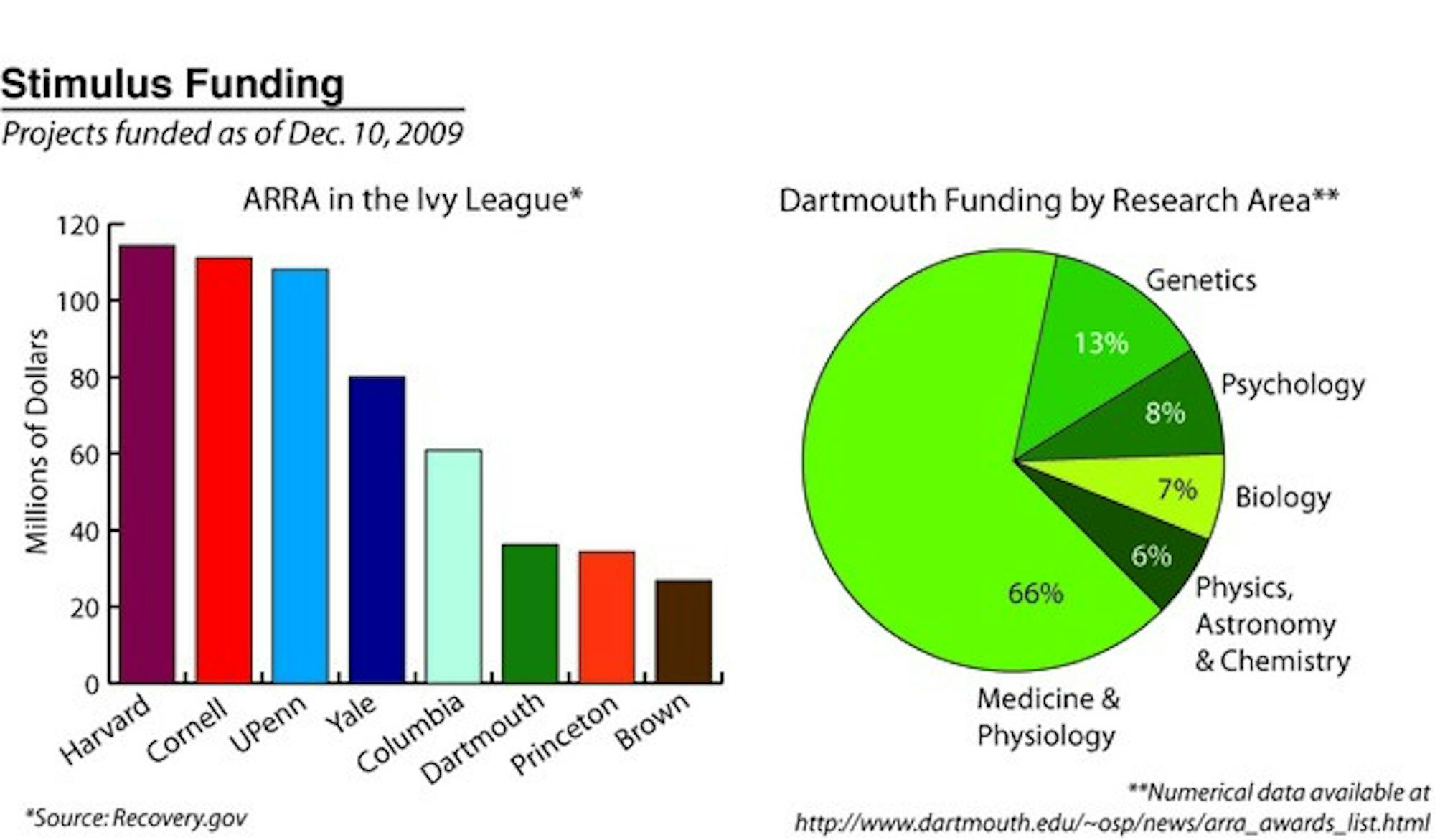
The College was the fourth largest recipient of federal funding in New Hampshire, after the New Hampshire Transportation Department, the Executive Office of New Hampshire and the New Hampshire Department of Education, according to Recovery.gov. Within the Ivy League, the College was the sixth largest recipient of federal funding. The largest recipient of the Ivy League, Harvard University, received $114 million in funding.
To determine who would receive funding, ARRA funds were first distributed to federal agencies like the Department of Energy and the NIH. Individual researchers seeking grants then submitted a research proposal to one of those agencies, Mortali said. Agencies sent the proposals to experts in the relevant fields for peer review and provided funding based on their recommendations. As of Dec. 10, 94 proposals by Dartmouth faculty members had been granted ARRA funding.
Most of Dartmouth's funding went to projects in the engineering and science departments, according to Mortali. Dartmouth Medical School received a significant amount of funding through the National Institutes of Health, Mortali said, adding that ARRA increased the NIH's budget by a third.
"The ARRA-funded projects at Dartmouth represent the breadth and quality of research being conducted across all parts of our campus," Acting Provost and Dean of the Faculty Carol Folt said in the press release. "These projects were selected because they were considered to be of high value to the country. In addition, they contribute to our community by enhancing learning opportunities for our students."
Recipients of ARRA grants receive their funding over a only two-year period because it is intended to provide short-term economic relief, according to Mortali.
Undergraduates at the College are very involved in research projects, especially in departments like biology that will benefit from ARRA funding, Mortali said.
"[ARRA] definitely increased research funding significantly, and that will enable people to do research that they might now have otherwise been able to do," Mortali said.
Judy Stern, the director of the Human Embryology and Andrology Laboratory at Dartmouth-Hitchcock Medical Center, told The Dartmouth that her current project to develop an registry of families involved in infertility research relies entirely on an ARRA grant that she received through the National Institute of Child Health and Human Development, an affiliate of the NIH.
"We couldn't do this new project without outside resources because it involves setting up a completely new database, which is why we applied for federal funding," Stern said.
The NIH rejected Stern's initial funding application in June 2008 because its budget was not large enough to support her project at the time. When the ARRA money was approved, the NIH was able to grant funding to a number of additional projects, Stern said.
Other Dartmouth researchers receiving ARRA funding are working to develop a secure wireless network and information system for use by the health care industry. The funding will also support the College's Global Health Initiative, according to the College Office of Sponsored Projects web site.