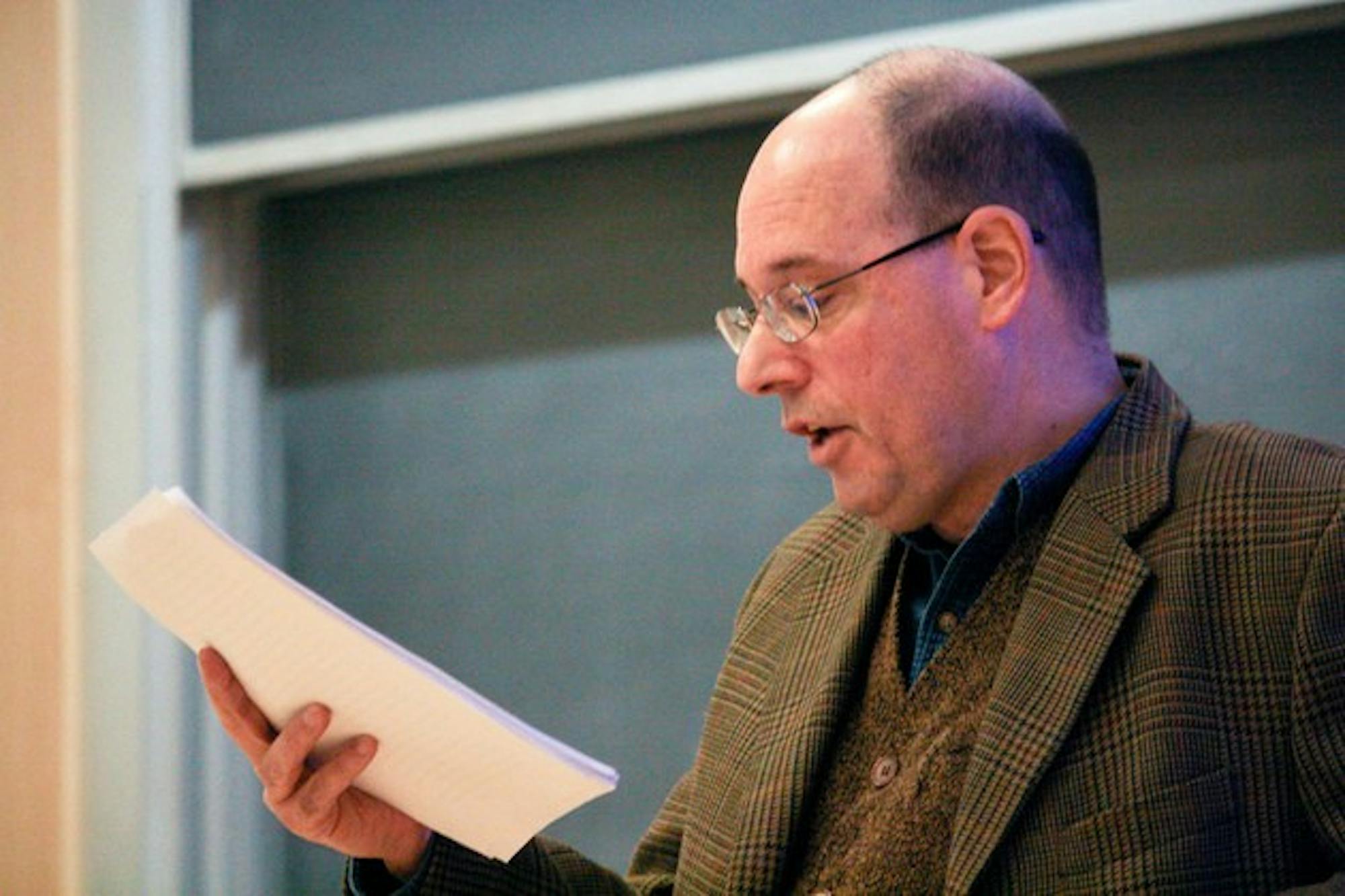
Briggs' book, which is scheduled to be released this May, discusses the later years of the Middle Ages, specifically the 14th century, using the metaphor of the "body of Christ."
According to Briggs, the body of Christ metaphor, incorporating imagery of the Crucifixion and the Last Supper, was used to imply a single, unified Christian community in Medieval Europe, and was commonly seen in the artwork and pageantry of the era.
Briggs cited the Catholic ritual of the Eucharist and the Medieval Feast of Corpus Christi as examples of this phenomenon. Both rituals became increasingly important representations of the body of Christ during the 14th century, Briggs said.
The notion of the body of Christ was also used as a way of conceptualizing numerous institutions of the era, particularly state structures, Briggs said. He noted that many similarities between the rituals of the church and those of monarchs emerged in the 14th century.
The Catholic Church used the doctrine of Christ's body as an all-encompassing idea to solve three problems impermanence, conflict and skepticism, Briggs said. In each case, the notion that all Christians had to be united in the greater body of Christ was used as a unifying force in Medieval Europe.
By the 15th century, however, the Protestant Reformation began to challenge the ideas of the larger, more unified body of Christ and the concept's importance in society diminished. It is this "permanent breaking" of the body of Christ, Briggs argues, that marks the true end of the Middle Ages.
His new book is part of a collaborative trilogy discussing the early, High and late Middle Ages.
The first book in the series, English historian Malcolm Barber's "The Two Cities: Medieval Europe 1050-1320" which discusses the High Middle Ages was released in 1993.
Briggs said that his goal is to create a new metaphor for the time period, which he said has usually been categorized as a time of chaos that was overshadowed by the subsequent Renaissance. Briggs said he was dissatisfied with existing scholarly views of the late Middle Ages, saying that they reinforce the mistaken perception of a clear break between the "enlightened" modern era and the "primitive" Middle Ages.
"I wanted to make sure my book avoided falling into the trap of simply repeating [these] frameworks," Briggs said in his speech. He later told The Dartmouth in an interview that he "really tried to take this time period seriously."