
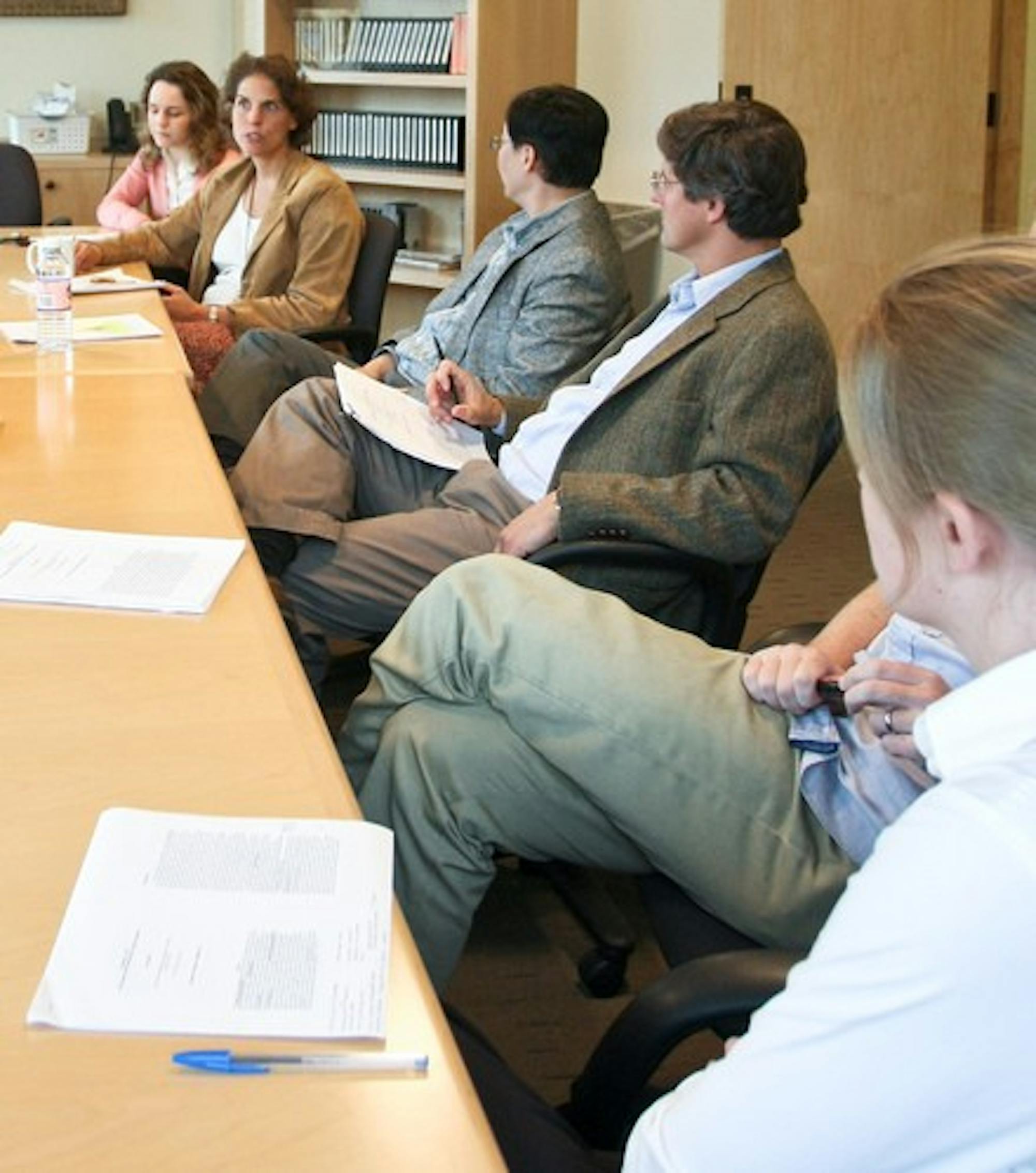
Glinert met with the group to gather feedback on his forthcoming paper, "Apologizing to China: Elastic Apologies and the Meta-Discourse of American Diplomats."
The professors received the paper a week in advance, and the meeting took the form of an informal dialogue.
"Apologies are a big industry in the political world," Glinert told The Dartmouth following the discussion.
Glinert's newest work focuses on two diplomatic incidents between the United States and China: the bombing of the Chinese embassy in Belgrade by NATO aircraft in 1999 and the 2001 collision of an American spy plane and a Chinese fighter.
In each case, Glinert said, the diplomatic discourse highlighted the underlying linguistic differences in the ways Americans and Chinese view apologies, particularly in official contexts.
"A mainstream Chinese apology is expected to be more formal, more sincerely meant," he said.
Americans, on the other hand, tend to view apologies in a more "laid back" light, Glinert said. Of particular interest to him is the official apology following the 2001 incident. Then-President George W. Bush's administration said it was "very sorry" following the collision, which involved the death of the Chinese pilot as well as the detention of the American flight crew for 11 days. Such an apology, Glinert asserted, seemed "childish" and somewhat of an afterthought to the Chinese.
In researching his paper, Glinert interviewed contacts at both the State Department and Department of Defense, attempting to analyze the American approach to formulating official apologies and paying particular attention to the role of "off-the-cuff" negotiations.
There is generally no official set of rules for apologizing, which means that the decision whether to issue a statement of regret, as well as the formulation of the apology itself, is usually centered on negotiation, calibration and nuance, Glinert said.
This was highlighted by the Chinese government's response to the 2001 crisis, which involved a "reinterpretation" of the official American apology, so as to make it more suitable for Chinese customs.
The role of domestic public opinion, often perceived as the driving force behind official apology, was also discussed at the workshop. Attendees observed that the government often does not feel the need to apologize, as illustrated by its decision to label the 1999 bombing incident an "accident."
Ultimately, Glinert said he hopes to highlight the need for linguistics to be less "rules based," with more attention placed on the emotional and cultural impacts of discourse.
"Language and society cannot be divorced," he said. "My goal is to show how words affect or influence what's going on."
The discussion, which occurred in the Haldeman Center, was the first in a series of International Foreign Policy Workshops this term, co-hosted by the John Sloan Dickey Center for International Understanding and the Rockefeller Center. The workshops are typically held five times per term and allow professors to hear analysis and criticism of papers prior to publication.
Wednesday's meeting brought together professors from the government department as well as fellows from the Rockefeller and Dickey Centers.
The workshop, in addition to providing criticism of the paper itself, served to provide a forum where scholars from different disciplines could offer their perspectives on the subject at hand.
"It's basically an exercise in constructive criticism," said Chris Wohlforth, associate director for program development at the Dickey Center and coordinator of Wednesday's workshop.


