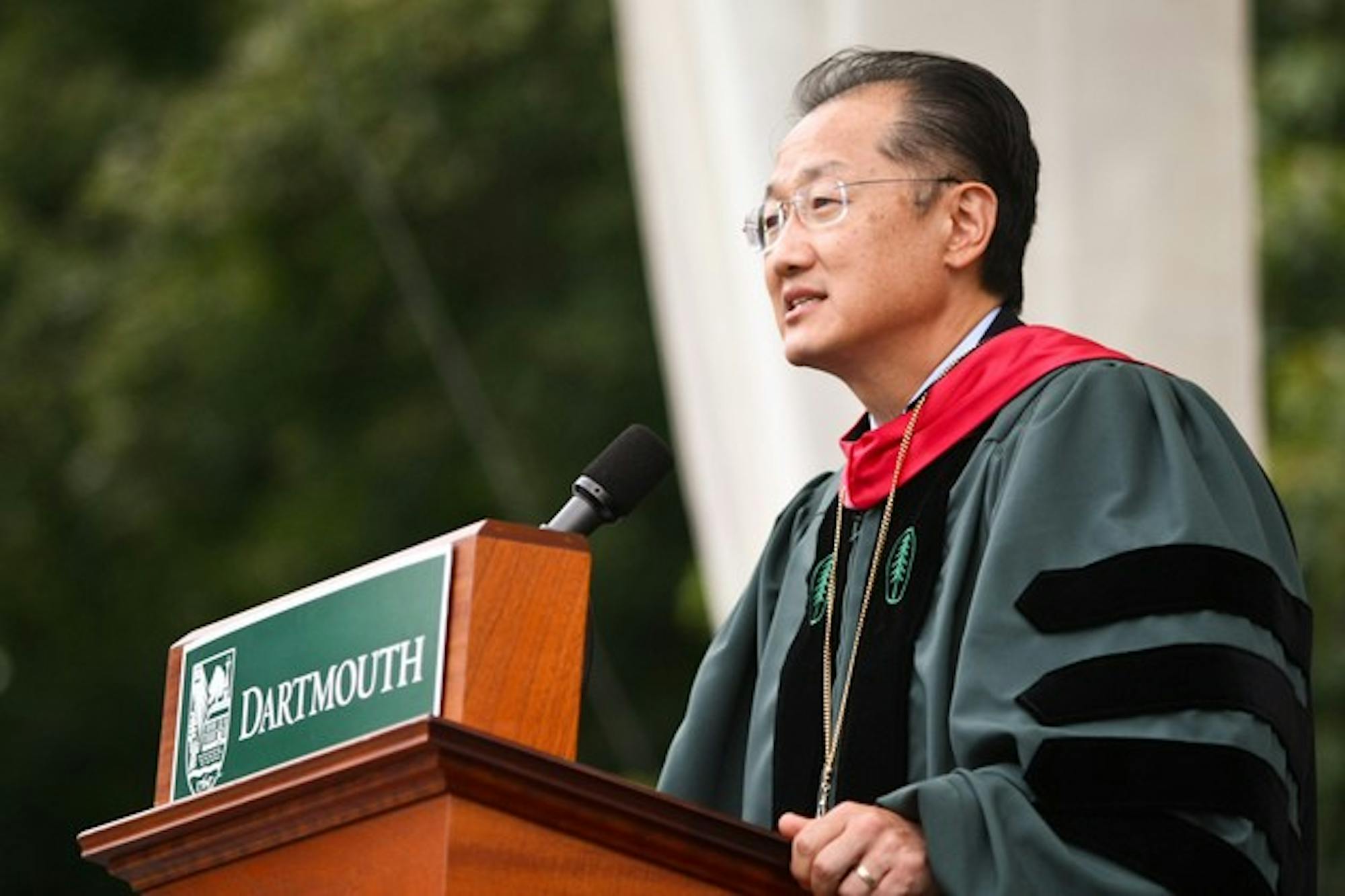
Throughout his speech, Kim, who is renowned for his research on drug-resistant tuberculosis, mentioned the arts and humanities as frequently as the sciences, emphasizing his commitment to a well-rounded liberal arts education.
"This historical moment requires a generation that unites the passion to transform the world with the intellectual capacity to tackle the most difficult scientific challenges, to apply sophisticated management strategies in new ways, to create art that resonates in a changing world and to lead teams of people toward common goals," Kim said.
Dartmouth Medical School professor Christina Skourou said in an interview with The Dartmouth that, prior to Kim's address, many members of the Dartmouth community were worried that Kim might not have a broad appreciation for academics beyond the sciences. Kim's speech demonstrated that he is "very well-rounded," Skourou said.
Art history professor Angela Rosenthal also said that Kim's frequent mention of the humanities was "reassuring."
"I liked his embrace of the humanities," Rosenthal said. "It was something that didn't come across early on. But the people in the humanities also want to be swept away because we are also ambitious. It is heartening to know that he appreciates all aspects of Dartmouth."
As if aware that some community members perceive him as too science-focused, Kim detailed why he values the arts.
"Reading The Tempest,' debating Aristotle's ethics or choreographing a dance are supremely practical activities," Kim said. "They deepen our understanding of what has been and open our imagination to what yet could be. They provide the experiences of beauty and shared meaning which are central to building a more just world."
Skourou said that, even as a professor of medicine, she appreciated Kim's acknowledgment of the arts.
"It makes him very human, it shows that he's loving, and it is important to have that in a president because not all the students will go into the sciences," Skourou said.
Kim, who is the former chair of the department of global health and social medicine at Harvard Medical School, focused on Dartmouth's undergraduate college throughout his address, only mentioning the graduate schools once by name and even then also pointing to the importance of research in undergraduate education.
"Not only will we support research by our faculty, we also expect every Dartmouth student to engage in significant original scholarship during their time at the College. The discovery of new knowledge must be at the core of our collective mission," Kim said. "Dartmouth's world-class professional schools Tuck, Thayer and Dartmouth Medical School provide the College with decisive strengths for that mission."
Kim also urged Dartmouth students to strive for social change and equity, reflecting his background as a co-founder of Partners in Health, a non-profit organization that provides medical support to low-income communities around the world.
With what he described as the College's blended practical, liberal arts education, Kim said, Dartmouth graduates are prepared to have an impact on the world.
Kim compared educators in Latin America working to break "the chains of poverty" with engineers in "cutting-edge production facilities," saying that both embody Dartmouth's historic educational mission a mission that is currently "more vital than ever."
The mission relies on both "the passionate commitment to making the world a better place" and "the practical understanding of complex systems required to deliver solutions on a global scale," Kim said. "Either without the other will be inadequate to tackle the challenges we face today."
Kim spoke directly to students when stressing the immediate need for change.
"I've spent most of my adult life trying to tackle social problems around the world, but I came to Dartmouth because I'm convinced that those of you gathered here today will achieve far more than I ever could," Kim said. "Helping you do that is now my mission in life."
Kim used student-directed rhetoric to relate to the incoming class.
"Aspire to change the world," Kim said. "If you're an engineer, take on climate change and move us toward a more sustainable future. If you're a musician, play or write something that truly moves people. And if you play football, beat Harvard. Please. This year."
Members of the incoming class interviewed after the inauguration said Kim's speech was invigorating and made Kim appear approachable.
"It really pumped me up," Lindsey Romero '13 said. "I thought it was really inspirational because he's accomplished so much, but he's still so humble."
Laura Gray '13 said Kim's urging to "find your passion, be persistent in achieving mastery, pursue knowledge in the way that works best for you, and embrace the planet's problems" was simultaneously daunting and inspiring.
"In some ways, it does make you scared because he charged us with such an immense task," Gray said. "But he's so personable that he made it seem like we could accomplish it."
Kim, previously a College outsider, appealed to the greater Dartmouth community of alumni and students by frequently referencing notable figures from the College's history, including eight of his 16 predecessors, and by acknowledging the importance of Dartmouth traditions.
"Just last week, up at the Ravine Lodge on Mount Moosilauke, I watched with enormous pride as our upperclass women and men went to truly extraordinary lengths to welcome the Class of 2013 into the loving embrace of the Dartmouth community," Kim said in reference to the tradition of student "Croos" and upperclass leaders welcoming freshmen during Dartmouth Outing Club First-Year Trips.
Kim specifically paid homage to former College President John Sloan Dickey by announcing that he will revive Dickey's "Great Issues" class, in which "students explored critical questions as an entire class, creating a common vocabulary through which differences in views and values could be examined and understood," Kim said.
"Let's revive the Great Issues' course to give today's students a shared intellectual foundation for taking on the most challenging problems of our time," Kim said, to much applause.
Kim will teach a "Great Issues" class this summer to the Class of 2012, Kim said in a press conference after the inauguration ceremony.
Thayer School of Engineering professor Shuba Srinivasan said she appreciated that Kim had clearly spent time learning about the history and traditions of the College.
"It was very comforting that the person who comes in takes his role seriously and knows his history and tradition," Srinivasan said. "His speech didn't change my opinion of him in any way, it just made me happier."