
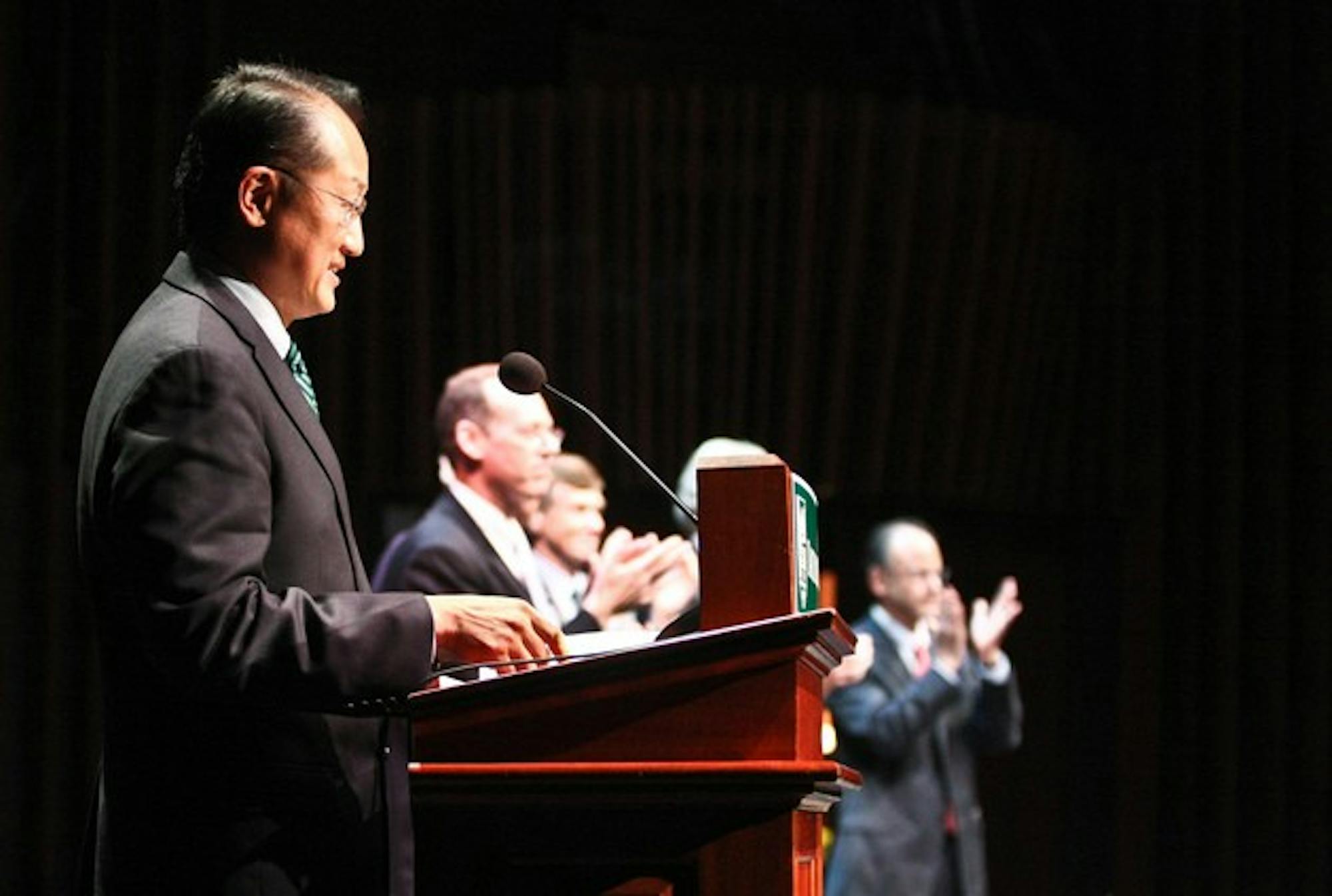
"I get that I have been given an unbelievably important, sacred trust," Kim said in an interview with The Dartmouth last week.
In an interview with The Dartmouth this week, Kim said he plans to convey his appreciation for his place in Dartmouth's history during his inaugural address on Tuesday.
He also said he will pledge to "take care of this institution, to preserve it, to make it grow, to help it adapt to the times" as Dartmouth's past presidents have.
"I need to show [the Dartmouth community] that I've thought deeply about what previous presidents have done, and that anything that I do will be very much in keeping with the spirit of my 16 predecessors," Kim said.
Kim said he also plans to discuss what he believes makes a liberal arts education, and specifically a Dartmouth education, so valuable.
He will speak to the responsibility that Dartmouth students have to make a difference in the world, he said.
THE HISTORIC MOMENT
In his 1987 inaugural address, then-College President James Freedman acknowledged the historical weight of the ceremony in which he was participating.
"These inaugural ceremonies, like education itself, are an exercise in reflection and renewal," Freedman said. "As part of that exercise, we reaffirm our historic conviction that Dartmouth College must be a commonwealth of liberal learning."
To prepare for his own inaugural speech, Kim said he read biographies of several Dartmouth presidents, as well as "just about every inauguration speech going back to [former College President] John Sloan Dickey's."
To supplement his reading, Kim said he has talked with alumni who knew Dartmouth's earlier presidents. Reading and hearing personal stories about previous presidents, Kim said, has given him a profound respect for his predecessors.
"Every single one of them made changes, every single one of them had to respond to the exigencies of their time, every single one of them has had to take Dartmouth through, at times, major transformations and upheavals," Kim said. "And each time they did so, they did so in a way that kept that which was unique to Dartmouth."
Kim said he also plans to demonstrate his growing understanding of the College's traditions and history, which many presidents have acknowledged in their inaugural addresses.
"Within the past year," then-College President William Jewett Tucker said in his 1893 speech, "the phrase has become current amongst us the new Dartmouth And yet let me say at once, we cannot make too great an acknowledgment of that which has been done before. The chiefest factor in the new will be the old."
In his 1998 inaugural speech, "Dartmouth: Forever New," former College President James Wright conveyed a different message about the College.
"We all know that Dartmouth is a place that is marked by strong traditions," Wright said. "But Dartmouth's history is one that resonates and lives, not one that encapsulates and confines."
Later in his speech, Wright added a gentle warning.
"Today, I say to you that Dartmouth, while proud of its heritage, must be forever new."
A DARTMOUTH EDUCATION
After discussing the historical context of his presidency, Kim said he plans to explain why receiving a liberal arts education at Dartmouth is "worth the money that it costs and is as special as we think it is."
It is unfortunate, Kim said, that the economic downturn requires all institutions of higher learning, and especially Ivy League institutions, to "rethink in a kind of fundamental way how we talk about our value proposition."
"Why should alums keep giving, why should foundations keep giving?" Kim said. "What makes the experience of a liberal arts education at Dartmouth College so special that people should do anything they can to come and experience it? I believe that. I believe that people should."
Many of Dartmouth's past presidents have similarly discussed why they so highly value a liberal arts education in their inaugural addresses.
"Such a training gives width of view and flexibility of intellect," former College President Ernest Martin Hopkins said in 1916. "Industry and commerce will be most successfully pursued by men whose education has stimulated their imagination and widened their sympathies."
SOCIAL RESPONSIBILITY
Kim said he will also remind students that attending Dartmouth is a privilege that comes with responsibilities.
"Responsibilities about doing fantastic things in the world, in the social sector, but also in the business sector, in the arts, in the humanities," Kim said. "Being so lucky as to have an education at Dartmouth means that you bring upon yourself some responsibilities to the world."
That theme of responsibility has been consistently present throughout past presidential inaugural addresses.
"Society's need for liberally educated men and women has never been greater than it is today, as we ponder still the transforming horror of the Holocaust, as we live daily with the existential possibility of nuclear annihilation, as we experience the awful anguish of failing to meet the simple imperative of feeding all the people on our planet," Freedman said in his address.
More recently, Wright also reminded students of the need to look beyond oneself.
"We know that the purpose of a Dartmouth education is not merely the enhancement of the self," Wright said. "This is not a sufficient consequence of privilege."
ADVICE FOR NEW STUDENTS
Kim said he plans to distinguish his address from most Dartmouth convocation speeches by giving specific advice to the members of the Class of 2013.
"I've been to so many speeches where college and university presidents go on and on," Kim said. "But I've never really heard one say, Okay freshmen, here are the five things I expect you to do this year.' And, you know, it can't be, Take calculus.'"
Kim said he will use his knowledge of recent research in education to help him advise the freshmen.
"I'm going to be rather prescriptive," he said. "Not in any nitpicky, minutia, detailed way, but I have my ideas about how they can maximize their educational experience, and I'm going to speak directly to them."
PEOPLE OF DARTMOUTH
In the last part of his address, Kim said, he plans to highlight what he has found makes Dartmouth "such a special place" during the two and a half months he has been on campus.
"I'll focus a lot on the relationships between people," Kim said.
More than a century ago, Tucker made a similar observation in his address.
"Each generation waits to pour into its life the warmth and richness of its own and departing bequeaths to it the earnings of its strength," Tucker said. "The College lives because nourished and fed from the unfailing sources of personal devotion."
UNTIL THE LAST MINUTE
Although Kim discussed his plans for his inaugural address with The Dartmouth last week, he cautioned that his speeches are "always as given."
"Am I really clear about what I'm going to say?," he said. "Absolutely, in terms of the general themes. But there are always better ways of saying anything. So I'll be tweaking until the last minute."


