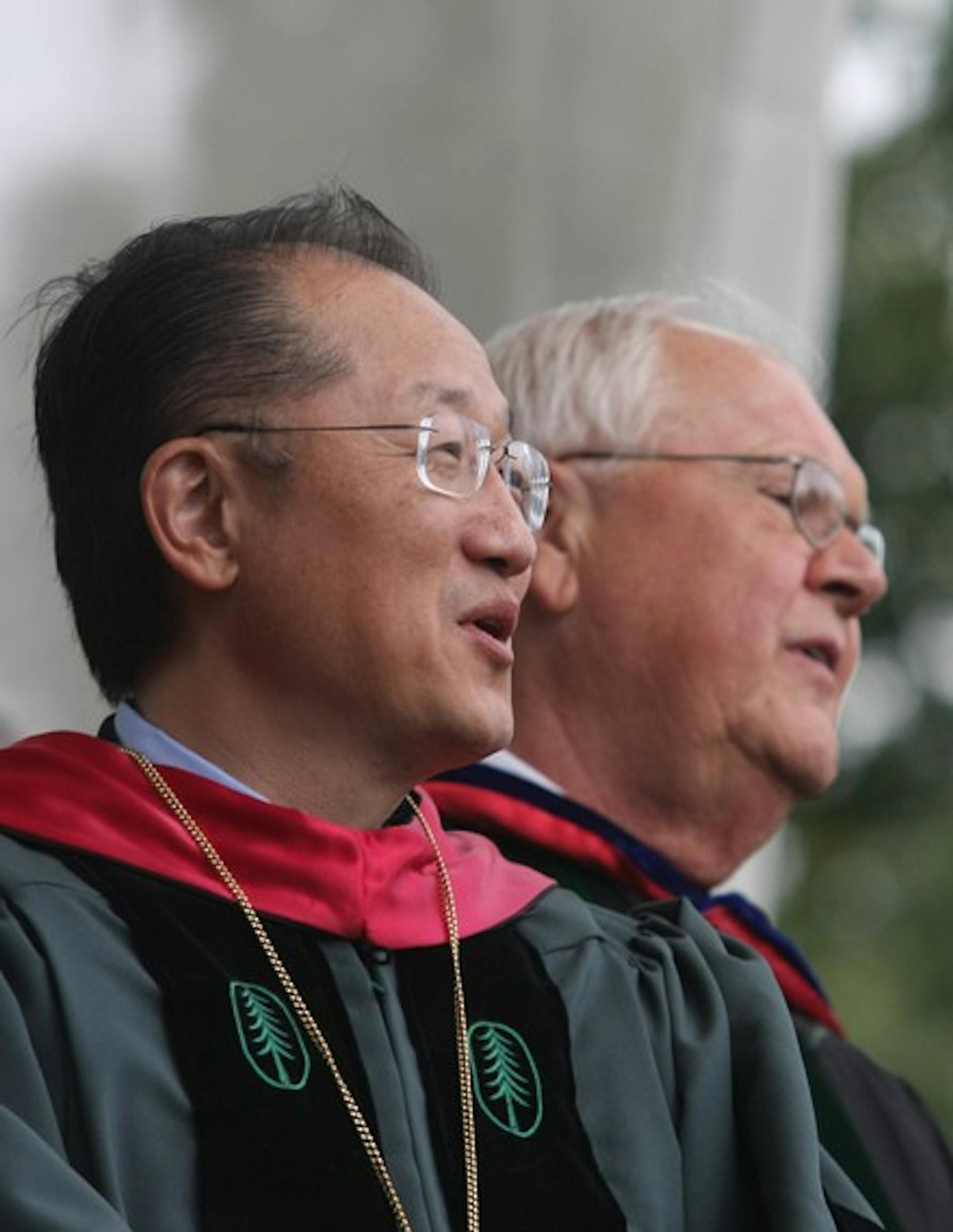
Global health leader Jim Yong Kim was officially inaugurated as Dartmouth's 17th president on Tuesday before an audience of more than 5,000 people. Kim, in his inaugural address, stressed the College's historical commitment to teaching, but also urged students to use their liberal arts education to tackle the world's issues.
"For nearly two and a half centuries, Dartmouth has flourished, adapting itself to the changing educational needs of this country and the world," Kim, who took office on July 1, said. "Yet there has always been constancy at its core, a clear sense of purpose that sets this College apart."
Quoting former College President John Sloan Dickey, Kim described the liberal arts as the "liberating arts" because such an education "liberates the best in us."
Kim said the liberal arts education at Dartmouth teaches students to merge passion with practicality, something he said he learned to value from his parents one a dentist, and the other a philosopher.
"If we did nothing else at this College but contribute to humankind's understanding of itself and of the world, and start to learn for the pure love of learning, our work would be amply justified. But like many of my predecessors, I believe Dartmouth's liberal arts education prepares its graduates to impact the world," he said.
Kim said students should use their education to tackle pressing issues for example, working to produce more energy-efficient technologies to combat climate change, or creating inspirational works of arts to address human rights violations.
Many previous Dartmouth presidents, Kim said in his speech, have also emphasized this combination of passion and practice. Dickey described "the dual pursuit of competence and conscience," and former College President John Kemeny spoke about the "distance between dreams and delivery," reaffirming Dartmouth's commitment to training leaders who can serve society, Kim said.
"Educators in Latin America helping peasants break the chains of poverty seem worlds apart from systems engineering in cutting edge production facilities," he said. "Yet I believe they embody two sides of the educational mission set forth by my predecessors: on the one hand, the passionate commitment to making the world a better place; on the other, the practical understanding of complex systems required to deliver solutions on a global scale."
The College must also continue its strong legacy of "inspired teaching" by promoting collaboration between faculty in different fields, supporting faculty research and encouraging students to engage in "original, significant work," Kim said in his address.
"At Dartmouth, faculty have brought the complexity of their research to the classroom to strengthen students' learning," he said. "In turn, professors have reformulated their research questions after being challenged by students. We must support faculty research for its intrinsic value, and because without it, teaching at Dartmouth will suffer."
Kim said he plans to teach a revived version of Dickey's "Great Issues" course.
Kim also gave advice, what he called his four "P's," to the Class of 2013, urging the incoming students to embrace the planet's problems, to be persistent, to pursue knowledge by finding out how they learn best and to find their passion.
"I'm not talking about passing fancies," he said. "The passion I want you to find takes work. It represents less an emotional sensation than an intellectual achievement you won't find it by sitting passively in the classroom or surfing the web."
Kim concluded his address by describing what he termed the "sweetness" of social interactions at Dartmouth. He said he borrowed the term from the writer Jack Beatty, who taught an English class at the College last Fall term. Kim said that Beatty, in an e-mail, noted that he was surprised by how much respect his students had for each other, even when critiquing each other's work
Board of Trustees Chairman Ed Haldeman '70 presented Kim with the College's charter, officially installing Kim as president.
Kim later praised Haldeman for "answering the call of service" by taking the helm of Freddie Mac, the beleaguered government-sponsored loan organization.
Former College President James Wright, who also spoke at the event, presented Kim with the Wentworth Bowl, an artifact symbolic of the Wheelock Succession of Dartmouth presidents.
Wright will travel to South Korea later this fall, at Kim's suggestion, to deliver a series of lectures on the Dartmouth experience and the value of a liberal arts education.
Several of Kim's colleagues also delivered speeches at the event. Harvard Business School professor Michael Porter, in his remarks, praised Kim for his willingness to learn. Porter collaborated with Kim on an interdisciplinary global health project while Kim was a faculty member at Harvard Medical School.
Harvard professor and Partners in Health co-founder Paul Farmer Kim's long-time friend and the godfather to Kim's son, Thomas said he believes Dartmouth is fortunate to have a leader like Kim, noting that he believes in the realm of global health everything that Kim has predicted has come to pass.
The inauguration also featured an invocation by Kim's maternal uncle, Presbyterian minister and philosopher Hearn Chu, and an address by Student Body President Frances Vernon '10. Gov. John Lynch, D-N.H., also delivered a speech in which he pledged to continue working with Dartmouth to make the state an example for the country. Lynch also joked that Kim will have to lead this year's polar bear swim during Winter Carnival.
Kim was welcomed into the Council of Ivy Group Presidents by Brown University President Ruth Simmons, the first black president of an Ivy League institution.