
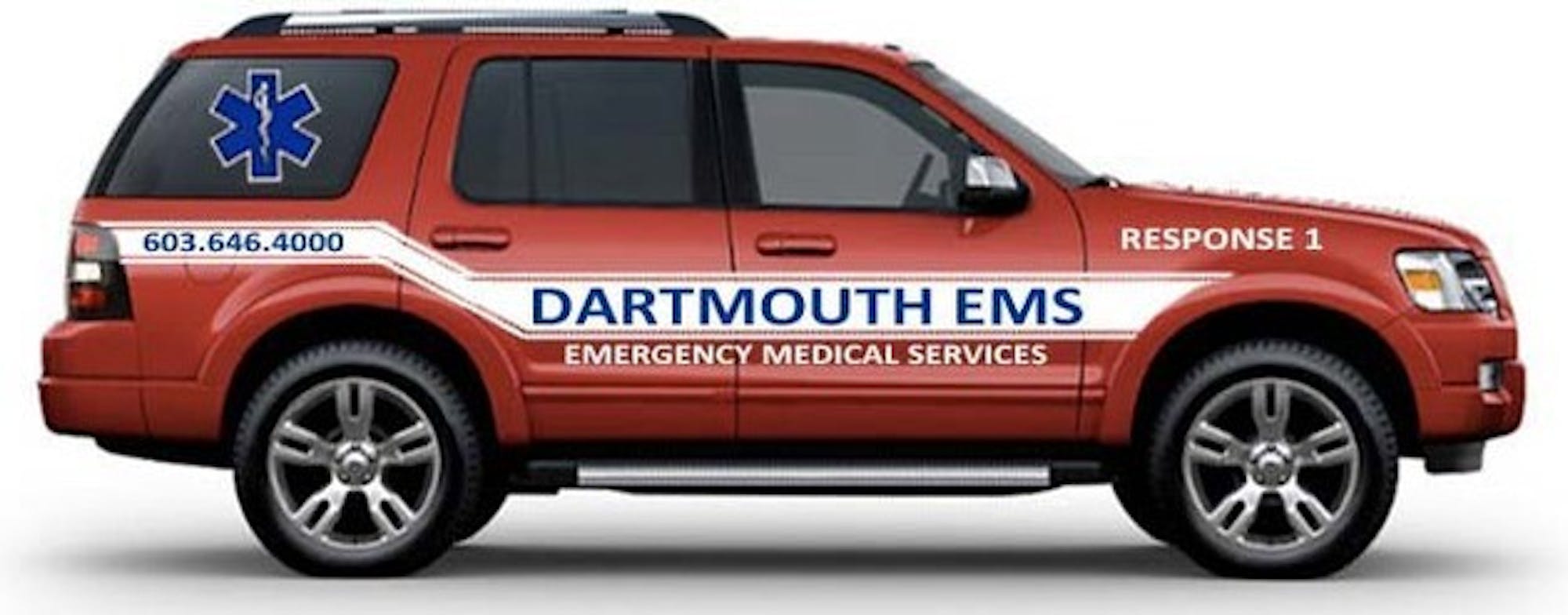
Dartmouth's student-run Emergency Medical Services response team is leasing a 2008 Ford Explorer in order to allow the group to arrive faster at scenes with more equipment and resources when responding to calls, according to Summer EMS director Ryan Speers '11. The SUV is not currently authorized to transport patients in any condition, however, and its availability will have a negligible effect on the College's Good Samaritan policy, Speers said.
Dartmouth EMS expects to begin using the vehicle which is being refitted with emergency lighting, EMS identification and storage space for medical supplies at the beginning of Fall term. The SUV will be used primarily for responding to medical calls during weekends, when EMS serves as the first response team for on-campus emergency calls. It will also be used to transport equipment and personnel to various training classes and medical standby events, Speers said.
"This is a major step forward for the [EMS] program," Speers said. "We'll hopefully be able to expand hours, and that will be a benefit to students on campus. [It will also] allow us to bring a ton of extra equipment to calls, beyond what's required by law but which could be really useful."
The vehicle is not technically classified as an ambulance, according to EMS 2009-2010 director Jeffrey Spielberg '10, because the state of New Hampshire does not recognize sport utility vehicles as valid emergency response vehicles. Although the state does not prohibit such vehicles, he explained, it neglects to address them.
"It doesn't seem like something that's ever come up for [New Hampshire]," he said.
Similar vehicles are relatively common on college campuses in states including Massachusetts, according to Speers, but they are often used for the transportation of non-critical patients who do not require the continuous care that only responders with larger ambulances can provide.
Spielberg said he hopes to meet with state officials in order to seek an exemption for Dartmouth EMS that would allow them to transport students in need of medical attention, provided the patients do not require continuous care. Even if Dartmouth obtains an exemption, however, it will have little effect on student arrests following a Good Sam, Speers said, because students who are intoxicated to the point of having to go to Dartmouth-Hitchcock Medical Center require continuous care, and thus cannot ride in the vehicle. "We would not be replacing ambulance transport for severely intoxicated people, which is the situation in which someone gets sent to DHMC," Speers said. "In an SUV, you don't have continuous monitoring of the person, so we wouldn't be able to provide the medical care that someone so intoxicated they need to go to DHMC needs."
Several campus figures have suggested that the College purchase a larger ambulance as a means of reducing arrests stemming from students who are "Good-Sammed" and later transported to DHMC because of their high level of intoxication. If underage, such students are currently arrested for unlawful intoxication, as a Hanover Police car follows the Hanover Fire ambulances that transport students to DHMC.
Dartmouth students must pass a specific College driving test in order to be allowed to operate the EMS vehicle. The test is slightly more stringent than normal New Hampshire state requirements, Speers said.
The group is leasing the SUV through the College for a four-year term.
Funds for the vehicle's lease, which includes coverage of potential repairs, have been paid in advance using funds earned from providing standby coverage at College events and teaching First Aid and CPR classes on campus, Speers said.


