
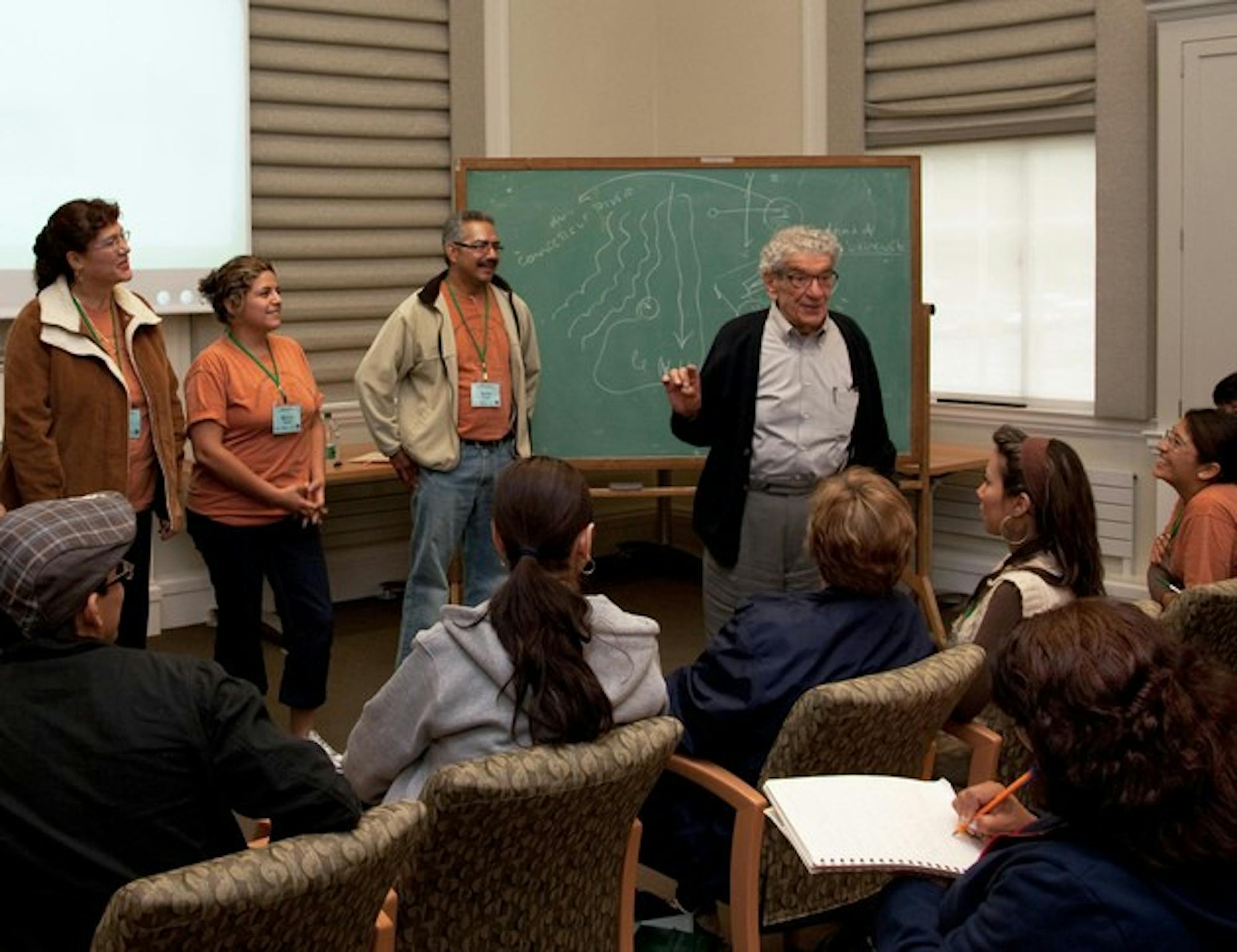
Every summer since 2007, Dartmouth's Rassias Center for World Language and Culture has partnered with Nextel de Mxico and non-profit organizations Worldfund and Bcalos to run the Inter-American Partnership for Education Teachers' Collaborative, according to James Citron '86, the program's director.
IAPE was conceived four years ago by Worldfund executive director Luanne Zurlo '87, a former Wall Street executive who wanted to introduce new methods of English language teaching in Mexican schools with few resources. Zurlo hoped to provide teachers with a network to develop their curricula, according to John Rassias, chair of the French department and developer of the Rassias language method, and during the program, Rassias spends hours each day teaching the Mexican educators during their visit.
"When [Zurlo] told me her idea I agreed that it was a fantastic project, so neat and straightforward," Rassias said. "I agreed within five minutes, and that's been the spirit of the project ever since."
IAPE has since gained support from the Clinton Global Initiative Commitment, a program launched by former President Bill Clinton in 2005, according to Citron. Obtaining the initiative's "special recognition," Citron said, will help IAPE connect to other groups doing similar work and find ways to fund and expand the program.
The program staff has been "blown away" by the visiting teachers, Helene Rassias-Miles, Executive Director of the Rassias Center, said. Teachers' days usually begin at around 7 a.m. and are filled with classes and activities until late in the evening, she added.
"We're all teachers from different parts of Mexico, different states, schools and ages," Marcella Carrillo, a teacher participating in the program, said. "By making the program this way, they are able to take some of the best English teachers in Mexico and bring us together to learn a method that will spread throughout the country."
More than 160 educators applied to participate and roughly 60 were selected for interviews, Citron said, adding that the program sought dynamic teachers with good English skills who would represent a range of schools from elementary schools through universities, at wide variety of locations.
The Rassias method, which includes fast-paced language instruction and cultural education, plays a large part in the curriculum, which generally comprises four to five hours of study each day, Citron said.
"The method allows us to share our knowledge with students in a way that they don't feel like they're studying," Gaby Corillo, a secondary school teacher from Jalisco, Mexico, said.
In addition to interactive lessons in teaching method with Rassias, participants have attended lectures and seminars on topics ranging from working with at-risk youth to language proficiency testing to addressing cultural differences in language instruction.
"Working with these people is an absolute joy. They're fired up and want to learn," Rassias said. "I think these teachers drink octane fuel in the morning: they've got no negative attitude, learn quickly and are always asking for more."
Rassias said he is confident that the teachers will share new teaching skills with their peers and help spread the method throughout Mexico. Two Mexican states have even incorporated techniques from the Dartmouth program into their official English curricula, he later added.
Maria Nelly Guetierrez, an elementary school teacher, said she thought her fellow teachers had all been inspired to make changes to their teaching methods.
"Our mission now is to better educate our students and also to share with other teachers, so that this program has a greater impact," she said. "IAPE is a life-long commitment."


