
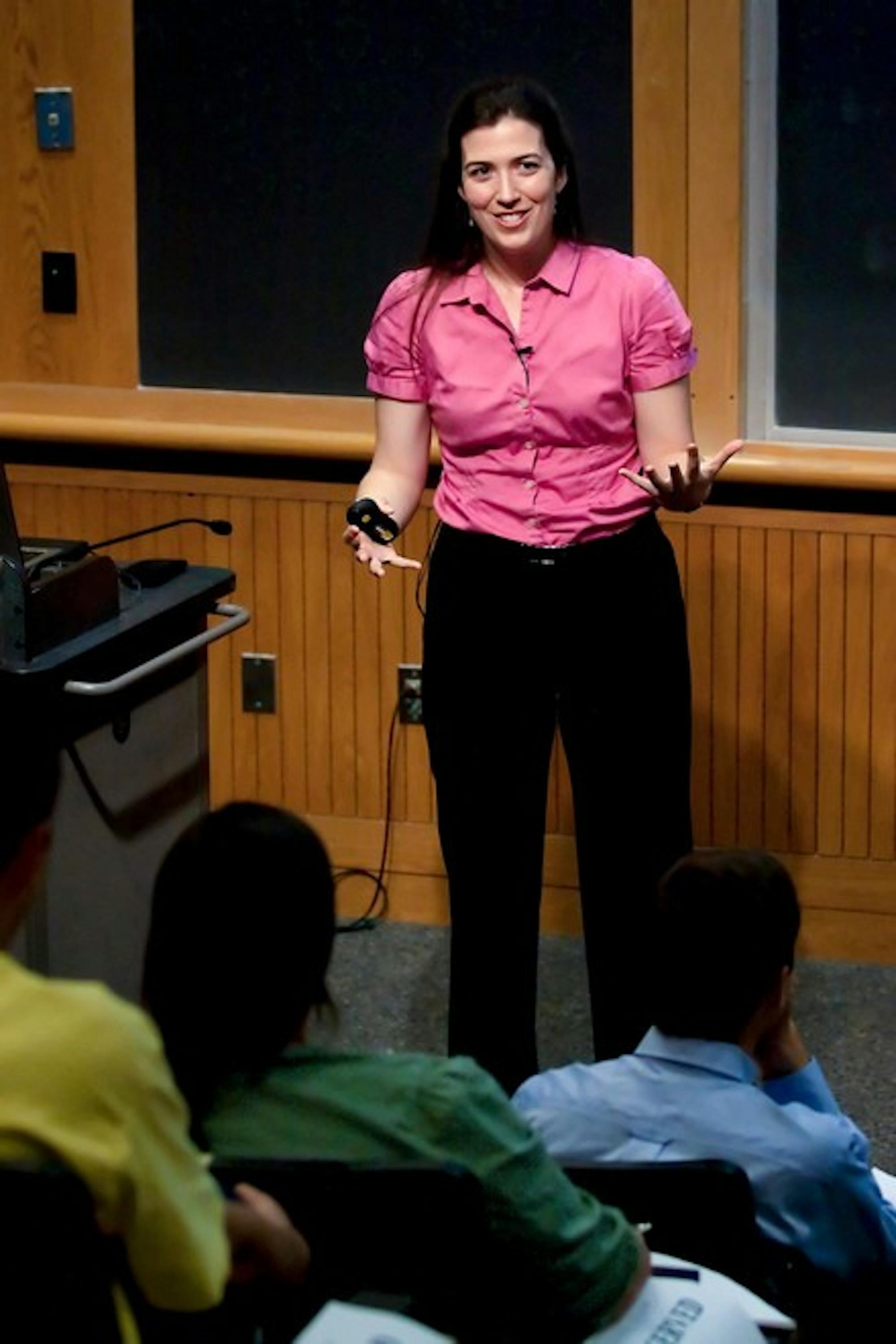
Post continues the work of her great-great grandmother Emily Post, who founded the etiquette advice organization in 1946.
"Etiquette is not something off in the ether," Post said in an interview with The Dartmouth prior to the event. "Etiquette is very real for people in their daily lives. It's not just something on a shelf that you save for when you visit your grandmother."
Etiquette can be defined as a code of conduct and practicing empathy around other people, Post said, adding that while manners are a part of good etiquette, her great-great grandmother never held a teacup with her pinky in the air.
"Whenever two people come together and their behavior affects one another, you have etiquette," she said.
The three principles of good etiquette are consideration, respect and honesty, Post told the audience, emphasizing the importance of thinking before acting, making choices that build relationships and acting with sincerity.
Post cited several statistics to demonstrate the importance of good etiquette during the lecture. According to a poll conducted by the Associated Press and IPSOS News Center, for example, 69 percent of those surveyed thought that Americans were less polite than they were 20 or 30 years ago.
"New parts of our lives call for new etiquette," she said. "I think what we're seeing is a demand for a response to new technology."
Post also told the audience members that individuals often lose awareness of how their actions affect others.
One poll found that 89 percent of respondents said they knew someone who used a cell phone rudely, Post said, but only 8 percent reported having done so themselves.
Poor etiquette on the part of employees can also sometimes result in companies losing productivity and profits, according to a University of North Carolina study that Post cited. In such circumstances, companies risk recruiting and employee retainment difficulties, she said.
Post recommended greeting colleagues, identifying oneself on the phone and using salutations in e-mails as simple steps toward better etiquette.
She also urged individuals to proofread before sending e-mails, because poor grammar or word choices often reflects badly on a person and the company, she said. People should also consider if the message is public or private, Post said, offering the hypothetical example of an employee venting to a colleague about his or her boss only to find it posted on the company's bulletin board or refrigerator.
The rules of etiquette for social networks, however, are still developing, she said. Post advised the audience to be constant professionals by recognizing that actions outside of the workplace and on the Internet can affect their careers.
Individuals should also think about why they are using a social networking web site, Post said. People are responsible for what they post on their Facebook pages, she said, and should bear in mind that business associates may be able to view their profiles. It is acceptable to "untag" a photo, decline requests to join groups or decline friend requests, she said.
People looking to network for work may be better off using LinkedIn, which was designed for business-based relationships, Post said.
Post originally became interested in etiquette after "growing up with it at the dinner table," she said. After graduating from Phillips Andover Academy and the University of Vermont, she began to work for Sen. Patrick Lahey, D-Vt., and later for the Motion Picture Association of America.
The event, sponsored by the Rockefeller Center, was part of the Dartmouth Professional Student Workshop, a three-week program designed to help students hone their business skills during the Summer term. During her stay at the College, Post also held workshops for students.


