
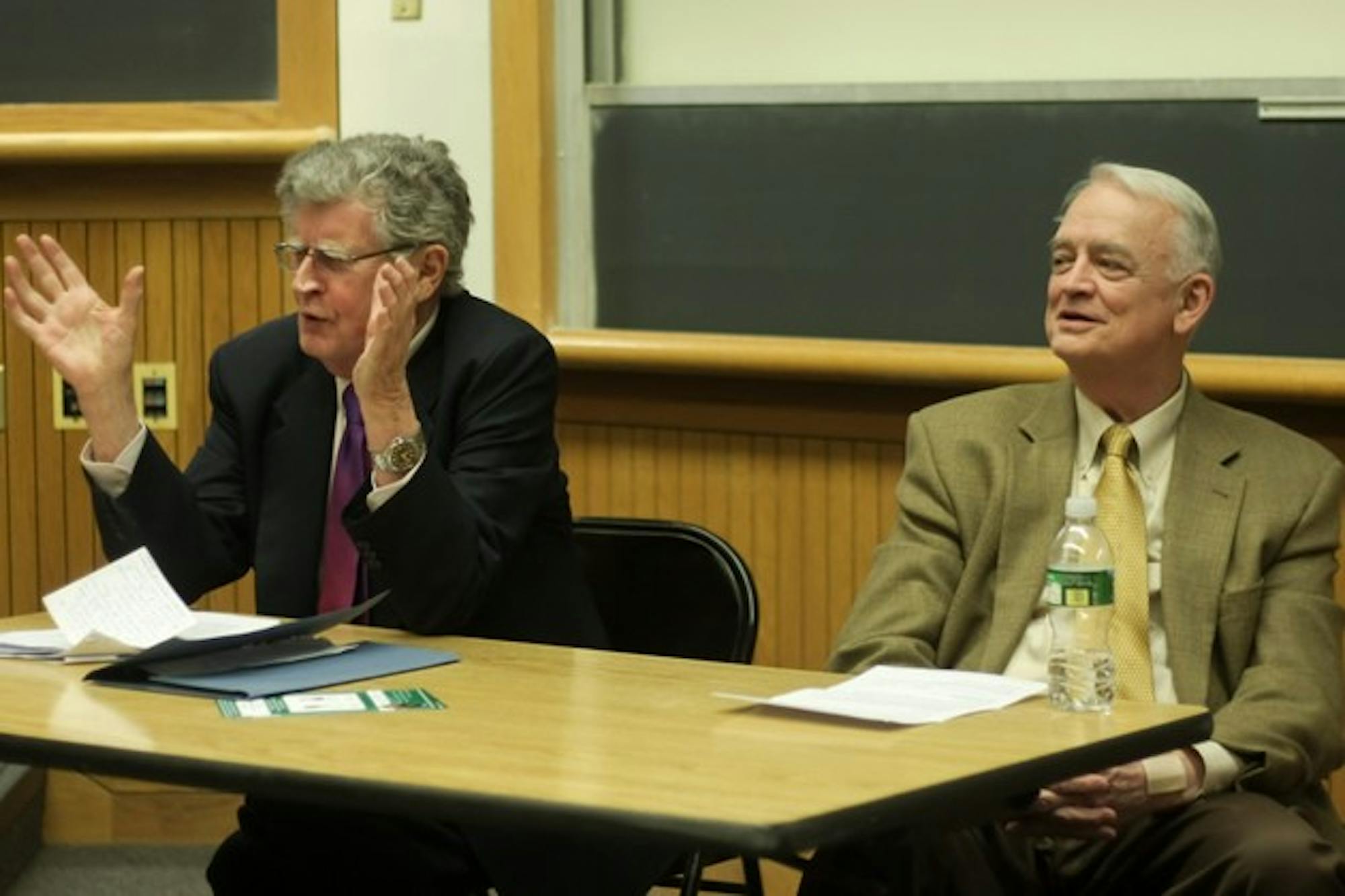
Faculty are forced to focus on research and publication at the expense of teaching as a result of societal and academic pressures, Fuller said, which creates "anxiety" among liberal arts professors.
"Part of the anxiety is not really knowing where we are going and how to respond to the traditions we have inherited and the circumstances we now have to operate under," Fuller said.
The influence of college rankings and the limitations imposed by grant-giving foundations have also decreased professors' influence, Fuller said.
"Professors will no longer be the primary determinants of the curriculum they teach," he said.
In addition, the number of students enrolled in for-profit and online institutions, rather than in traditional liberal arts institutions, is increasing "dramatically," Fuller said.
"It is likely that more and more students will take their undergraduate degrees in ways that are not typical for institutions like Dartmouth," he said.
Fuller said that alternative approaches like online education may be more convenient for older persons seeking to expand their education, but that they do not provide the same experience as more traditional institutions.
"There is something to be gained from being part of a community of teachers and learners that is not captured electronically and through distance," Fuller said.
Scholars are currently debating multiple approaches to a liberal arts education, Fuller said, explaining that academia is in "an age of non-consensus" about how to reform the liberal arts paradigm.
"The lack of consensus is likely to continue with us for some time to come," he said. "We can identify predicaments more readily than we can identify a way to solve them."
Minogue described the liberal arts tradition as a "moral enterprise" and a "struggle" that teaches students to perceive the world and society differently.
"You pay attention to things that uneducated persons would not pay attention to," Minogue said.
Minogue, citing philosopher Michael Oakeshott, described a university's purpose as "continually recovering what has been lost, repairing what has been neglected and collecting together what has been dissipated."
Both professors said that students overly focus on how their education can help them secure future employment. Colleges and universities should help students pursue their academic interests, Fuller said.
"What you hope is that when people enter institutions they have vocational ambitions," he said. "You hope that in the course of their studies they will also find something that interests them above and beyond [vocational training] that they can pursue."
Minogue said that people should not attend a university only to secure future employment.
"The fact that people think they need to go to universities to get a good job is very bad for universities," Minogue said. "There is an illusion that if you study economics you will get rich. This is not true."


