
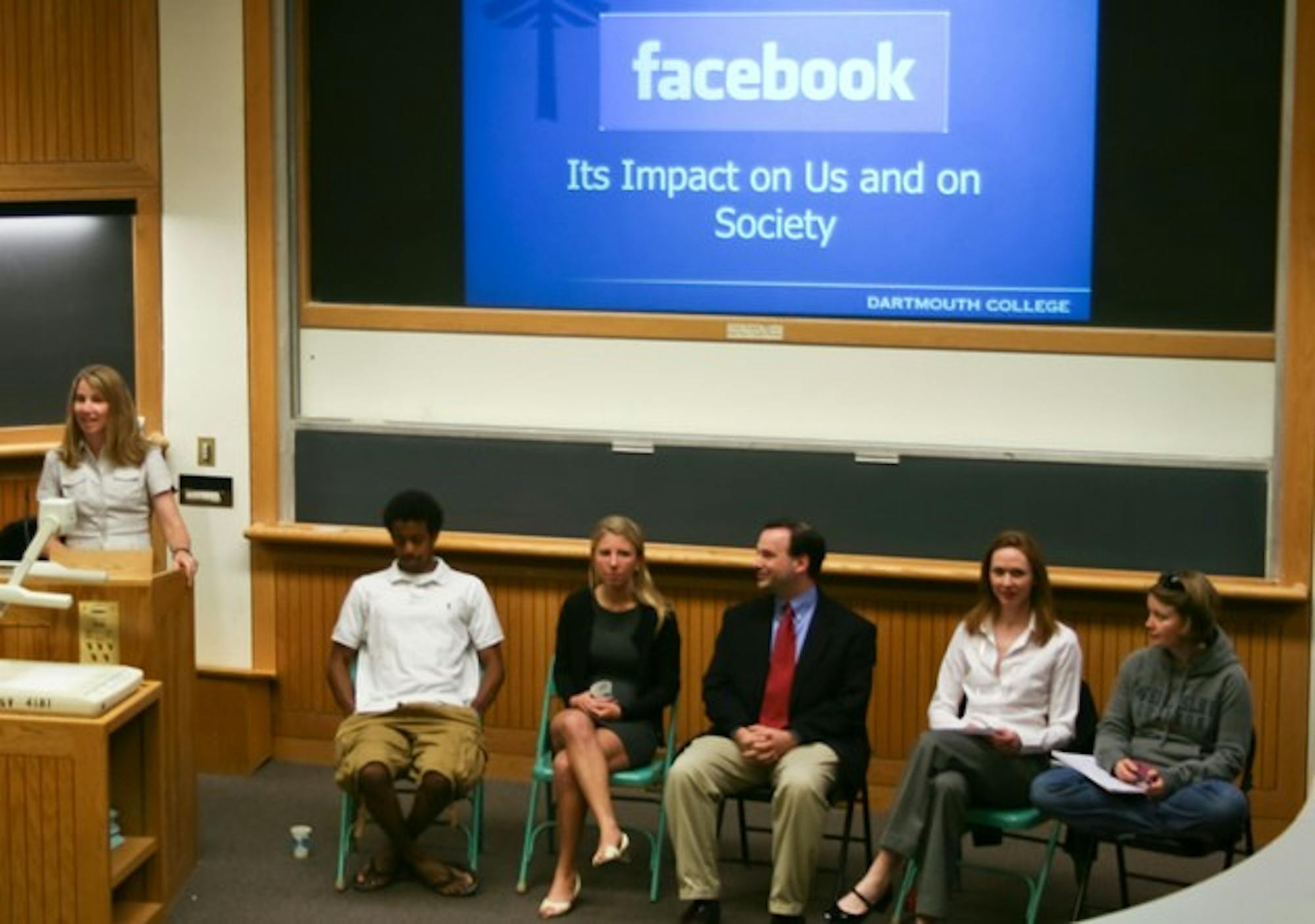
Sociology professor Denise Anthony, research director for the Dartmouth Institute for Security, Technology and Society, which sponsored the event, said in an interview that the panel was intended to explore the way Facebook has affected communication and friendship.
"Some think Facebook is great and changing everything for the better," she said. "Some say, 'Yeah, Facebook is changing things, but I'm not sure if it's for the better.' Others are thinking: 'Facebook, what the heck is that anyway?'"
Anthony said Facebook is changing the way people interact. The online social networking medium was started in 2004 at Harvard University and, since then, has registered 200 million users worldwide, she said. The web site expanded to other colleges and high schools in 2005. Facebook users spend three billion minutes on the site each day and upload 850 million photos each month, according to Anthony.
"I vividly remember being in my senior year of high school and knowing the kids who got in early decision to Harvard and Dartmouth and other schools," Browne said.
Browne is a staff columnist for The Dartmouth.
Browne said he has used Facebook increasingly less often during his time at the College, adding that he now uses the site primarily to view photographs.
"Whenever I'm out and see people with cameras, I expect to see that picture on Facebook the next day," he said.
Browne attributed his diminished use of the site to the Dartmouth environment. Dartmouth's small size fosters a tight community, Brown said, making Facebook less necessary. He also noted the popularity of BlitzMail, an alternative to Facebook for communication.
Professors and other adults often find Facebook useful, although usually for different reasons than young adults, Samwick said.
Samwick described Facebook as a vehicle of communication that allows people to connect with one another, share information and target advertisements. He said that the advertisements he sees on Facebook are not as "ridiculous" as those he has seen on other web sites.
Facebook also helps connect alumni, Samwick said. Many of the groups created by College alumni make alumni relations "irrelevant," as Facebook has become the "connection place that surpasses all others."
Samwick also said that Facebook is a good way to keep in touch with former students, but that he does not communicate with current students through the web site.
Panelist Lauren Farleigh '09 described the web site as medium through which friendship can be "acquired and enacted." She said that Facebook helps to connect people in different geographic locations, which is increasingly important as people change jobs or move.
Communicating through digital media, however, can reduce in-person interaction, Farleigh said.
Facebook can also lead to "huge" privacy issues, Farleigh said, a sentiment that was echoed by panelist Meg Houston Maker '87, director of External Information Services at the College.
"Facebook is about as private as shouting in a public square," Maker said, adding that this lack of privacy sometimes causes people to self edit, fostering a degree of artificiality.
Maker said that Facebook allows her to display her "three dimensionality."
"This three dimensionality is important in creating a sense of me as a whole person, and in return I see that in other people as well," she said.
Maker said she uses the web site to connect with friends in her area, coworkers, family and high school friends.
Panelist Sara Sinclair, a graduate student studying computer science, said using Facebook requires a significant degree of trust in a person's "Facebook friends" and in the site's privacy control settings.


