
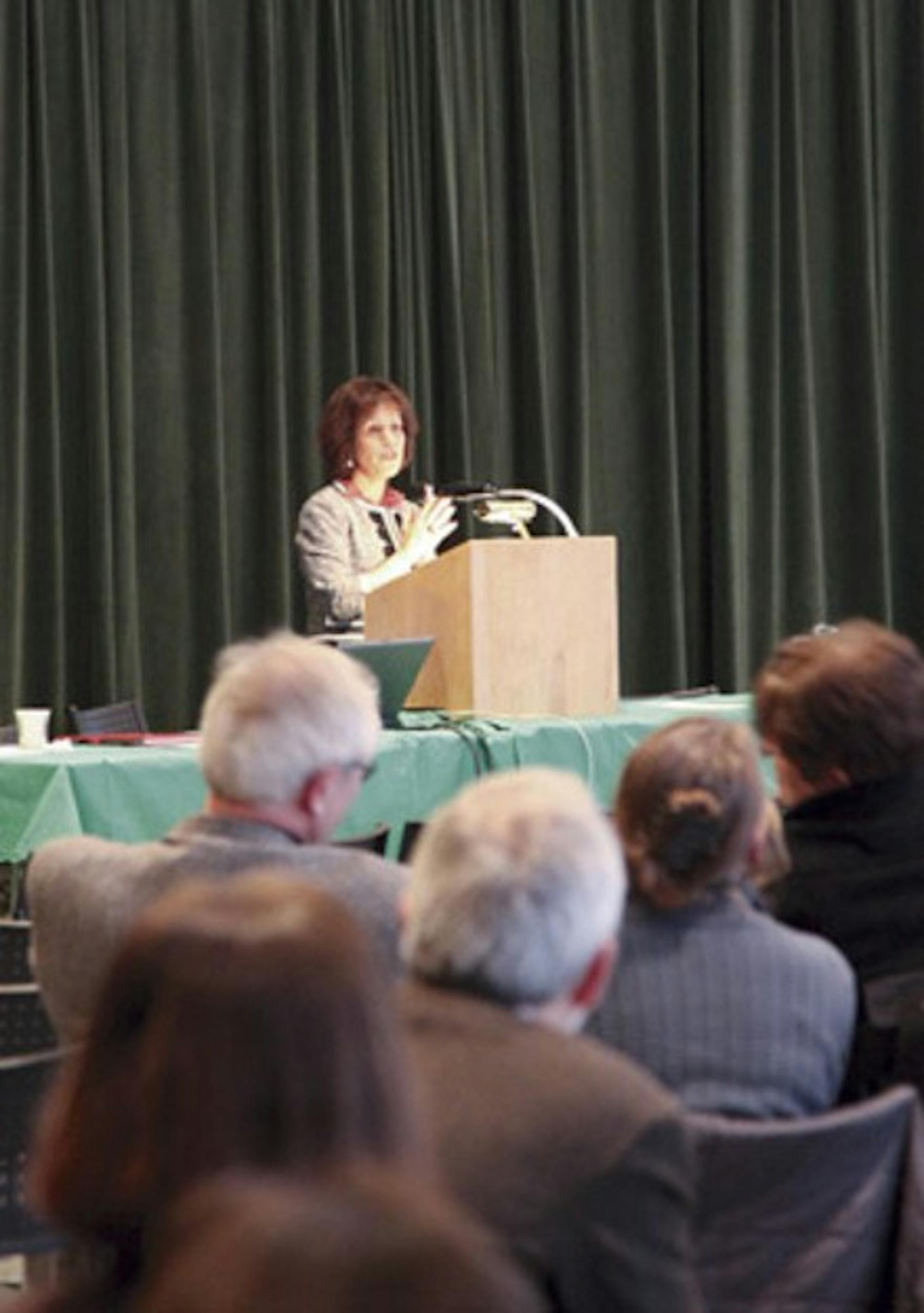
The professors, in a question and answer session following Folt's report, challenged assertions that recent layoffs did not target particular segments of the College, and questioned whether cuts to academics were adequately balanced by reductions in athletics funding.
"I am receiving a lot of comments, questions, e-mails pointing to a fairly pervasive undercurrent of concern ... that layoffs were targeted, these things were done very cynically or clinically," Colin Calloway, chair of the Native American Studies department, said at the meeting.
Folt's office attempted to restructure departments to allow them to operate more efficiently without undermining their central values, Folt said. She defended decisions to freeze faculty salaries and offer continuing benefits to employees who lost their jobs.
"I didn't think about individuals; what I thought about was the geography of Arts and Sciences," she said. "I think we really did try to protect the core institutional values of the faculty."
Athletics is often funded by targeted donations, rather than by general College funds, Folt said, adding that the athletic budget has also been reduced where possible.
The College has also implemented a policy to give employees who were laid off preference in new College hiring, Folt said, which could significantly reduce the net number of people who have lost their jobs. Folt said she could not release current numbers because the figures are rapidly changing.
Anthropology professor John Watanabe questioned the decision to cancel the Winter term faculty meeting at the same time that layoffs were announced and departments underwent major restructuring.
"The fact that we didn't have a formal faculty meeting to discuss this as a body is a difficulty that exacerbates this," he said. "That makes it all the more important for us, as a body, to be informed by this and to be a reality check."
The Winter term meeting was cancelled at the last minute as the College prepared to announce President-elect Jim Yong Kim's appointment, Folt said, adding that administrators attempted to make the restructuring process transparent by offering multiple public forums for faculty to voice their concerns and suggestions.
In her report, Folt also encouraged collaboration among departments. Partnerships between the Faculty of Arts and Sciences and professors at Dartmouth Medical School have led to millions of dollars in research awards, she said, while faculty at the Thayer School of Engineering and Tuck School of Business have expanded course offerings and research opportunities for undergraduates.
Different disciplines have also become interconnected through campus centers like the Rockefeller Center, the Hood Museum of Art and the Hopkins Center for the Arts, which work with multiple departments and act as spaces for diverse interests to collaborate, she said.
"We're stretching well beyond our departments and programs, and reaching out to the campus," Folt said.
Although Dartmouth already facilitates interdisciplinary work -- for which the College receives some of its largest research grants -- the success of current programs offers a promising course for future development, Folt said in an interview with The Dartmouth.
"My goal was really to demonstrate how it's happening," Folt said in the interview. "I think, as we look strategically, this could be something even bigger at Dartmouth. We can make this so clear to our students, what this means for their ability to get an outstanding liberal arts education."
Folt also used her address to tout accolades received by Dartmouth professors, as well as the large volume of faculty publications. More than 30 books were published by members of the Faculty of Arts and Sciences in the past year alone, while professors throughout the College wrote around 3,500 articles.
"Thirty books is a lot of books just from the Arts and Science faculty in a single year," Folt said in the interview. "Usually, people take two to five years to produce a book, so that also is showing their productivity is very, very strong."
The faculty voted unanimously at the meeting to approve changes to its policies on disciplinary action and academic freedom. The amendments rewrote and clarified the process by which professors may appeal administrative sanctions, and established a new faculty committee to review disciplinary actions.
"This has been part of a very long discussion, going back several years," said philosophy department chairwoman Amy Allen, who headed the Faculty Coordinating Committee that drafted the changes. "Now, whatever disciplinary grievances that might arise would not be heard by the same [body] that discusses tenure promotion and faculty fellowships."
The changes will also make it easier for the Dean of the Faculty Office to consult with senior faculty when disciplinary issues arise, Folt said.
"That's the most important thing: the faculty has to have a real say in how you adjudicate those sorts of grievances, even if they're extremely rare," she said. "It takes more than one head, sometimes, to think about the best way to do these things."


