
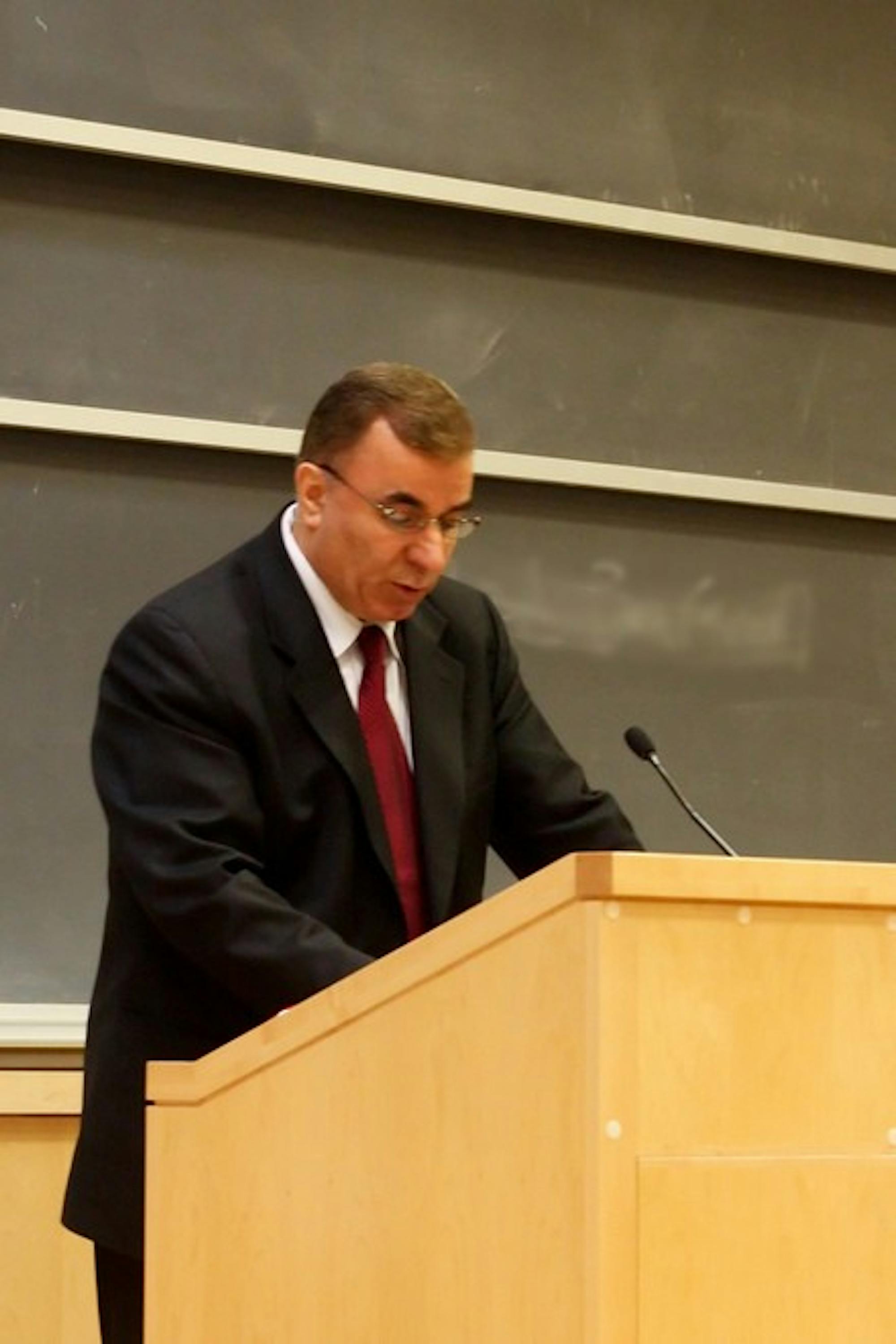
In a lecture held in the Haldeman Center on Monday, Abuznaid, now charge d'affairs of the mission of the Palestine Liberation Organization to the United States in Washington, D.C., argued that the Israeli-Palestinian conflict can be resolved peacefully.
"Some of you have probably given up on us, thinking that a peaceful resolution is impossible," Abuznaid said. "There is no conflict in the world that cannot end."
Peace negotiations have failed to adequately address the issues of compensation for Palestinian refugees, "illegal" Israeli settlements in the Palestinian territories, jurisdiction over Jerusalem and rights to resources, such as water, Abuznaid said.
The 1993 Oslo Accords between the Palestinians and Israelis failed to settle these issues, and attempts to address them at the 2000 Camp David Summit failed because neither side "had time to build public opinion," Abuznaid said.
The summit's lack of definitive goals also made negotiations difficult, as "each side was trying to get more," Abuznaid said.
"I think this year is critical," he said. "If nothing happens, I think that the area will be driven to terrorism and violence. The radicals win."
Abuznaid also stressed that the effects of the conflict are not limited to the Middle East.
"We live in a small world, and the hate of the Middle East conflicts will not stop at borders," Abuznaid said.
Abuznaid said he does not support a one-state solution.
"We support two states, not eliminating one," he said.
Palestinian terrorist organizations must be convinced that violence is not the way to achieve Palestinian independence, Abuznaid said. There needs to be a "change of attitudes of both sides" for the peace process to move forward, he said.
Abuznaid also detailed many of the Palestinians' everyday grievances and outlined the perceived abuses that he said Palestinians have suffered under Israeli rule.
"I cannot walk in my own city without a military permit," Abuznaid said. "Settlers make it impossible for us."
Abuznaid stressed his belief that diversity is a significant aspect of the region and that Palestinian and Israeli leaders "should never abdicate [their] duty to diversity."
"I do not know why God created so many religions within a few miles of each other," Abuznaid said. "Did God mean it for people to fight forever, or to show coexistence?"
Change is possible in the Palestinian territories and Israel through unification and peace, as occurred in once bitterly divided Europe, Abuznaid said.
"We need a 'Yes, we can' attitude," he said.
He urged Americans to have a more optimistic view of the possibility of peace.
"I have no doubt that the day will come and we will look at each other and say, 'Why did it take this long?'" he said.


