
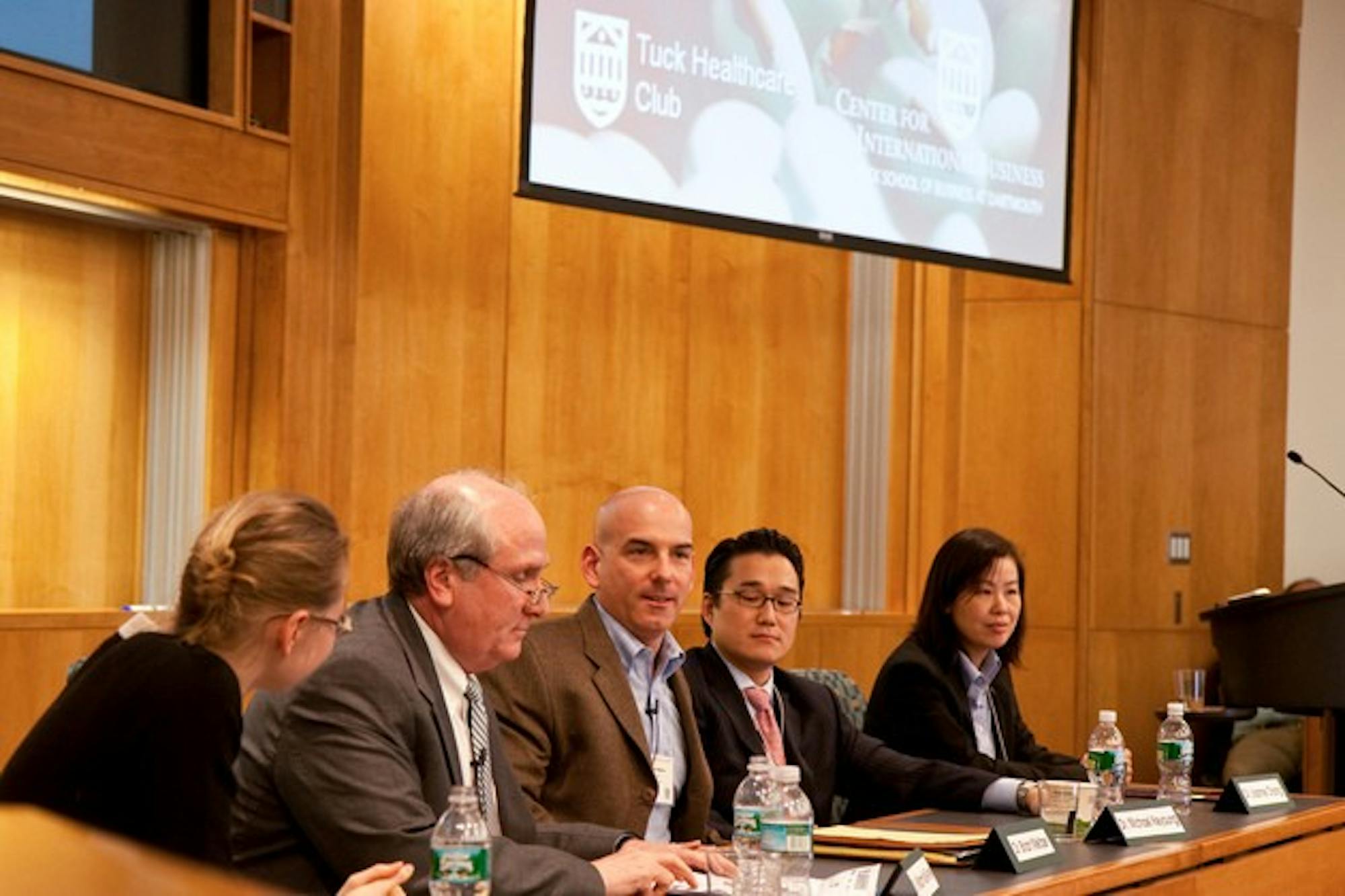
Errik Anderson '00 Tu'07, who moderated the first panel, "Can the Pharmaceutical Industry Find New Paths to Success?" said that outsourcing medical trials can help the U.S. health care industry keep up with its global competitors.
The pharmaceutical industry operates in a linear sequence: research, discovery, pre-clinical trials and clinical trials, Anderson said. It may be more efficient for researchers to outsource parts of this process to other scientists, Anderson said, a method that is increasingly seen as a way to limit the industry's rising costs. Cancer research, for example, requires $2.6 billion to be spent during initial clinical trials, Michael Choukas, president and CEO of Oncopartners, a biotechnology company focused on supporting cancer research, said.
Many speakers agreed that leading academic centers are finding it difficult to meet these expanding financial needs for both sites and patients.
Outsourcing allows for additional specialization for increasingly complex research, panelists said. The "long list of various diseases" simply cannot be tackled in a university laboratory, Choukas said.
His company, Oncopartners, became the first pharmaceutical company to partner exclusively with the Brazilian government. The country serves as a perfect test case, Choukas said, because it has an immense population of individuals who cannot afford newer medical technologies. Consequently, Choukas said, Brazilians are "highly motivated to contribute to clinical trials."
Oncopartners operates within 20 of 42 Brazilian cancer centers, Choukas said. Its principal site, located in Sao Paulo, cares for 100,000 patients per day, Choukas said.
Outsourcing also facilitates new scientific innovation and has the potential to expand flexibility and speed turnaround rates, Preston Hensley, former senior director of Pfizer, said.
Despite the apparent successes of this method, several panelists expressed doubts about certain aspects of outsourcing medical research, saying they are still unsure about how to interact with outsourced research companies while maintaining a sense of independence.
Steve Hutchins, vice president of business development for pharmaceutical company WuXi AppTec, suggested a way that researchers might be able to resolve this issue. WuXi AppTec began as WuXi, Hutchins said, a research company in the field of toxicology. In 2008, WuXi acquired AppTec and began specializing in molecular discovery and research. At that point, the company began outsourcing its research and refashioned its business model. Instead of performing research, WuXi AppTec now operates as a service company, finding and coordinating research for its clients.
"It's really a service-oriented company [now]," Hutchins said.
Additionally, Choukas stressed the importance of gaining efficiency without sacrificing performance. The Food and Drug Administration and European Medicines Agency are still unsure about whether they can rely on foreign data, he said.
Another concern among panelists was whether the current business model can be maintained in a changing marketplace.
"Is the multi-site clinical trial sustainable?" Choukas said.
Rather that altering the current model to fit new developments, companies should create a new business model altogether.
"We're in trouble," he said.
All panelists agreed that streamlining programs to rationalize portfolios is essential.
The conference also sponsored a second panel, "New Value Propositions: Which Innovations Will Win?" in which panelists from several pharmaceutical companies analyzed and discussed innovative consequences within the global, competitive landscape.
The conference was sponsored by the Tuck Center for International Business, the Tuck Health Care Club and the Dickey Center for International Understanding.


