
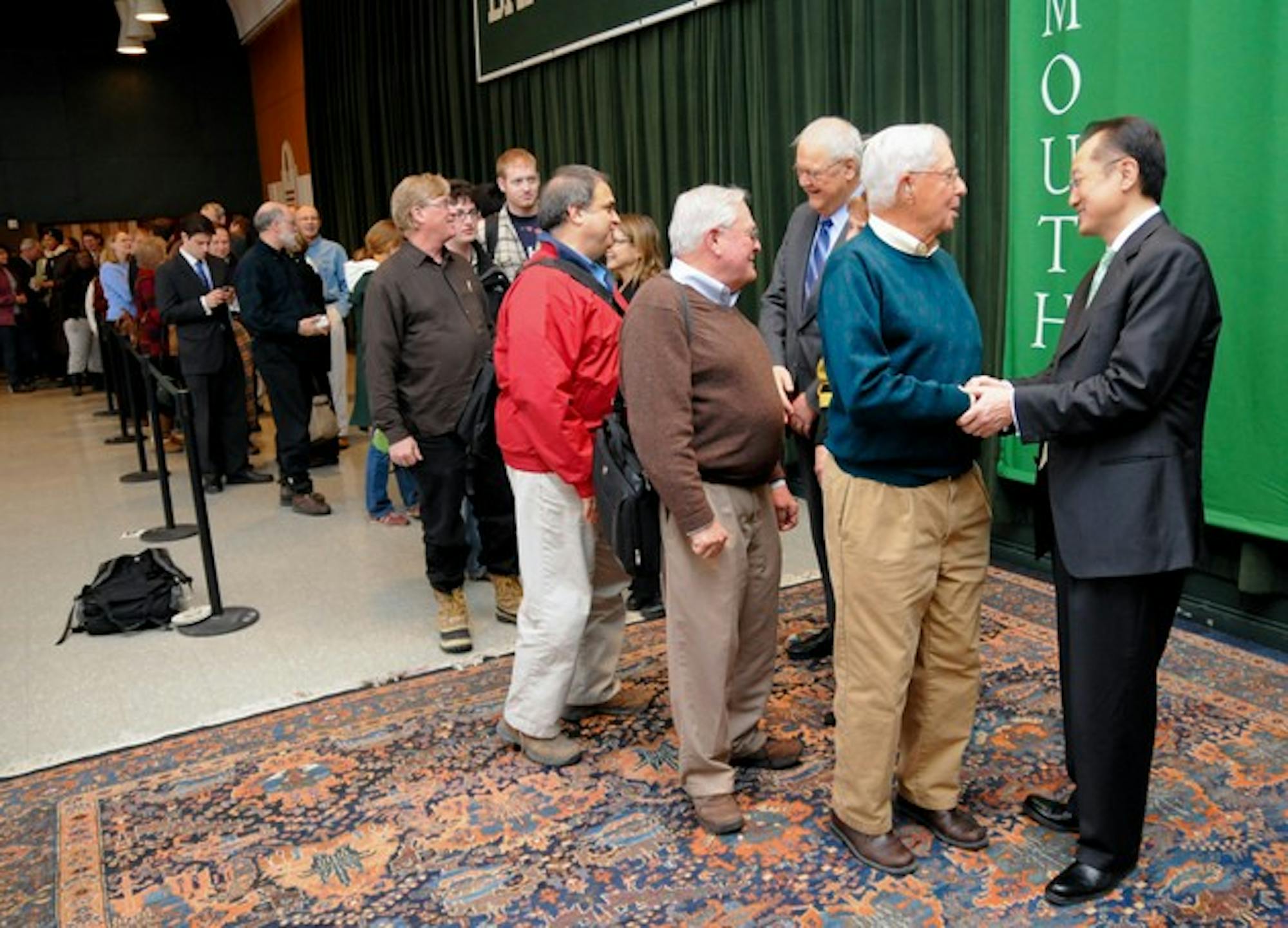
Carolyn Pelzel, vice president of development, said she was optimistic that donors who have supported Kim's work in the past but have not previously contributed to the College may now be interested in giving to Dartmouth. Interest, though, is not the only factor in a donor's decision to give, Pelzel said.
"The other [factor] is having ambitions and funding opportunities that match those interests," she said. "[Kim] brings with him these wonderful contacts, foundations and individuals. It is terrific to have these contacts as part of the Dartmouth landscape, but we need to make sure we have funding opportunities that match the interests of those donors."
Pelzel said she could not predict whether these donors would be focused on funding research.
"It's too soon to speculate on what a donor might want to support," she said. "The new president will want to come on board and work with the faculty and put together ideas that he will want to take to these to those donors."
Brian Lally, vice president of development and alumni relations for Dartmouth Medical School and Dartmouth-Hitchcock Medical Center, said the College president should work with the medical school faculty to determine which research projects can be funded by outside contributors. Lally added that DMS is currently focused on completing the Campaign for the Dartmouth Experience, Dartmouth's College-wide capital campaign.
The campaign will likely be complete by Dec. 31, six months after Kim takes office, Pelzel said. The campaign has raised $1.16 billion as of Thursday, Pelzel said, with a final target of $1.3 billion.
The initiative has not yet received a donation of more than $100 million, a major goal for the College that all other Ivy League institutions have obtained, Pelzel said. She said she hopes Kim's presidency will inspire larger donations, regardless of whether they are received through the capital campaign.
"What produces very large gifts is a combination of many factors and some serendipity," she said. "Sometimes a relationship we began some 40 years ago and we have nurtured over the decades will result in a very large contribution, and it is hard to know at what point over the past 40 years a seed was planted, an idea advanced which ultimately yielded a very large gift."
Pelzel emphasized the importance of unrestricted gifts, contributions not designated for a specific use, in preserving Dartmouth's priorities. Pelzel praised College President James Wright for successfully raising unrestricted funds throughout his tenure. She said she believes Kim will continue to do the same.
"It is clear that [Kim] has bold, ambitious goals, and he has achieved them," she said. "He is going to bring that spirit to Dartmouth and hopefully that will yield some very significant investments."
Kim grew PIH into a large, non-governmental organization partially by soliciting monetary support, he said in an interview with The Dartmouth prior to the announcement of his appointment.
After the organization's founding, PIH received a grant from the Open Society Institute and Soros Foundations Network, an organization started by financier George Soros to promote socio-political activity globally. After receiving the grant, PIH released a study discussing the global effects of multidrug-resistant tuberculosis, according to the PIH web site.
Kim also began to build a relationship with Bill and Melinda Gates during the 1990s. In 2000, the Gates Foundation gave PIH $45 million. The organization used the money to launch a nationwide initiative combatting tuberculosis in Peru and to fund a general clinic project in Russia. In 2002, PIH received a $13-million grant from the Global Fund to Fight AIDS, Tuberculosis and Malaria, U.S. News and World Report reported in October 2005, when they listed Kim and PIH co-founder Paul Farmer among "America's 25 Best Leaders."
When Kim began his work with WHO, initially serving as an adviser to the director-general on tuberculosis, several of his financial backers followed. In 1998, the Soros Foundations funded the Stop TB Partnership, which is affiliated with WHO in Geneva, Switzerland. When promoted to director of the WHO's HIV/AIDS division, Kim assumed increased fundraising responsibilities, as he had to convince numerous countries to support his "3 by 5" initiative, which sought to treat three million people with HIV/AIDS with antiretroviral drugs by 2005,
Kim continued working with PIH during his tenure at WHO. In 2005, PIH was awarded $1.5 million after winning the 2005 Conrad N. Hilton Humanitarian Prize. The same year, PIH launched an anti-HIV/AIDS project in Rwanda as part of a $10-million initiative by the William J. Clinton Presidential Foundation, according to U.S. News and World Report.
Kim's experience advocating for social change and global health will be useful when he begins his tenure as College president, Pelzel said. Kim's message that "the world's troubles are your troubles," echoing former-College President John Sloan Dickey, will resonate with alumni, parents and other donors, she said.


