
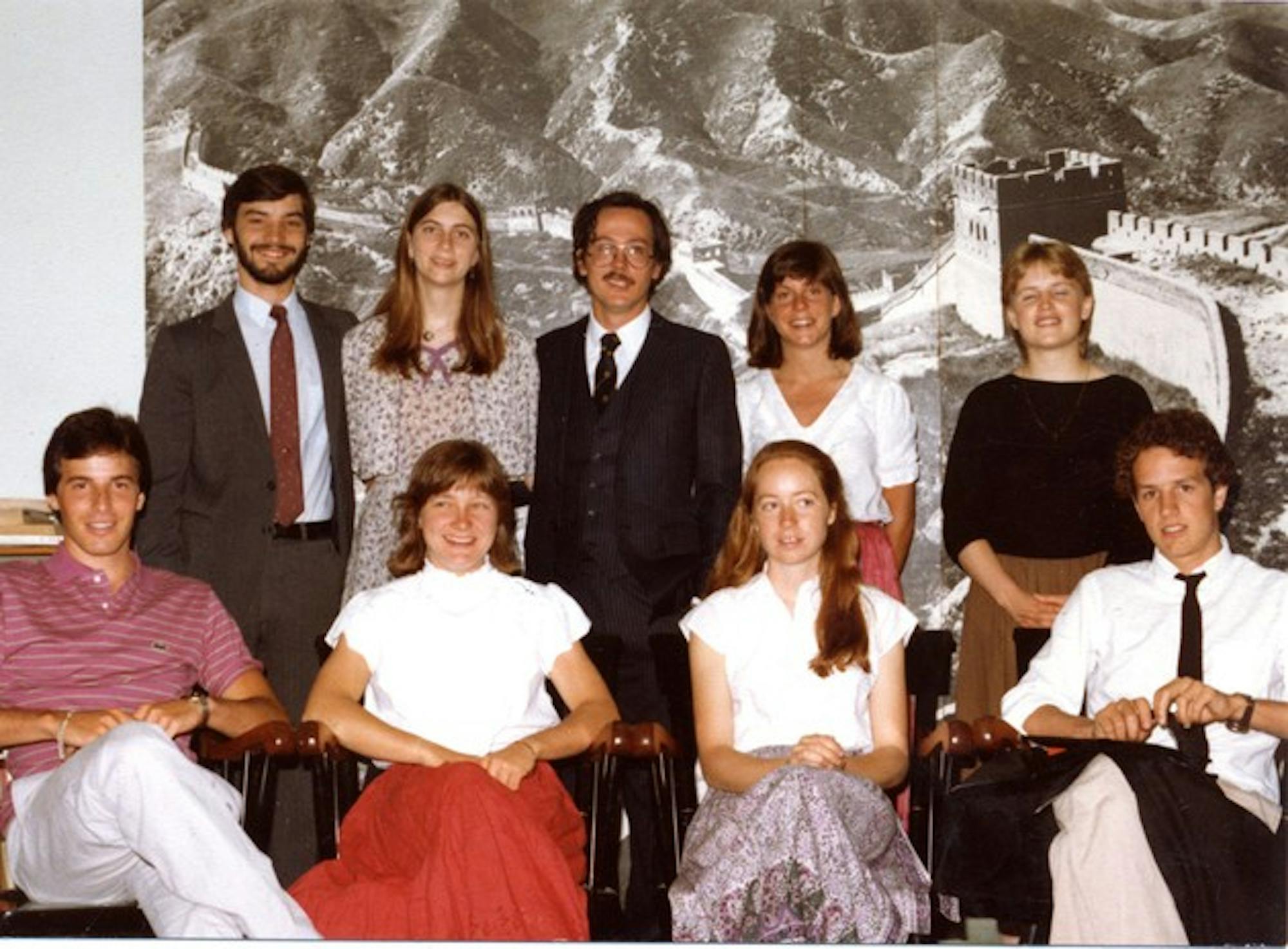
As Asian studies majors and two of the first Dartmouth students to study abroad in Beijing, Gillibrand and Geithner both honed skills that have likely helped them throughout their careers.
Both are remembered by classmates and professors as enthusiastic, talented students and eager travelers who embraced local culture.
Justin Rudelson '83, now a professor in the Asian Studies department, studied in Beijing with Geithner in 1982 and remains close friends with him, he told The Dartmouth. He described Geithner's open attitude towards other cultures and the pair's exploits while navigating a Beijing, which in 1982 had minimal automobile traffic, no taxis and only a few restaurants.
"We only had hot water once a week," Rudelson said. "So the first time the shower room steamed up, this new white paint got transparent, and we could see these anti-American slogans painted in bright red, 'Overthrow the American imperialists,' that kind of thing."
Geithner tried to change negative perceptions of the United States while abroad, Rudelson said, helping organize an international badminton league among his fellow students, which included participants from Sierra Leone, Iran and North Korea.
"We were pretty good," Rudelson said of Geithner's team, which they called the 'American Imperialists' in honor of the shower graffiti.
Geithner and Rudelson also explored the city in their spare time.
"It was a 45 to 50 minute bike ride from where we lived to Tiananmen Square," Rudelson said. "So we'd ride our bikes up behind buses, grab onto the door and have the buses drag us behind them."
Eve Stacey '87, who traveled to China with Gillibrand in 1986, said the senator also embraced Beijing's popular mode of transportation -- bicycles -- with gusto, jetting through the unfamiliar city.
Gillibrand, then known as Tina Rutnik, loved to practice her Chinese by interacting with the local population, Stacey said. She eventually traveled to Tibet and Taiwan and wrote a thesis for which she interviewed the Dalai Lama, Stacey said.
"Tina was pretty fearless about talking to people," Stacey said. "She'd just throw herself into slightly nerve-racking situations."
Chinese professor Susan Blader, who taught both future politicians, said the two were particularly welcoming of new experiences in different cultures. The first Dartmouth program Blader led to China, in 1986, included Gillibrand.
"I was so proud of the four women on that trip," Blader said. "In [1986], China wasn't really ready for foreign students, so they were really roughing it. These were great students, very mature, but they obviously came from much more comfortable backgrounds, and yet they threw themselves into everything and never complained."
Geithner and Gillibrand's friends said that they were both talented amateur photographers, enthusiastically documenting the people and places they encountered while traveling.
Stacey recalled hearing that Gillibrand invited a large group of family and hometown friends to watch a presentation about her trip to China that lasted for hours upon returning from her travels in Asia.
"They both have an ability to see people, which is part of being a talented photographer," Blader said. "I thought Tim was going to grow up to be a photographer."
Rudelson added that he believes that Geithner's experiences living abroad, both as a child and at Dartmouth, shaped his worldview.
"It's remarkable how much China has changed in 20 years," Rudelson said. "Our trip probably shaped his perspective on where China has come from and where it's going."
Although he did not expect Geithner to be a high-profile politician, Rudelson said he knew his friend was thinking about the future while in China.
"Tim was wrestling with the fact that he didn't want to focus on just China his whole life," Rudelson said. "During that time, he decided he didn't want to narrow his focus that much, that he wanted to be involved in things on a bigger level."
Rudelson added that he was glad Geithner focused on big picture economic issues, because even as an undergraduate his talent was evident.
"His knowledge of the world, of the interconnectedness of countries and relationships, was and is really profound," Rudelson said.
Neither Gillibrand nor Geithner's offices responded to requests for comment by press time.


