
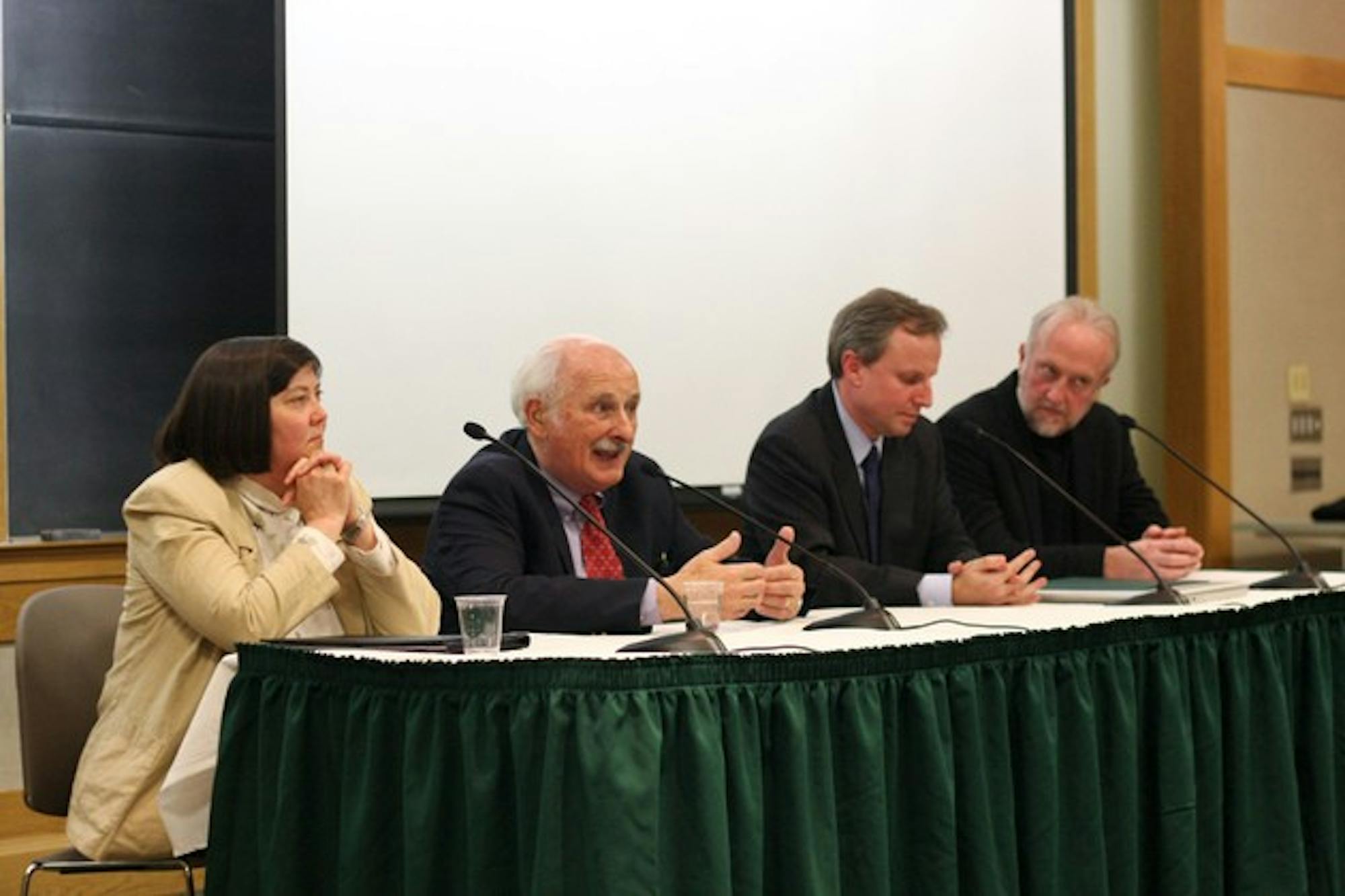
The recent writers' strike was motivated largely by changes in digital technology, panelists said. Unlike film and television studios, writers were not earning additional revenue when programming was made available over the internet, film studies professor Bill Phillips, a member of the panel, said.
"What happened last year is that we decided that the future of media is in digital," Phillips, a writer and WGA member, said.
New digital technology has created confusion surrounding the copyright laws that protect creators' rights, said panel member David Seaman, associate librarian for information management.
"The opportunity that you have to reach audiences, to exploit creative content are different now," Seaman said. "A lot of the copyright laws we have now were written before the copier, before the computer."
Electronic rights have emerged as a new issue in the courtroom as well, Seaman said. In cases like The New York Times Co. v. Tasini and Rosetta Books v. Random House, the court ruled that copyright infringement laws protect electronic versions of articles and books, Seaman said. Companies, as a result, require separate contracts to distribute texts in print and online.
Digital technology has also challenged previous notions of ownership, Phillips said.
"I think that the new technology is what's testing ownership," he said. "Illegal ownership is very hard to stop and has had very real ramifications."
Phillips compared the most recent writers' strike to a writers' strike in 1988. During the "Bloodbath of 1988," as Phillips called it, studios purchased significantly fewer scripts, and writers began to write "on spec," working on their own time and with their own funds.
Strikes are often an important tool for labor unions, especially craft unions like the WGA, economics professor Patricia Anderson, another panelist, said. Labor groups typically resort to negotiated settlements, though, because sustaining a strike can prove to be a significant financial burden for workers and studios.
"There's power that comes from the threat of a strike," Anderson said. "Strikes are costly. It's important to realize that this relative power that comes from the threat of a strike doesn't necessarily mean that we're going to see a strike."
Mediation and arbitration can often avoid such strikes, panelist Everett Marder, an attorney and arbitrator, said.
"It's not always easy," he said. "It takes some kind of negotiations, and negotiations don't always result in an agreement of decision between the parties.
The lecture, moderated by sociology professor Marc Dixon, was sponsored by the Dartmouth Centers Forum, which this year is themed "conflict and reconciliation," according to Patricia Palmiotto, director of the Allwin Initiative for Corporate Citizenship at the Tuck School of Business. The Allwin Initiative is a co-sponsor of the Centers Forum.


