
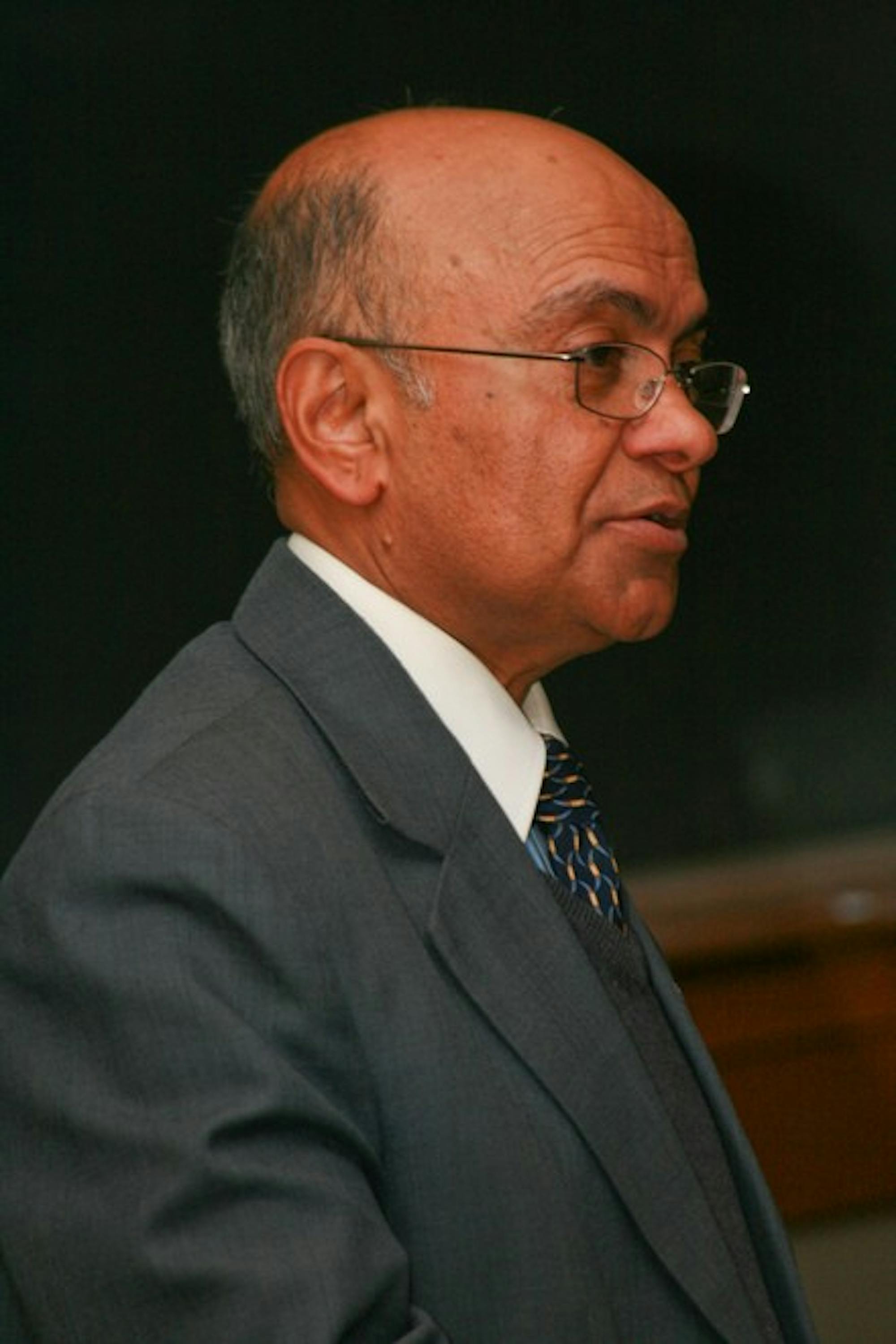
Gautam argued that adults' concerns about "human rights and human wrongs" are driven by their focus on their children.
"Why do we care about climate change?" Gautam asked the audience of about 60 members of the Dartmouth community. "Isn't it because w e worry about the world our children will inhabit?"
Parents want their children to grow up to be "healthy, well-educated and productive," Gautam said.
Gautam explained that giving aid to children in developing nations benefits all of society.
"Nothing is more disempowering to parents than to see their children die," Gautam said, adding that having healthy children allows adults to focus on demanding education, social services and other improvements to the family's quality of life.
Improved child health care also leads to lower population growth, Gautam said.
"People begin to have smaller families and fewer children only when they feel confident their first children will survive," Gautam said.
Gautam referenced the trend in his native Nepal, where, when he left for Dartmouth in the late 1960s, 400,000 children were born annually, and a quarter of them died before reaching the age of five. When he returned to Nepal in 2007, 800,000 children were born each year, but only 50,000 died before age five, a marked improvement. On average, six children were born per family in Nepal in the 1960s, whereas in 2007 the average had fallen to three, Gautam said.
Gautam credited immunization, oral rehydration therapy, vitamin intake, increased education for girls and women's empowerment as factors contributing to the improvement of children's health across many nations.
UNICEF, where Gautam worked for 35 years, used a "two-pronged approach" to improve child health care: speaking directly to heads of government about immunization programs and enlisting religious leaders, Hollywood celebrities and athletes to promote its initiatives, he said.
That campaign continues today, Gautam said, citing the contributions of actress Angelina Jolie and tennis star Roger Federer.
Despite the current global financial crisis, Gautam said he believes the world can work to improve children's health.
"We should not accept the indignity of absolute poverty as inevitable," Gautam said.
Developing nations would require $50 billion of assistance from developed nations each year for child health care initiatives, he said, comparing this to the $1 trillion spent worldwide on annual military expenditures.
"Malaria, diarrhea and measles account for a majority of child deaths," Gautam said, explaining that "most of these deaths can be prevented [for] pennies, or at least nickels and dimes."
Gautam criticized the United States specifically for its failure to ratify the United Nations' Convention on the Rights of the Child, which he described as the "most universally ratified human rights treaty in the world."
The United States and Somalia are the only U.N. member states not to have ratified the treaty, though it was signed by former Secretary of State Madeline Albright in 1995. Fourteen years later, the treaty remains unratified by the U.S. Senate.
The United States' handling of the treaty "baffles" many non-Americans and Americans alike, Gautam said.
Gautam encouraged Dartmouth to join the coalition of civil rights activists, religious groups and academic institutions pushing for the ratification of the convention under President Barack Obama's administration, invoking the famous legal defense of Daniel Webster, Class of 1801, before the Supreme Court and the College's history of "sticking up for the rights of the underdog."
"It would be very fitting for Dartmouth to take up the lead among American universities for the cause of the little boys and girls of the world, the cause of the convention on children's rights," Gautam said.
Acknowledging the abundance of problems facing the College and the world as a whole, Gautam said protecting children's rights, which he describes as "the obligation of all enlightened adults" in democratic societies, is urgent.
"Most other problems can wait -- children cannot," Gautam said. "They only have one chance to grow."
Gautam, in an event on Thursday, said his years as an undergraduate at Dartmouth in the 1970s contributed to his interest in international development. Guatam was born and raised in a small Nepali village and applied to Dartmouth after meeting an alumnus who was in the Peace Corps in Nepal. After graduating from the College, Gautam worked for UNICEF, where he served for 35 years as both an aid worker and as a senior manager.
Gautam is this year's recipient of the Tucker Foundation's Lester B. Granger '18 Award for Lifetime Achievement.


