
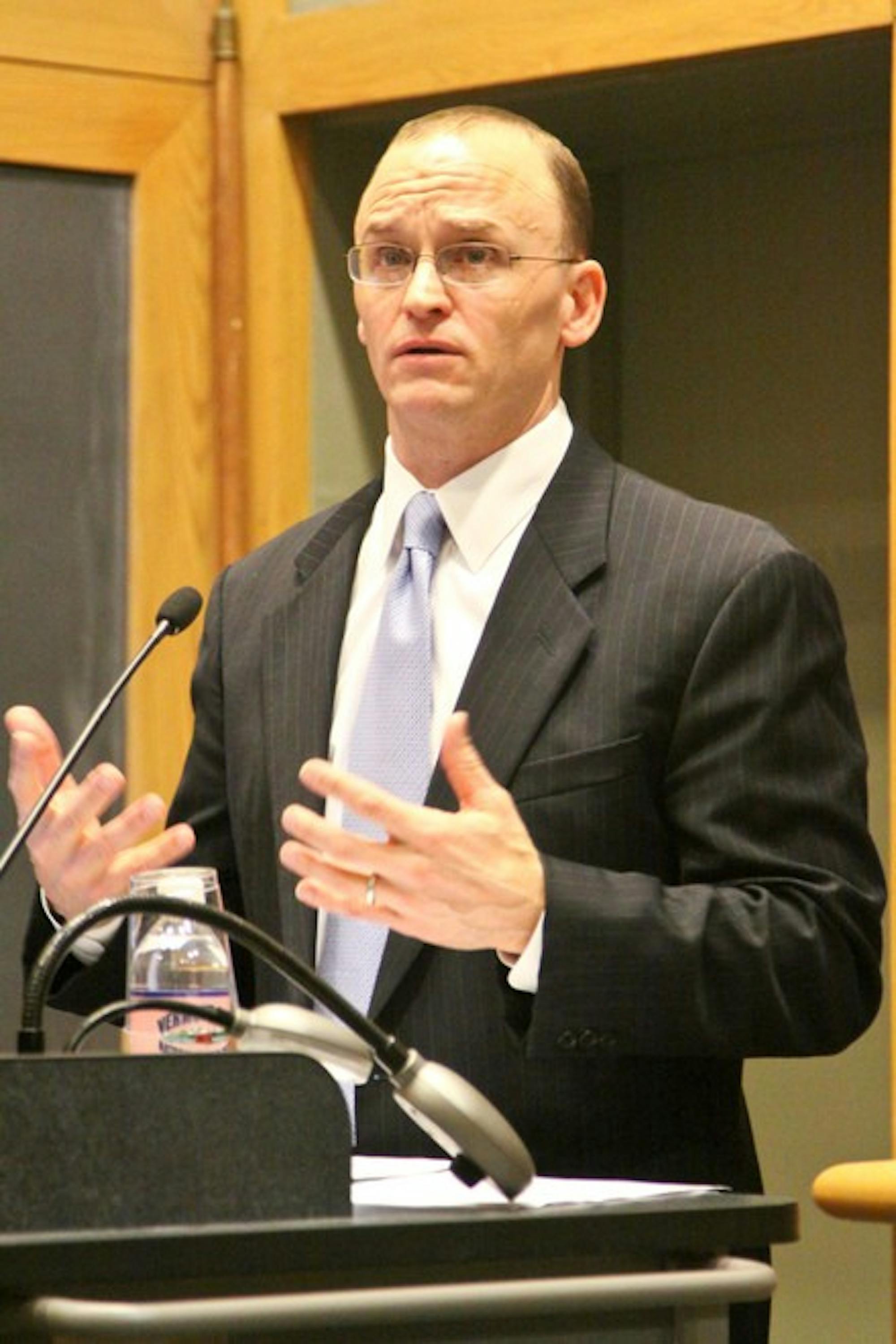
The Office of the Solicitor General represents the United States in all Supreme Court cases.
The Supreme Court in recent years has chosen to hear fewer cases than in the past, but its decisions have more frequently established important precedents, touching on issues ranging from the death penalty to intellectual property rights, Garre, who served under President George W. Bush, said.
The Office of the Solicitor General plays a role in about two-thirds of all cases the Supreme Court hears, he said. While the United States may not be a party to all of the cases, the lawyers in the Solicitor General's office can file a "friend of the court" brief in support of either side of the case, Garre said.
"The lawyers in the office have to decide: does the government have an interest in the case, and if so, what that position might be?" Garre said.
The Solicitor General is often described as "the 10th Supreme Court justice," as the Court often invites the counsel to provide an opinion on a case, Garre said. In this role, the Solicitor General functions as an officer of the court.
"Only it's not really an invitation, because you have to respond to it, and you don't always want to because they are usually these sensitive cases," Garre said.
The lawyers of Solicitor General's office have assumed additional responsibilities in the wake of the Sept. 11, 2001 terrorist attacks, Garre said. Lawyers who normally argued only in front of the Supreme Court are now prosecuting criminal cases relating to suspected terrorists in the lower circuit courts, including the trials of Guantanamo Bay detainees.
The Solicitor General's office experiences less turnover of personnel than do many other federal offices, Garre said, and most lawyers work under many presidential administrations. These "career lawyers" allow the office to operate independent of any one presidential administration or political party, Garre said.
His office's defense of the McCain-Feingold Act, which placed restrictions on political campaign financing, exemplifies the office's independence, Garre said, as Bush and many Republicans opposed the law.
This case also demonstrates that the solicitor general must defend the constitutionality of Congressional legislation, regardless of his or her personal beliefs, Garre said.
"The way this relationship manifests is the solicitor general has a duty to defend the constitutionality of legislation," he said
Prior to his appointment to the Solicitor General's office, Garre served as a law clerk to then-Chief Justice William H. Rehnquist, which he said helped to prepare him to argue in front of the Supreme Court, and was a partner of a Washington D.C.-based law firm.
"As a law clerk, you attend a lot of oral arguments, and you get a better sense of how justices approach cases and the back and forth between the justices and lawyers," he said in an interview with The Dartmouth before the event.
Garre was appointed to be solicitor general in 2008 after he served three years as principal deputy solicitor general, arguing 27 cases before the U.S. Supreme Court during his career. After graduating from Dartmouth as a government major, Garre attended George Washington University Law School, where he is now a professor.
Garre's address, "The Solicitor General and the Supreme Court," was this year's Thurlow M. Goodman 1906 Lecture.


