In this year's winter rush process, as in years past, a contingent of the potential new members were athletes that perhaps did not want to rush during their fall season or were off last term. During the rush process, many athletes grapple with how much their athletic identity will contribute to their future Greek identity.
Although some speculate that that older teammates influence their younger counterparts to join a certain sorority, Ally Dutton '12, a defender for the women's soccer team, said that in her experience, this influence has been negligible.
"I would say in the past there was much more influence from older teammates and much less diversity among the team," she said. "Soccer girls were really in only two sororities. In the past few years, however, this has changed and we now have girls in several sororities. Personal choice and comfort is definitely encouraged by the older girls on the team."
Sue Schmitz '10, a member of Kappa Delta Epsilon sorority and a defenseman on the women's ice hockey team, echoed Dutton's sentiments.
"As a member of the ice hockey team and KDE, I don't try to pressure my teammates to join my sorority," she said. "I encourage them to go through the rush process with an open mind, meet a lot of new people, and decide which house they feel most comfortable at and where they see themselves fitting in."
Although older teammates do not necessarily push their younger teammates to join a certain sorority, however, the upperclassmen still show them the ropes of college life and help them to become comfortable in their new environment -- which may translate into increased comfort in a certain Greek organization, some female athletes said.
"A few of my teammates were already in KDE when I was rushing, but I also knew a lot of other sisters beforehand," Schmitz said. "I guess it was a little bit of an extra security that I had a few teammates already in KDE, but they never tried to persuade me to join or influence me in any way."
Schmitz added that she did not feel pressured to join KDE because some of her older teammates were already members.
"I didn't feel any particular obligation to join a specific sorority because of the sport I play," she said. "I did get to know KDE the best out of all the sororities because of the time spent there with teammates, and knew from that that it was the house I wanted to join."
KDE seems to be a popular choice among female athletes.
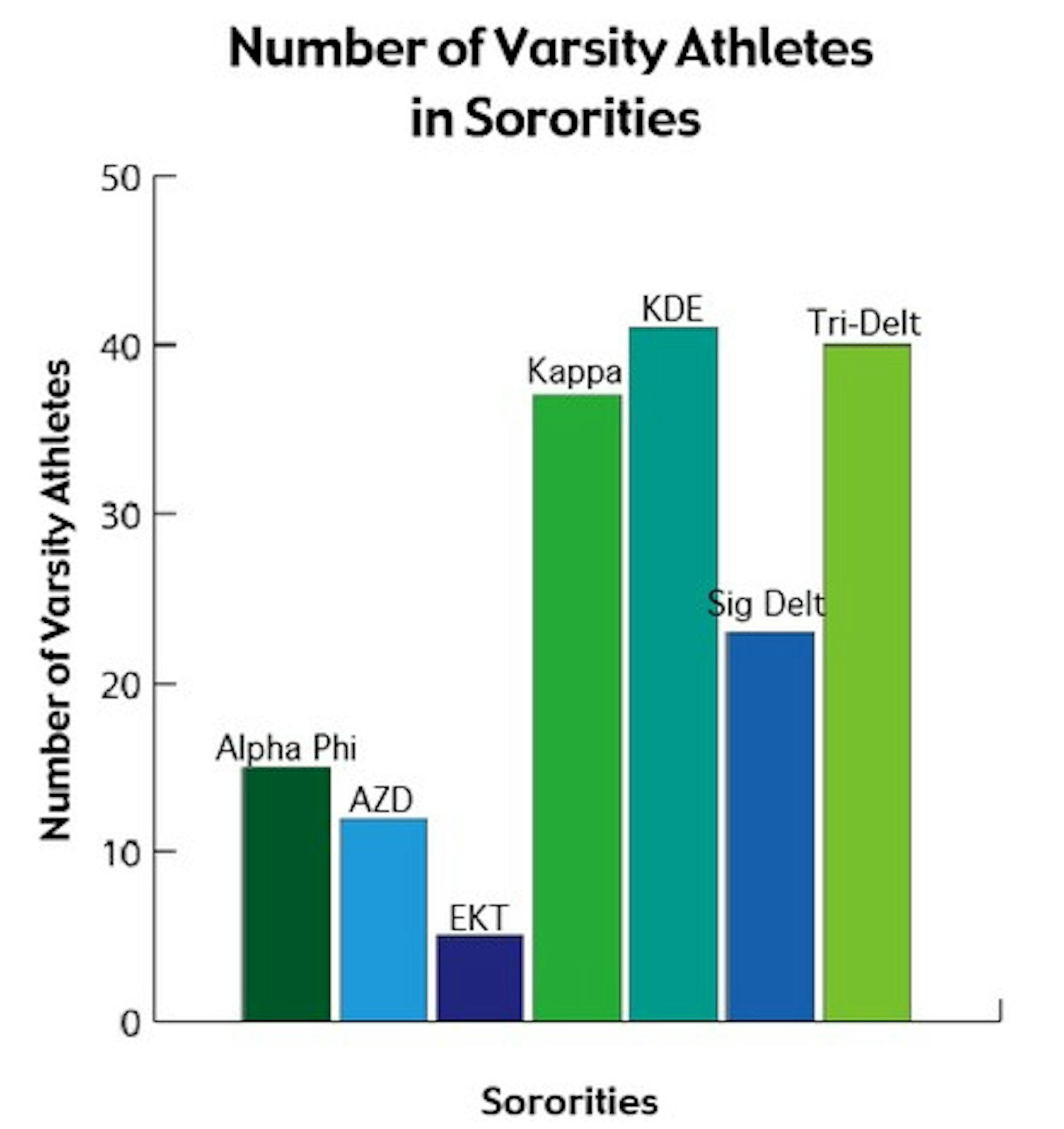
The organization leads all other Dartmouth sororities with 41 female athletes in its membership. Delta Delta Delta sorority and Kappa Kappa Gamma sorority follow close behind, with 37 and 35 female varsity athletes, respectively. Epsilon Kappa Theta sorority's membership includes the fewest number of varsity athletes, at five.
These numbers were obtained by comparing membership rosters provided by a member of each sorority, with the varsity sports rosters on DartmouthSports.com
Sigma Delta sorority falls in the middle of this ranking, with 20 varsity athletes, while Alpha Phi sorority, Alpha Xi Delta sorority and Theta all have less than 20 varsity athletes in their membership.
Sigma Delt, which has the most varsity crew members among its membership and was once commonly thought of as "the crew sorority," has found a change of identity in recent years, said Kristen Rounds '09, the current president of Sigma Delt.
Rounds also said that the spectrum of varsity athletes in Sigma Delt's membership has expanded. The sorority now includes members of the varsity lacrosse, squash and water polo teams, among others.
The athletic diversity in Sigma Delt evidences the fact that older teammates do not pressure their younger teammates to join a certain sorority, Rounds said.
Sigma Delt in no way solicits membership from specific athletic teams, Rounds said, and sister athletes do not "recruit" for the sorority from their respective teams.
Rounds said she believes that older sisters on varsity sports teams host events and invite their teammates to spend time at their sororities so the younger members become comfortable there, and remember that feeling during rush.
This perceived familiarity, however, does not translate into any special treatment during the rush process, Rounds said. Any potential new member that walks into Sigma Delt during rush is considered through the same process, she said, whether they are athletes or not.
The rush process can be grueling for anyone, and can especially put a strain on athletes, who already maintain jammed-packed schedules, said Melissa Lokensgard '09, vice president for the Panhellenic Council. Panhell tries to be responsive to the needs of these students, Lokensgard said.
"We try to arrange special schedules for athletes, and make as many accommodations as we can," she said.
Lokensgard said that rushing is a time commitment like any other made by students at the College, and said that, although it can take time away from other activities, many athletes show enthusiasm for the process.
"The fact that they know upperclassmen because of their teammates really helps," she said. "It allows them to be comfortable, and not intimidated by the exposure to so many upperclassmen."
Lokensgard, who is a member of Alpha Phi, said many athletes do not know if they should join the same sorority as their teammates or branch out, and join a different one.
"They always come to me and ask for my advice, and I always tell them that they should join the sorority that makes them most comfortable," she said. "They spend so much of their time with their teammates, they wouldn't be losing anything, but rather, they'd be getting to know new people."
Lokensgard said she encourages the diversity of athletes within various sororities, because it is beneficial for athletes to know people outside of their specific sport.
Lokensgard pointed out that a prime example of someone who did not rush the same sorority as her teammates can be found in the current president of Kappa, Nell Beattie '09, a former member of the women's crew team.