
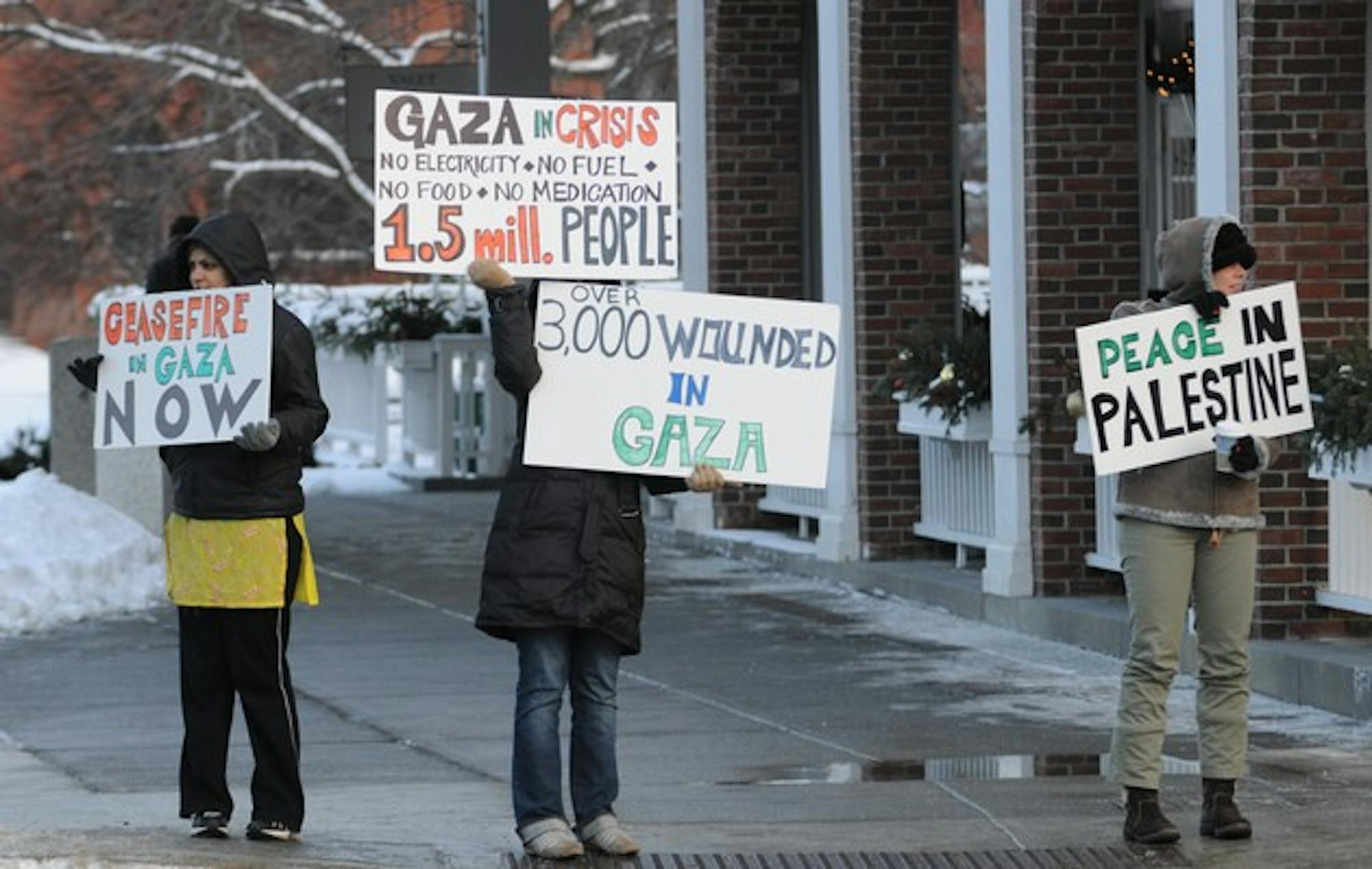
"I'm actually a first-year medical student, and I read about the situation in Gaza," Mahmood said. "The major hospital there has 600 beds. There are over 3,000 wounded, and the hospital doesn't have medicine. They barely have any energy and food."
Mahmood joined community members and other students in a demonstration on Friday at the intersection of Main and Wheelock Streets. Protesters carried signs that called for peace in Palestine and cited the number of Palestinians wounded or killed as a result of the violence. Demonstrators said they were motivated primarily by humanitarian -- not political -- concerns.
"We are demonstrating for a humanitarian issue," Tafaoul Abdelmagid '11 said. "Nothing about this is political. We feel it's our duty and role to support peace in Palestine."
Mackenzie Howell '10, who is currently volunteering at a home for the disabled in Jerusalem, described the current mood in Israel as subdued and restrained.
"The war had begun a few days prior to when I left, and my parents freaked out and asked me not to go, but the danger was mostly in the south of Israel," Howell said in an e-mail to The Dartmouth. "I am in Jerusalem for the term, so I felt comfortable coming. I couldn't be happier that I am here."
Israelis in Jerusalem have been paying close attention to the news, Howell said. All Israelis serve in the military -- women for two years and men for at least three -- so everyone in Israel knows someone currently serving in Gaza, she added.
"Nobody wants this war, but most people here understand that it is necessary," Howell wrote. "They hate that they are perceived by much of the world as aggressors, as Israelis really are a peaceful people who wish that the rest of the world would just leave them alone to live their lives without being afraid. The unfair media coverage really bothers me, and I'm not even Israeli."
Rabbi Moshe Gray, the director of Dartmouth's Chabad chapter, said he observed similar sentiments among the Israeli people when he recently visited the country. Gray led approximately 40 students for a 10-day annual birthright trip, which takes Jewish youth to Israel, from Dec. 15 to Dec. 25. The group left before the violence began.
"The mood was more or less that something has to happen," Gray said. "There were more rockets coming in further and further into Israeli territory, being fired sort of indiscriminately into Israeli towns. People wanted an end to this because the attacks were more brazen than ever before."
Gray estimated that five to seven Dartmouth students are from Israel.
Julie Norman, a visiting fellow at the John Sloan Dickey Center for International Understanding who researches non-violent resistance in the Palestinian territories, has found similar frustrations in her research working with young Palestinian refugees. She described the conditions in Gaza as urgent and deteriorating.
"I have interviews with citizens that are finding very creative, non-violent ways of directly resisting the occupation," Norman said. "This goes beyond rocket attacks because they are going to great lengths to improve their lives ... I know from Palestinian friends and contacts that there are a lot of feelings of frustration, deep sadness and sympathy for the people [in Gaza]."
Norman spoke to one U.S. family living in Gaza that said the Israeli blockade of the Gaza Strip had made it difficult for them financially. The family told Norman that they are approaching the situation with "soummoud," an Arabic word meaning steadfastness and survival despite difficulties, she said.
"I think obviously the conflict has caused a lot of suffering for civilians in both communities for the duration of the conflict," Norman said. "Because of the media, we see it from the point of those in command, not so much the people most affected on the ground. It is often so hard for people depending on their location and ideologies; they are caught in the middle without anything to do with politics."
The Dickey Center is coordinating a Middle East Forum in response to the current increase in violence, according to Norman, who is helping to organize the group.
The lunchtime discussion will allow students to articulate their views about the Middle East. Norman said she would like to bring in Dartmouth professors and outside speakers to share their expertise at the discussions.
The current violence began after a six-month truce between Israel and Hamas expired on Dec. 19, 2008. Hamas fired rockets into Israel's southern towns and cities on Dec. 24 after Israel did not lift its blockade on Gaza. Israel retaliated with airstrikes on Dec. 27, and Israeli Defense Forces began a ground invasion on Jan. 3. Both sides rejected a truce recommended by the U.N. Security Council last Friday. Approximately 900 Palestinians have died in the current conflict, according to the Palestinian Ministry of Health, as well as 13 Israelis, according to Israeli officials.


