
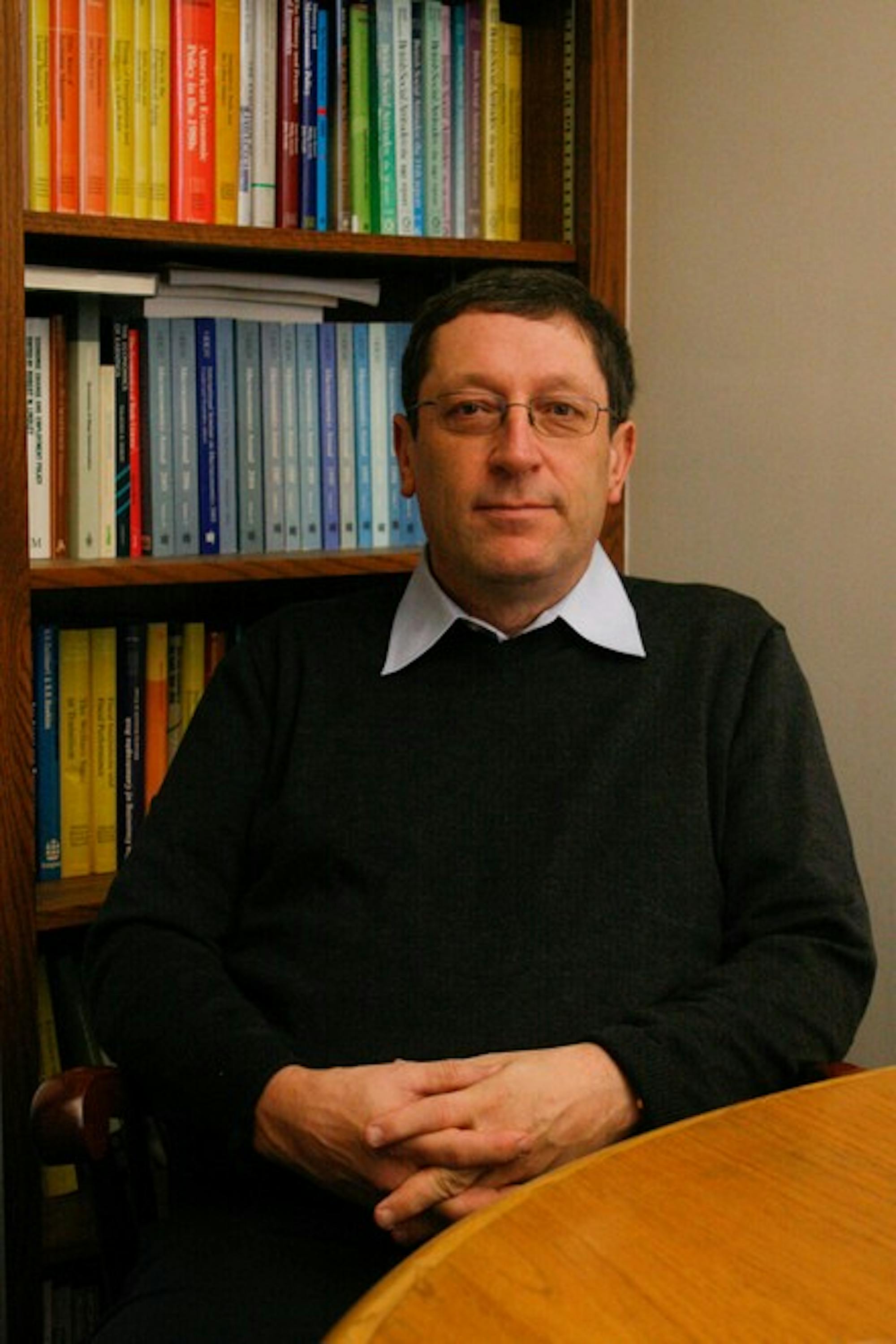
"Dartmouth gave me leave for three years, and commuting has been exhausting," Blanchflower said in an interview with The Dartmouth.
Blanchflower, who said he wants to share his experience with the Dartmouth community, plans to resume teaching at the College, although he did not know exactly when he will start.
"[Students] have the opportunity to talk to someone who has been right in the middle of it," Blanchflower said, referring to the current economic crisis. "This is probably the biggest event of our lives apart from a war, and it was actually a bigger issue in the election than the war."
As a member of the MPC, Blanchflower works to set interest rates based on regional economic data, that help to control inflation.
He has consistently voted for rate cuts to avoid recession, which has often put him at odds with the rest of the committee. Seen by many in England as having predicted the ongoing recession, he warned in a December 2008 Royal Economic Society Paper that unemployment in Britain could surpass three million during the current economic crisis.
Blanchflower had the opportunity to change policy directly in 2008 when he worked with colleagues worldwide to coordinate an international interest rate cut.
"Governments didn't know; the president didn't know; the prime minister didn't know," Blanchflower said. "We independently went and made this decision."
Blanchflower also participates in what he calls "the economics of walking about," in which members of the MPC travel throughout Britain four to five times each year to visit companies and manufacturers.
MPC members are more visible than their counterparts on the Federal Reserve, Blanchflower said. While members of the Federal Reserve Board receive information primarily through banks in their districts, Blanchflower has met directly with local banks, windmill makers, chambers of commerce, shipyards and bus manufacturers to gather data on the ground.
"It gives you a better sense of what's happening now," he said, adding that the MPC's research has revealed economic trends before they were confirmed by hard, economic data.
Blanchflower said his background in applied economics coupled with his experience with both the British and American economies helped him to understand current economic trends and allowed him to predict how changes in the United States' economy could affect the United Kingdom. "It's a common shock -- the U.S. went first, the U.K. went second, and Europe and other parts of the world are following," he said. "It makes it very hard for a single country to be able to say, 'We can work our way out of it, because it in part depends on what everyone else does."
Dartmouth economics professor Bruce Sacerdote said Blanchflower's ability to use new data sources and look at the problem in different ways also contributed to his understanding of the current economic climate.
"We found ourselves in this really unusual and shockingly bad situation where none of our basic models apply, and none of the data from the past 15 years apply in a simple way," Sacerdote said. "But [economic problems] are less bad because he was there."
Sacerdote said Blanchflower's first-hand knowledge of the financial crisis will be a valuable resource for students.
"People are often like, 'Why does Dartmouth go through so much trouble and expense to be a research institution and have top-notch faculty and have people doing top practice and work in their fields?'" Sacerdote said. "This is exactly why. Here we are in the middle of a financial crisis, and students are going to be in touch with someone who was on the front line."


