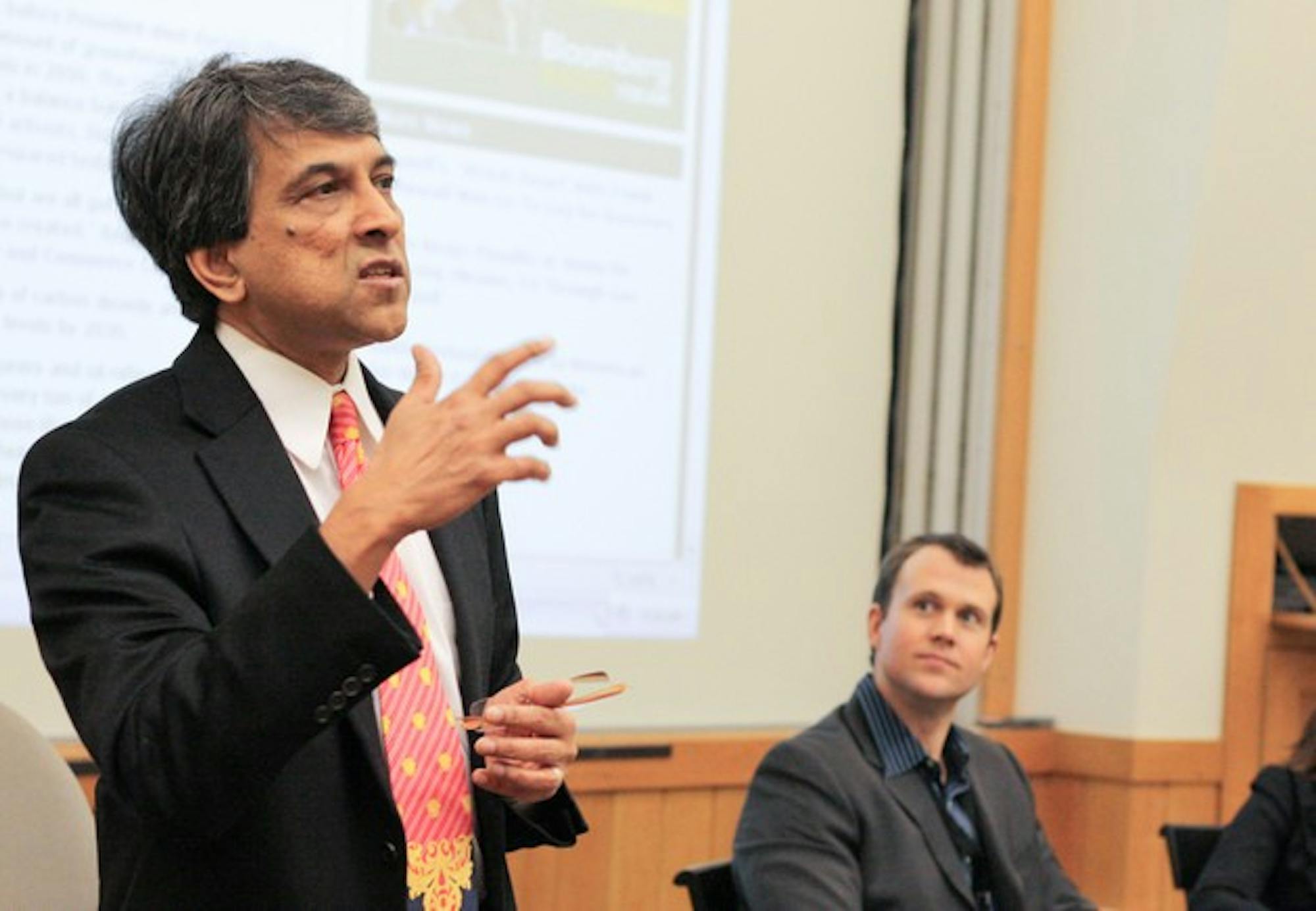
The conference, "Is Capitalism Sustainable?," examined whether capitalism can be maintained as an economic system, particularly in light of the current economic crisis, and whether capitalism promotes environmentally friendly business practices. The conference included six panel discussions, each of which focused on a separate perspective of sustainability as the term relates to both economics and "green" enterprise.
Part of the conference focused on sources of renewable energy and society's perceived failure to transition to "clean energy."
Panelist Jim Lang Tu'89, former president and chief operating officer of Cambridge Energy Research Associates, said society must draw upon all potential forms of renewable energy, instead of searching for one source of renewable energy to meet society's future energy needs. In addition to considering the issue of environmental and economic sustainability from a business angle, the panel, "Clean Tech: Overcoming Barriers to Economically Sustainable Renewable Energy," also discussed the relevant legal and technical viewpoints.
Thayer School of Engineering Dean Joseph Helble, who moderated the discussion, said he was surprised by the diversity of the issues raised at the event.
"The panelists' ability to engage the audience in thinking about issues of importance around the electronic grid was particularly effective, because it's something most people don't really think about," Helble said.
The conference also highlighted the importance of developing new technologies to increase the environmental and systemic sustainability of capitalism. Another panel, "Product Innovation and Supply Chains: Creating Value for the Next Generation,"
explored green products' potential to contribute to economic growth.
Jack Robinson, president and chief investment officer of the Winslow Management Company, said he found this panel to be particularly informative.
He said the discussion "opened up his eyes" to the role of product innovation and supply in making capitalism sustainable, and said he believes that more must be done to make product development environmentally sustainable.
A panel coordinated by Alex Rosati Tu'10 focused on socially responsible investing.
The discussion aimed to investigate whether an investment fund dedicated to socially responsible companies can generate substantial returns, Rosati said. The panel could not come to a consensus on this idea.
"We obviously didn't reach a conclusion to our question of the value of socially responsible investing, as that is a debate that will continue for a long time," he said. "But we did address many of the central issues on how, by thinking about society, investors can fatten their wallets."
Conference participants also discussed carbon offsets, green real estate and the current job market.
Panels attracted audiences between 50 and 100 students from the Tuck and Thayer Schools, as well as community members.
The conference was coordinated by students from the two graduate schools.