
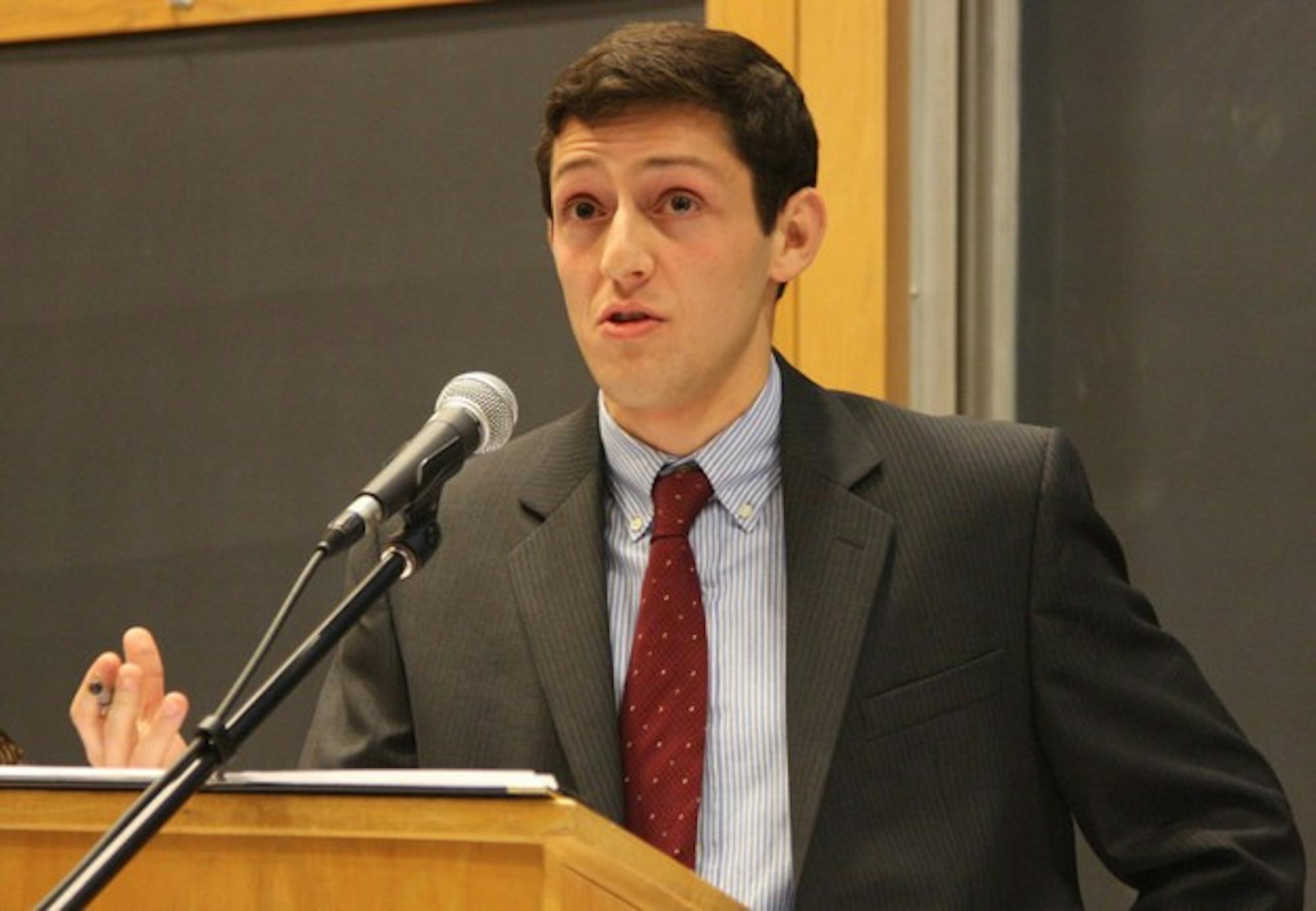
The debate, moderated by government professor Sonu Bedi, featured three College Democrats and three College Republicans who represented presidential candidates Senators Barack Obama and John McCain, respectively.
Jennifer Bandy '09, president of the Dartmouth College Republicans, and David Imamura '10, president of the Dartmouth College Democrats, went head to head in spirited exchanges on foreign policy and potential Supreme Court nominations.
Bandy argued that McCain's foreign policy experience, military service and ideological positions qualify him to be the country's next commander-in-chief.
Imamura responded, saying that, while he respected McCain's military service, Obama has shown superior judgment on issues like nuclear proliferation in North Korea and Iran and the wars in Iraq and Afghanistan.
"Right now, America's really at a crossroads in the election," Imamura said. "We're going to decide where foreign policy goes for the next term, and we're looking at a president and a party who have completely dropped the ball in Iraq, who have completely dropped the ball in terms of Afghanistan, who have completely dropped the ball in terms of nuclear proliferation -- and on the other hand, we have Barack Obama, who does not necessarily have military experience, but who had the judgment that, when the cards were down and the war in Iraq was an issue, even when his own party was in favor of going into Iraq, Barack Obama said no."
Bandy countered that Obama is severely lacking in judgement.
"Let's take the case of Russia's invasion of Georgia, which violated territorial sovereignty, which violated international standards," Bandy said. "And his response was, 'Well let's wait and see, we don't really know what caused it.' I'm sorry but John McCain came out, he spoke to [Georgian President] Mikhail Saakashvili on the phone. He said, 'Today we are all Georgians.' That is the kind of leadership we need."
Zachary Moore '09 of the College Republicans and Deanna Portero '12 of the College Democrats debated education, trade and health care. They brought up specific policy issues but primarily focused on the ideological differences between the two parties.
"Both sides want health care to be universal -- we just differ in what's the best way to do this," Moore said. "Do we want a kind of government bureaucracy to run it, or do we want individual families and doctors making the decisions? John McCain's plan will let individuals and families chose the doctors and the type of health care they need without big government getting in the way, and this is the best way to provide all Americans of any economic class and of any state in life with the best health care."
Portero responded that the current health-care system in the United States is poorly defined, evidenced by the fact that America spends twice as much on health care as other Western countries but its citizens are less healthy in comparison. As president, Obama would streamline health-care information systems, stop basing physician pay on number of procedures performed and spend more money on preventative care, she said.
Both Moore and Portero said their candidates support free trade with careful regulation, but Portero argued that Obama's policies are much safer, while McCain's would damage the economy. Moore said that Obama's tax policies will have a self-sanctioning effect, and will hinder economic growth.
"When we're angry at a country, when we want to punish a country, what do we do?" Moore asked. "We impose sanctions on them. Why should we impose this on ourselves voluntarily?"
Moore and Portero also drew sharp distinctions between the candidate's positions on education.
Moore said that McCain's support of vouchers and charter schools stems from his desire to expand programs that have worked in pilot areas, such as Washington, D.C., to the rest of the country. Vouchers and charter schools increase parental choice and involvement in education and decrease government bureaucracy, Moore said.
McCain has based his plan on flimsy analysis, Portero countered. Only a small set of unique students are able to make use of vouchers and can enroll in charter schools, she said.
Vouchers and charter schools are a simple, short-term attempt to solve a complex, long-term problem, Portero added. Obama wants to reform education by providing scholarships for secondary education, increasing teacher pay and reforming evaluation processes, she explained.
The final debate featured Greg Boguslavsky '09, chair of the New Hampshire College Republicans, and Tay Stevenson '09, secretary of the College Democrats of America, and focused on the economy and climate change.
Boguslavsky argued that McCain has the most measured and useful economic philosophy, and denied that the Republican nominee was completely anti-regulation.
"The biggest difference is what drives the economy -- for McCain, it's not just completely anarchy," Boguslavsky said. "In May 2006, he wrote a letter to the chairman of the senate banking committee and the then-majority leader [Sen. Bill Frist, R-Tenn.,] calling for increased regulation of Fannie Mae and Freddie Mac. It was signed by 18 other Republicans, including, incidentally, [incumbent Republican Senatorial candidate from New Hampshire] John Sununu, but not a single Democrat. They didn't really care. For John McCain, it's market forces. For Barack Obama and the Democratic Congress we're about to get in this coming election, it's about the government."
Stevenson said that Boguslavsky misrepresented the effects of McCain's conservative economic philosophy.
"The big point Greg's trying to make right now is that basically a rising tide will raise everyone up," Stevenson said. "Republicans are going to increase the floodgates and basically everything's going to go up, everyone will get more wealthy. This is what conservative economics is all about -- it's about the idea that you need to create more wealth indiscriminately."
"What he doesn't tell you," Stevenson added, "is that not everyone has a boat. In fact, the vast majority of people are sitting there, treading water, trying to struggle not to drown. And what the Republicans want to do is they want to take away people's life jackets. They want to take away the safety nets that a 'big government' offers."
Concerning climate change, Boguslavsky argued that McCain has demonstrated his willingness to move beyond party lines with climate change legislation that he and Sen. Joe Lieberman, I-Conn, proposed in 2002, 2005 and 2007.
McCain's acknowledgment of the problems of global warming and his willingness to implement cap-and-trade programs was admirable, Stevenson said, but his plans would bring too little change too late. Obama will challenge and enable the country to move beyond its dependency on fossil fuel and other unsustainable energy sources, Stevenson explained.
Most students interviewed by The Dartmouth at the event did not want to speak about their party affiliation or say who they believed had won the debate. Many students stated that they were impressed by the debaters' knowledge, direct approach to questions and use of specific examples in their answers.
"I was surprised by the amount of hard information both sides had to back their positions up," Grace Tiedemann '12, a member of the College Democrats, said when asked who she thought won the mock debates.


