
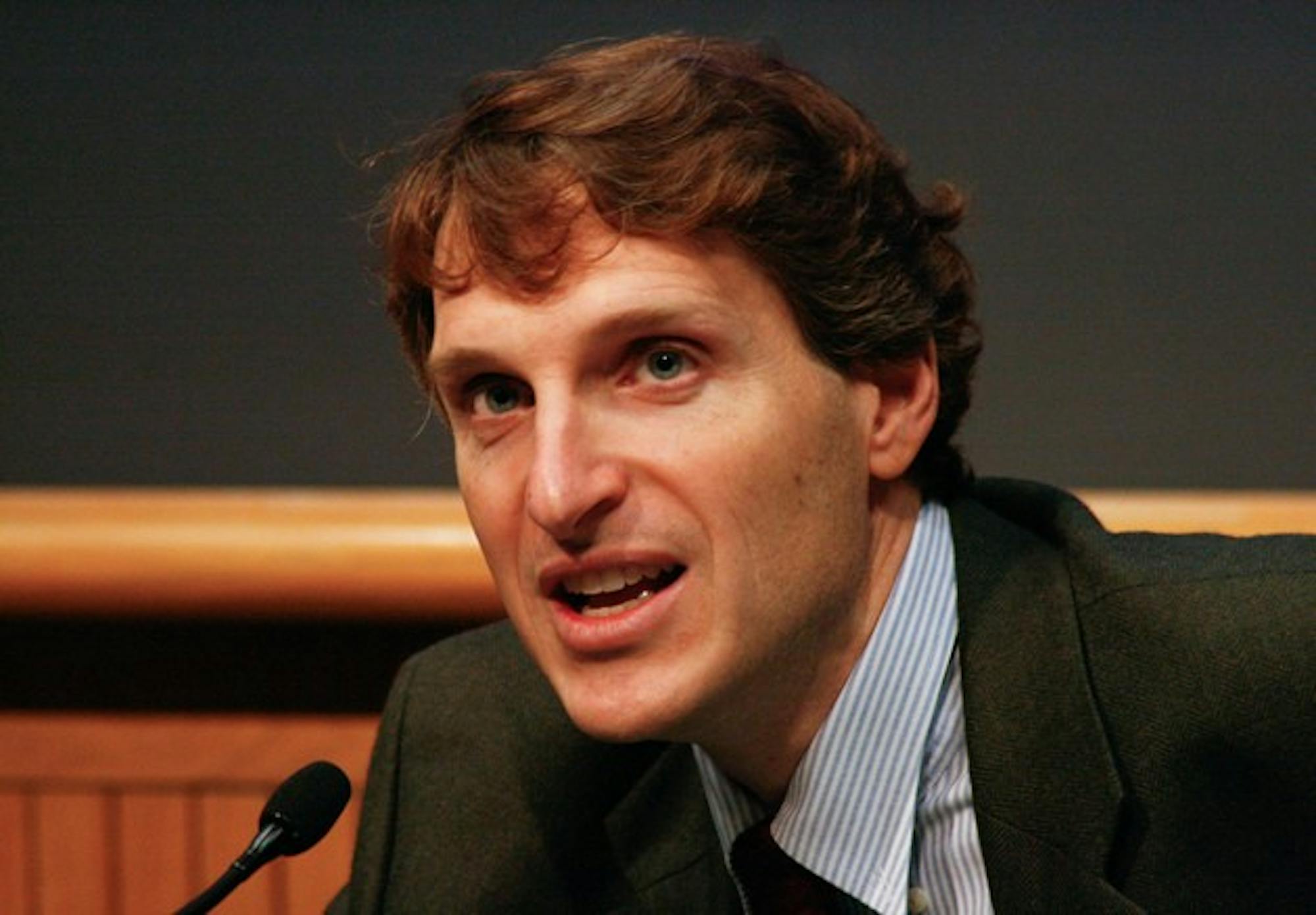
Professors Andrew Samwick, director of the Rockefeller Center, Bruce Sacerdote '90, vice chair of the department, Eric Zitzewitz and Nancy Marion discussed the causes, possible responses, international scope and history of financial crises at the event, "The Financial Meltdown: Causes, Consequences, and Options," which took place at the Rockefeller Center.
Sacerdote drew upon statistics from Lehman Brothers, the bankrupt investment bank, and A.I.G., the troubled insurance company, to illustrate the causes of the financial crisis. Subprime mortgages are not solely responsible for the crisis, Sacerdote said, attributing much of the current situation to bank panic.
"The financial sector is integral to everything we do. We've known this since the beginning of the country," Sacerdote said, citing Alexander Hamilton's 1792 government-sponsored rescue of the economy.
Subprime mortgages were only a small part of Lehman Brothers' total assets, according to Sacerdote, and the investment bank had decreased its short-term debt from $430 billion to $160 billion over the past year. Lehman Brothers failed when it was unable to raise capital after a failed merger with Korea Development Bank and divestment from nervous hedge funds, which rendered the bank unable to pay its debts, Sacerdote said.
"This is not to put the blame on the hedge funds or Korea Development Bank, but we only lost a year or two in housing prices," he said. "The fundamental issue was that our financial institutions managed to bet heavily on the most imprudent loans."
Zitzewitz raised the question of fairness as he laid out the advantages and drawbacks of all the government's possible responses to the financial crisis. He explained the situation of a manager of a small bank that did not make loans to unqualified candidates. Banks such as this one suffered in competition with those that extended risky loans, until these banks failed when the loans were not repaid. The bank managers of these "responsible" banks, Zitzewitz said, feel it is unfair of the government to purchase the bad assets and infuse capital into their now struggling competition.
Zitzewitz noted that a year ago, the Federal Reserve did not own any non-Treasury assets but now holds $900 billion worth. The Reserve acquired these assets as collateral for loans and investments in the government takeover of the finance groups.
"It is interesting that the government asked for a $700 billion bailout when the [Reserve] already had a $900 billion bailout of sorts," he said.
The panel also brought up Samwick's Law, an economics theory named after the panel moderator, which states that if an institution is considered too large to fail, it is only a matter of time before it does.
"Debt, the transfer of money from those who have it to those who claim to have the best use for it, is a wonderful thing up to the moment it isn't," Samwick said.
There have been 142 financial crises worldwide since 1970, and the current economic situation in the United States is less severe than previous ones in other nations, according to Marion.
"While this financial crisis is unprecedented in its scope, size and consequences, it is similar to those that occurred in emerging markets," she said.
Marion pointed to several measures of how severe a crisis is, such as the percentage of gross domestic product a government needs to spend on a financial rescue plan. Marion said the United States plans to ultimately spend $1.4 trillion to rescue the financial system, calculating the combined cost of the bailout bill and the takeover of Freddie Mac, Fannie Mae and other companies. The costs amount to 10 percent of the U.S. GDP, compared to the14 percent Japan spent on rescuing its financial system and the 53 percent Indonesia spent during the 1997 Asian financial crisis.
The panelists agreed on many of the consequences likely to result from the financial crisis. The financial system would become smaller, they said, citing the increase in former students' requests for graduate school and new job recommendation letters.
"We will see a decline of U.S. borrowing or Asian lending, which will lead to a decline of the dollar," Marion said. "While this might hurt us -- our European trips will become more expensive -- in the long run, the decline of the dollar will force us to live more within our means."


