
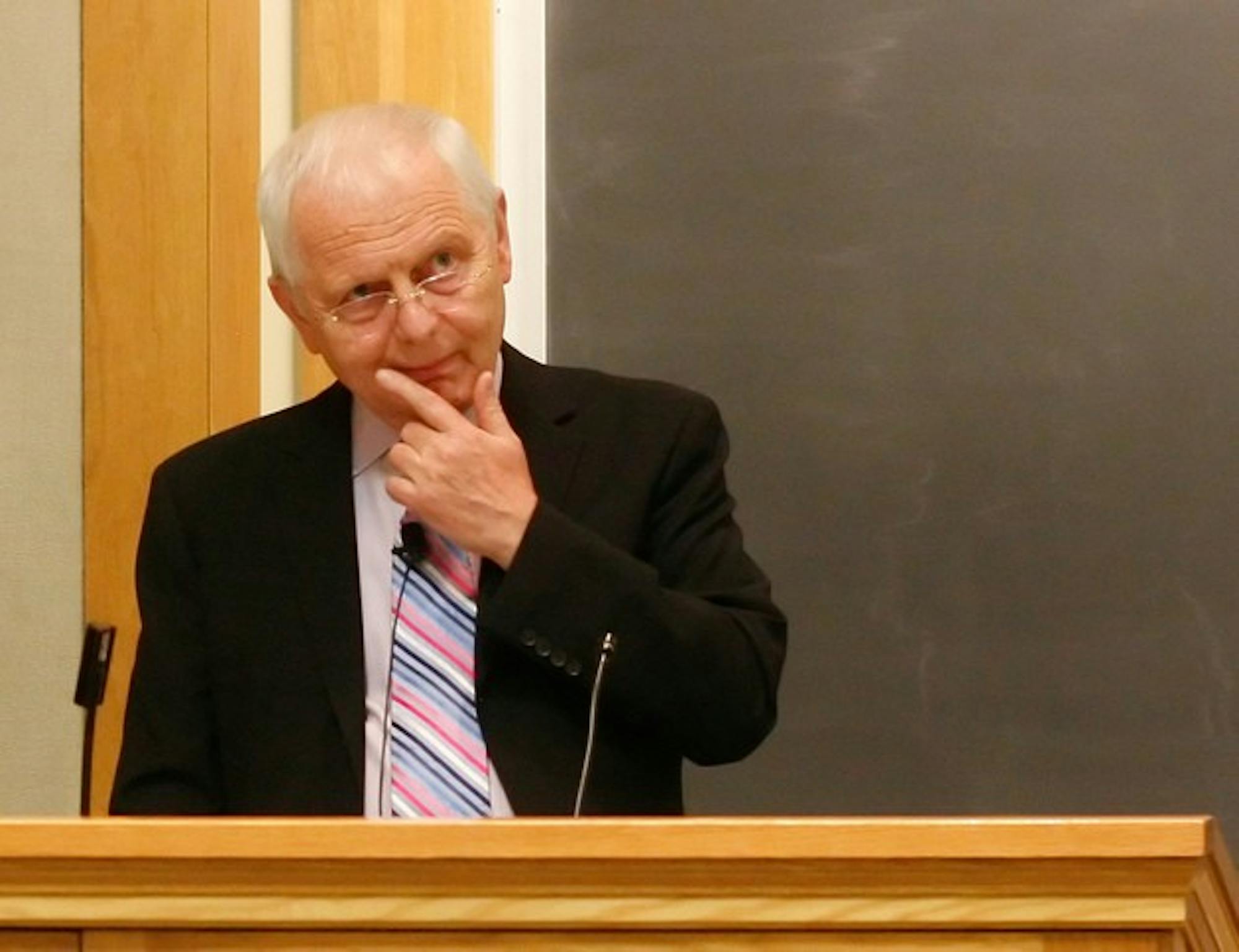
"The three institutions I'm talking about have been essential to secure, prosperous and free development," said Parry. "They have their roots in the failure of nations to turn rapid economic growth in the late 19th century into peace and stability."
Current threats to peace and stability include economic downturns, health crises, terrorism, immigration, and climate change. These issues demand multilateral responses because they involve and threaten the international community, Parry said.
"Cooperation and compromise are not dirty words," Parry said.
Parry highlighted his experience with the U.N., the E.U., and NATO to articulate the organizations' benefits, failings, and the necessary changes that must be made if they are to be effective in the 21st century.
"Each is now undergoing substantial changes in their particular journeys," Parry said.
Parry briefly mentioned other multilateral organizations, stating that growing multilateral organizations like the Association of Southeast Asian Nations may be sources of great good for their regions.
Parry spent much of his lecture discussing and answering questions about current global issues and how they should be addressed with a multilateral approach.
Myanmar was an issue of particular importance to Parry, and he compared multilateral reactions to issues there with multilateral efforts in Rwanda and the Balkans in the 1990s, which he characterized as "action, but too late."
Currently, Myanmar's national sovereignty is being respected, Parry said, but that sovereignty is one in which "for 60 years the regime has subjected people to the most awful conditions: The monks rebellion demonstrates that because the crackdown on protestors was a brutal and cynical attack by a government on it's own people."
The U.N. charter does not include national disasters among its basis for interference, however, Parry pointed out.
Another issue that Parry sees as in serious need of perusal is that of human trafficking, which he used as an example of the substantial work that can be done internationally.
"Immigration's a contentious issue," he said during a discussion about the effects of the strengthened purview of the EU, "but you can't keep immigration on a national level, because it brings with it one of the most pernicious crimes -- trade in people."
He added that many people don't understand the scope of international issues like trafficking.
"People are shocked when I tell them that 300,000 people that we know of were trafficked into the United States last year," he said, "in Asia 10 million people have gone missing in last five years."
Parry sympathized with the sense of some college students that, while on an isolated campus, taking up such challenging issues or any international development or affairs would have little effect. He also offered words of support.
"If you don't have issues of concern now, you're never going to have them, right?" Parry said. "I've seen that students are committed to things. Don't underestimate the power of being committed to a cause."


