After all, this is the same team that has been described by two of its own co-captains, Conlan O'Leary '09 and Kemper Pierce '08, as having a "collective personality bordering almost as a spiritual movement."
Whatever one might make of this statement on team unity, cohesiveness perhaps is is the key reason that next week, the team will be heading out to Albuquerque, N.M., to participate in the National College Club Division I playoffs for the third time in four years.
The 15th seeded Big Green will be taking on second-seed Brigham Young University on Friday, April 18 in the first round.
Dartmouth qualified back on Nov. 10, 2007 by beating SUNY Brockport in the semifinals of the northeast regional. The top two teams from each of the eight regions across the country advance to Nationals.
After securing a trip to nationals in the 2005-2006 season, the Big Green fell short last year in league play in the fall, where losses to Harvard and Boston College ended Dartmouth's run at a third straight qualification.
Despite the challenge of being the underdog in this year's tournament, the team is confident about facing two-time national runner-up BYU.
"We want a good showing," co-captain Drew Jennings '08 said. "They're known to be really big, and they have a lot of older guys coming back from their missions, so we just want to focus on tackling really hard and surprising some people."
Helping battle BYU's big forwards will be a group of former Big Green football players. Joining former strong safety Ian Wilson '08, who has been playing both football and rugby for the past couple seasons, are tight end Bret Lowe '08, offensive linemen Jared Dowdakin '08, free safety John Pircon '08 and fullback Ryan Mahoney '08.
All of these players were not with the rugby team when it qualified for nationals in the fall, but they each came out in the winter and spring and could make a big impact on how the team competes next weekend and in the Ivy League championship in two weeks.
Why would a group of seniors pass on the chance to take it easy and live the good life during their senior spring? Lowe and Dowdakin both agreed that it was simply to fill a competitive void in their lives.
"I've been competitive all my life, and I think that's the case with most of the football players," Lowe said. "We've been playing [football] since third grade through college. Ian Wilson had kind of talked it up to us, and it sounded like a fun thing to do. Really, I just like competing. And I wanted a chance to not only play a new sport, but meet a whole bunch of new people."
Dowdakin remembers exactly when he first started thinking about joining the team ' when he, Lowe, Pircon and Mahoney all took a break from the grind of pre-season football to attend the rugby's September match against Canada's Queens College.
"We just kind of liked what we saw," Dowdakin said. "We knew a lot of guys on the team, and we started talking that day about possibly doing it. Then over the winter we decided to go ahead with it."
Pierce is quick to point out that the rugby team has pulled former football players in the past, and all have had a significant impact during their respective spring seasons.
But to have five new players in one season is still seen as unusual.
"I think our senior football class was kind of a special class in that regard, in that we're all so close and really competitive people, and so we all wanted to keep competing after our season was over," Lowe said.
On their part, the rugby team has welcomed them with open arms. In a sport as physically demanding as rugby, adding a big body is always appreciated.
"The guys who play or played football at Dartmouth typically are hard-working, committed to the collision, and committed to becoming better athletes," head coach Alexander Magleby '00 said. "More importantly, they normally add and adapt well to our team culture."
The new players have been able to come along relatively slowly while still being able to make what their teammates feel is a positive impact.
"Even if we're not starting, we're still going to get in there, help out and make some plays," Lowe said. "So many people just go down and get hurt, because it is a rough sport. So its nice to have the extra bodies."
For O'Leary, the impact has been just as big off the field, as his new teammates have fit into the rugby culture seamlessly.
"I was off in the winter, and I came back for the spring tour, and basically met five strangers," O'Leary said. "But I walked away from the tour with five new best friends. What they bring to the team on the field is just dwarfed by what they bring to the team off the field."
Jennings agreed, and noted how Dartmouth has been able to adjust its strategy with the newfound depth at forward.
"In the fall we had a lot of backs, and that's always been who the Dartmouth team is, but it's really big for us because usually the forwards get hurt a little more. When we're playing BYU, its really going to help us to have bigger guys."
The new players have all been playing as forwards. In rugby, the fifteen players on the field are split between eight forwards and seven backs. The forwards are usually the bigger players on the field, and play crucial roles in scrums, mauls, rucks and line-outs.
For those unfamiliar with the technicalities of rugby, now may be the time for some quick explanations.
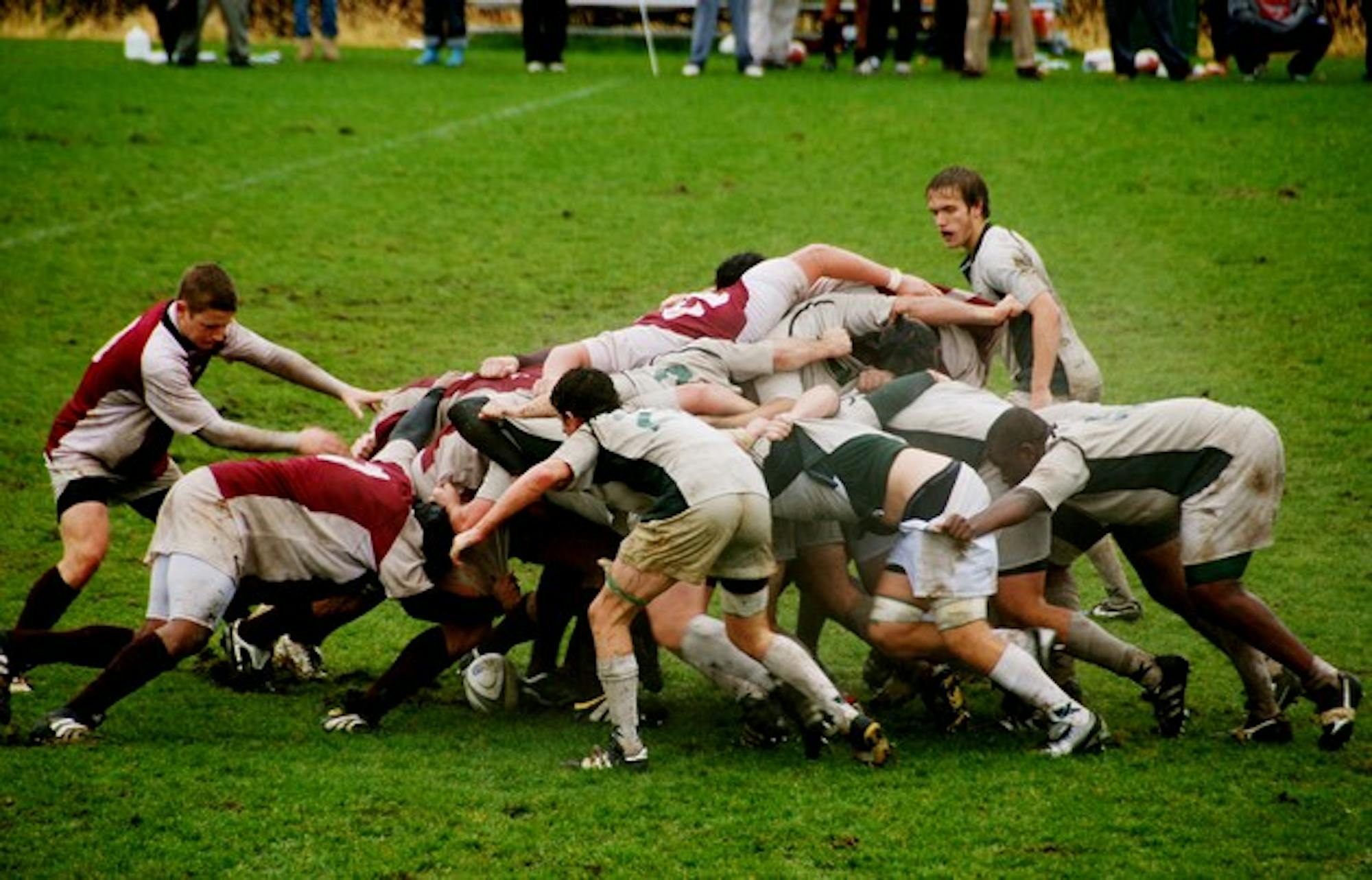
A scrum takes place after a minor rule infraction or when the ball is unplayable, and might be the most recognizable image in a rugby game. The eight forwards bind together in three rows, with the front row locked with the front row of the opposing team.
The team not responsible for the stopping play then rolls the ball between the two teams, and a team then gains possession either by hooking the ball to their side with their feet or by pushing the other team off the ball.
A ruck is basically a looser version of scrum that occurs when two players fight for possession of the ball during play. A player must release the ball when he is tackled to ground, and to preserve possession players from the attacking team will try to bind onto opposing players and keep them from poaching, or stealing, the ball on the ground.
A maul occurs when the ball carrier has been held up by the opposing team, but not taken to ground. His teammates (usually forwards) will bind onto him to protect the ball and provide a stable base to get the ball out to the backs and initiate an attack.
A line-out occurs when the ball goes out of bounds. Each team lines up a number of forwards opposing each other and perpendicular to the sideline. The team in bounding then throws the ball down the middle between the two teams, but to a spot where they can lift a player off the ground and have a jumping advantage.
However, it takes a whole lot more than simply being big to find success in rugby. For Dowdakin, the change in conditioning was a major adjustment coming from the football team.
"I'm used to five or ten seconds, full burst, and then twenty or thirty seconds of complete rest," Dowdakin said. "The cardio is just totally different. Plus, learning the game is a big stepping stone as well."
Indeed, all the players agree that the hardest adjustment is simply the challenge of learning a new game on the fly.
"The hardest part is definitely just learning the game," Lowe said. "I had never even seen a rugby game before I came out, and had no idea what was going on."
Jennings agreed. "We've all been there, because only a handful of guys come to Dartmouth having played before. I had played soccer, and had never played rugby before college."
According to Dowdakin, the understanding and willingness to help on the part of the veteran rugby players has been essential for picking up the game so quickly, and added that several of the upperclassmen players have really gone out of their way to help out the new players.
"I know for me personally, it really helped to have Kemper Pierce sort of take me under his wing and give me a role model to emulate."
Despite the fact that none of the new players were involved in the actual qualifying process, nobody on the team has taken any issue with these rugby rookies getting spots on the New Mexico trip.
"The way we see it, we just added five great athletes who can play A-side rugby, and that makes it more competitive for everyone," Pierce said. "Most guys appreciate the competition and respect that fact."
"There have been some changes with man management, guys who got a lot of time in the fall but get less time now maybe" he added. "But it's all merit-based selection; it's never about veteran status or anything."
"We've got a tough match against BYU," O'Leary added. "People appreciate that we're just putting out the best 15 players."
Of course, much of the credit needs to go to coach Magleby. The players all agree that he has played a huge role in getting the new players up to speed in time to have an impact this spring.
"Mags is just a great coach," Lowe said. "He does a great job of showing us what we need to know right away, so that we can get by on that, and then we can pick up all the little extra things we need to get better while we play more and more."
All the players agreed that going to England over spring break was a great opportunity for the team to improve. Every year the rugby team plans a tour over spring break to get a chance to play against some clubs internationally.
Past trips have taken Dartmouth rugby to South Africa, Argentina, Uruguay and California. This year's trip to England saw the Big Green in action against four different programs, including Cambridge Colleges and the University of Birmingham.
"Over there, we really wanted to focus on our defense, focus on the contact point, and really focusing on the breakdown," Jennings said. "We just want to make sure we're ready for BYU's size and anything they can throw at us."
"Going to England with the team was really helpful, just getting in a bunch of games," Lowe said. "Actually playing the games has helped me more than anything."
At this point though, there's nothing left to do but head out to New Mexico and find out what they can do. The Big Green rugby team is confident it can shock some people and, according to Magleby, can exploit BYU's perceived strength into Dartmouth's advantage.
"BYU might be looking past us, thinking about a third straight trip to the final," O'Leary said. "We're just going to go down there and hit them in the mouth."