
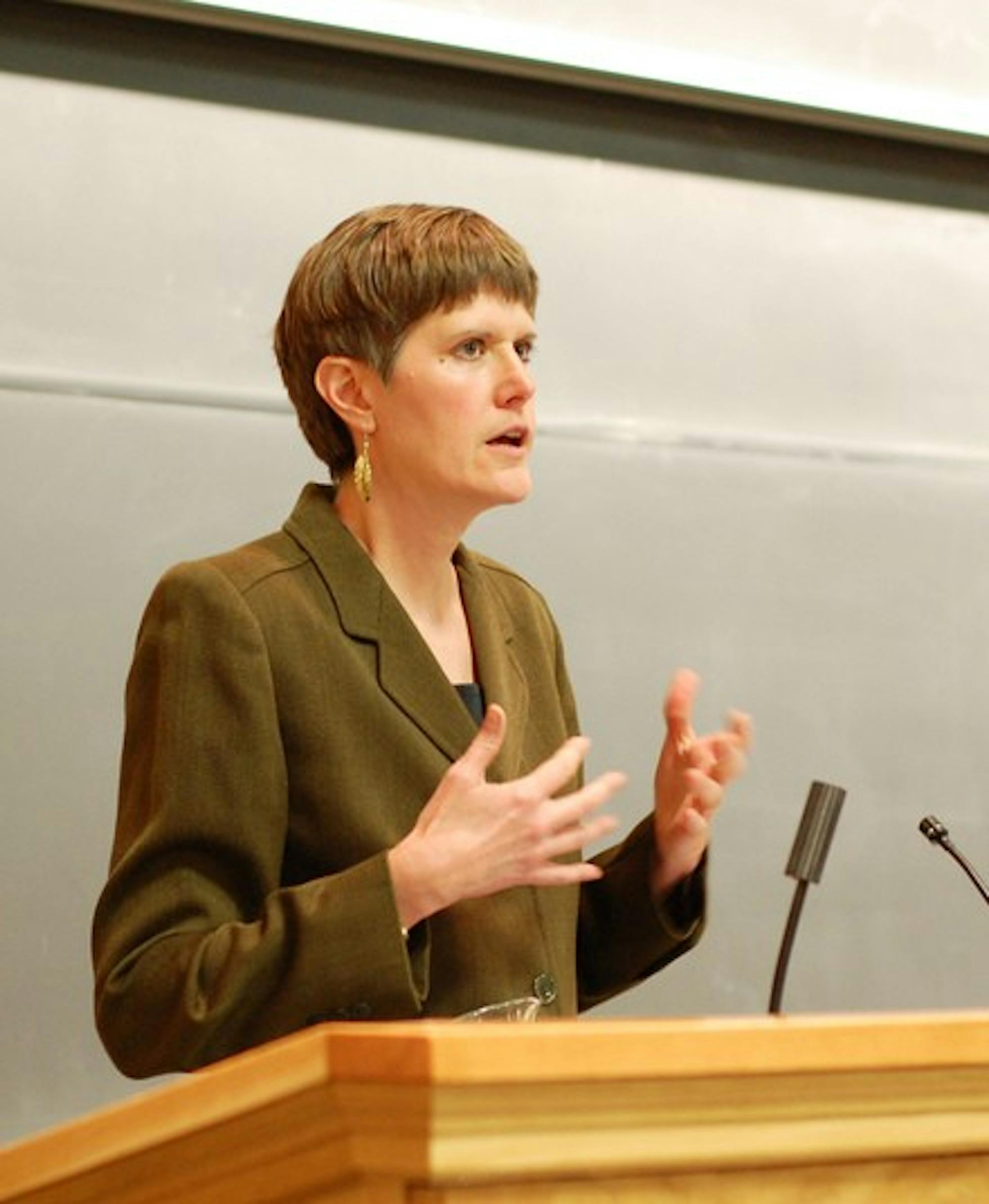
Steingraber said that protecting the population from toxic chemicals is an issue that can transcend religious and political divisions.
"It's challenging, but when I go into farming communities in red states I say that there's an important conversation we need to have about abortion," Steingraber said. "I tell people that they may disagree with me on abortion as a choice, but chemicals have power to end pregnancy against the will of a woman, and that's a human rights issue. I tell them that toxic chemicals are abortionists."
Steingraber began by outlining human fetal development and discussing childhood health. She then explained that many chemicals produced by human activities cause or contribute to a variety of health issues, ranging from cancer to birth defects and retardation.
"Covenants in the United Nations offer security and health to children, but things like breast milk contamination violates that by impeding their brain development," Steingraber said, giving one of many examples offered throughout the event.
Steingraber said she remains optimistic despite the scope and complexity of these issues.
"I think sometimes my books and research cause people to feel a sense of despair, that the problems are too large," Steingraber said. "Despair is a luxury we can't afford, so that's not my intention. I see hope internationally and at a grassroots level."
Steingraber advised the European Union as it created new toxic chemical regulation, which prohibits any chemicals, no matter how long they have been used, from being marketed without conclusive data demonstrating their safety.
"The growing disconnect between the way Europe is dealing with this and the way we are is very interesting," Steingraber said. "There's a marked contrast."
In the United States, the regulatory Toxic Substances Control Act requires companies to register new chemicals with the EPA, but does not require testing, she said.
The EPA then attempts to discover through modeling any potential adverse effects. Academics often cannot study chemicals' impact or attempt improvements because the manufacturers can declare the chemical formulas to be proprietary. The law "grandfathered in" the 61,000 chemicals already on the market when it was passed.
The United States' systems for measuring toxic chemicals are outdated and inefficient, Steingraber said. The EPA tests chemicals for a threshold dose, or a safe level of exposure for that chemical. The composite effects of multiple chemicals, however, are not uniformly considered.
Such lax policies violate human rights because chemicals that are safe for a mother can negatively impact fetal development by causing miscarriage, organ and limb deformations and lapsed brain development, among other issues, she said.
She also discussed chemicals' impact on fertility and human bodies.
"You don't usually connect 'when will I enter menopause or can I get pregnant in my thirties' with Dick Cheney's energy policy," Steinberger said to loud guffaws. "But how much coal we burn, which automobiles we use, how much diesel we use and our air standards may have everything to do with vitality of eggs in female ovaries."
Steingraber's discussion was funded by the George Link Jr. Environmental Awareness Lecture Series.
"I hope students will take away a greater understanding of the science exploring links between the environment and cancer," said Andrew Friedland, chair of the College's environmental studies program. "I also hope it will inspire undergraduates to see how you can pursue science and also strive to be an excellent writer."
Steingraber, who has a Ph.D. in biology from Illinois State University, is an internationally recognized expert about the environmental links to cancer and reproductive health.


