
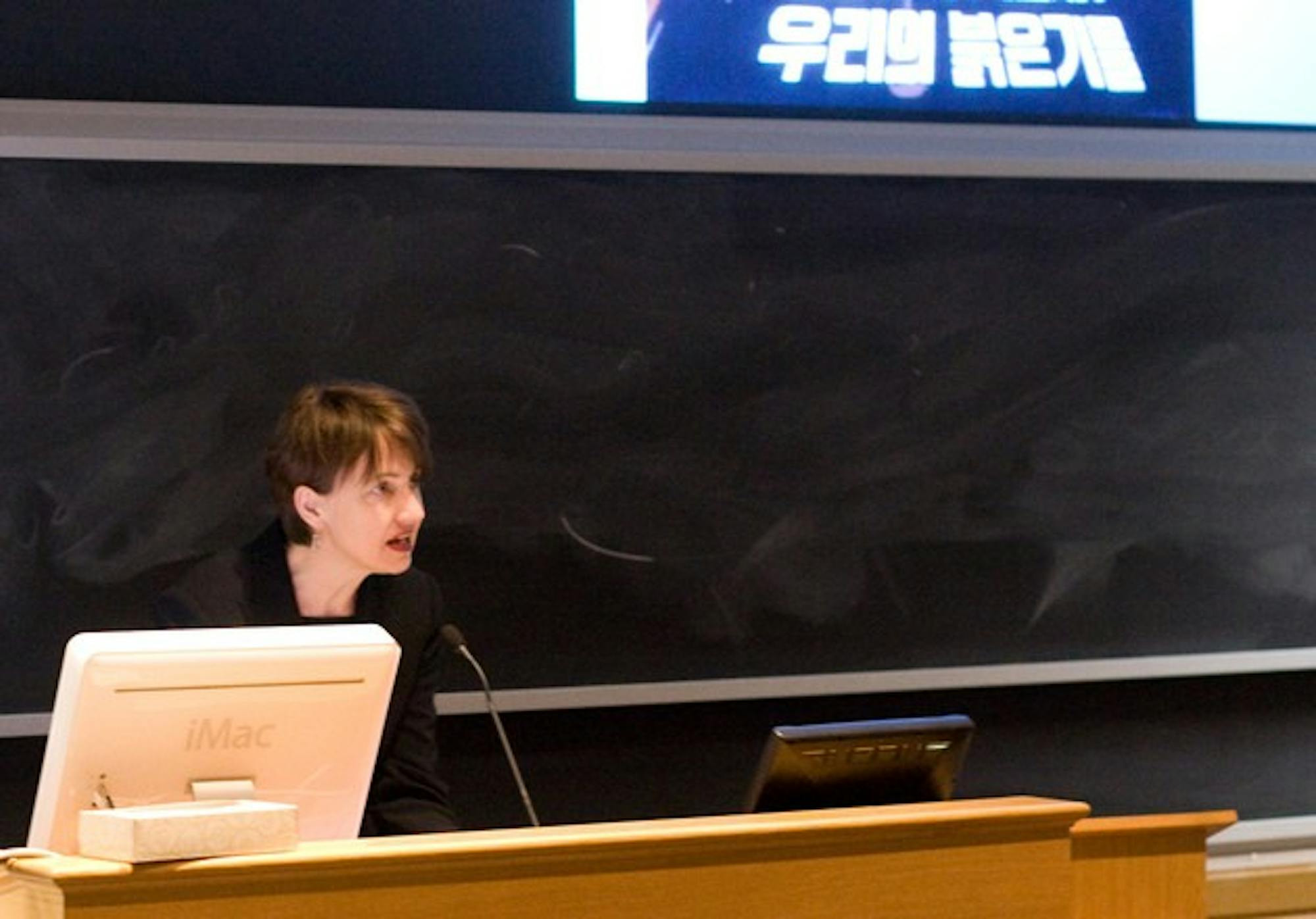
"This is not art, basically," Portal said. "It's propaganda... Some of it's technically very good, it's just the subject matter is limited."
Portal is curator of the British Museum's China and Korea collections. She traveled to North Korea to look for art for the museum's collection.
Since Kim Il Sung took power, forming North Korea in 1948, the country's limited contact with other cultures has included the importation of socialist art, primarily from China and the former Soviet Union, Portal said. This art primarily features the glorification of soldiers and laborers, according to Portal. Any visual art that deviates from standards of socialist realism or subjects of traditional Korean art, such as landscapes, is prohibited by the government, she said.
Kim is a recurring figure in North Korean art, a genre Portal calls "Kim cult" art. Kim has been the subject of pictures, songs, poems, stories and even a species of orchid named "kimilsungia" in his honor, according to Portal. Kim's image, frequently surrounded by children, is painted on many multi-story murals on the sides of new buildings, she said.
"It's probably the case that Kim Il Sung has had more buildings named after him during his life than any other leader in modern history," Portal said. "Kim was associated with benevolence. He came to be regarded as a kind of Father Christmas or Santa Claus."
The state's control of art parallels its influence on the work of North Korean archaeologists, Portal said. For example, the government falsely claimed that the remains of two bodies uncovered by archaeologists were the bodies of Korea's mythical founder, Dangun, and his wife. Officials constructed a mausoleum to commemorate the site where the bodies were found, Portal said.
Portal referred to the mausoleum as "rather like a dramatic but historically incorrect film set" appropriated by the government to enhance public support of the state. The history of other monuments has been revised by the state as well, she said, such as a Buddhist temple constructed by a major past figure in Korean history, which the government moved to a more central location during North Korea's reconstruction. The purpose of the move was to increase state legitimacy and historical power in the eyes of North Koreans.
"A lot of time and money has been put into this reconstructed Buddhist temple," Portal said. "It was renovated and relocated for political reasons."
In other cases, sites generally regarded by archaeologists as Chinese settlements have either been ignored or treated as if they were Korean sites, she said. Chinese objects discovered by archaeologists, such as jade figures, have been studied as if they were Korean subjects, she said.
Such cultural isolation is part of North Korea's larger policy of "Juche", or self-reliance, according to Portal. The state has made an effort to focus the North Korean people entirely inward, Portal said, and has trained them to believe that North Korea is a form of paradise. As a result, the country has only recently begun to open to the outside world, in response to the democratization of a number of other former communist regimes, according to Portal.
"I think that there is a problem with money and lack of resources and lack of equipment," Portal said. "Korea's just stuck in this kind of time warp, and nothing's happening...There is a gradual opening up, but it is very, very gradual."
Portal aims to document the current condition of North Korea, which she has attempted to do by bringing North Korean art to Britain for preservation, she said.
"The regime is going to change at some time, we know not when," she said. "It needs collecting and recording. Make what you will of it."


