
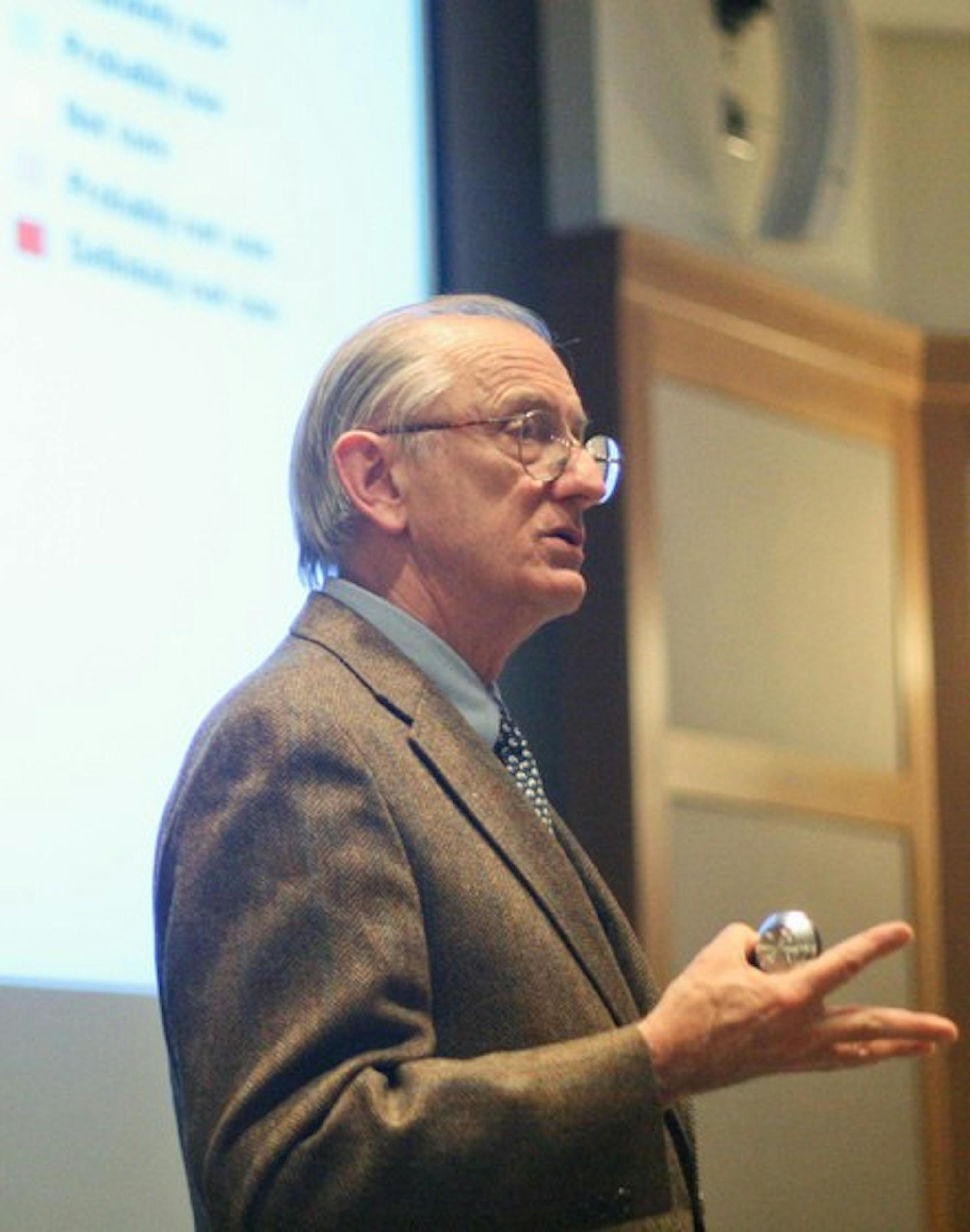
Jacoby likened climate change to a game of chance. He represented temperature increases as sections of a "wheel of chance," with each increase representing a part of the wheel proportional in size to the likelihood that the mean global temperature will rise that amount.
At the current level of greenhouse gas emission, there is a large chance that the Earth could warm by more than three degrees by 2050, Jacoby said. He argued that the general population does not take the issue of climate change seriously enough and that when they do, people set unreasonably high goals for reducing atmospheric carbon dioxide levels.
Rather than aiming to achieve the frequently proposed reduction of atmospheric carbon dioxide to 450 parts-per-million by volume, Jacoby suggested stabilizing national levels of carbon dioxide at 550.
Even modest reductions in emissions, Jacoby said, would go a long way towards managing the consequences of climate change. The reduction to 550 parts-per-million by volume would effectively eliminate the most extreme threat, a four- or five-degree rise in global temperatures. A reduction to 750 reduces the probability of a four- or five-degree increase in temperature, which Jacoby demonstrated with wedges on his figurative wheel of chance.
Jacoby said he examines climate change from an economic perspective, and principally recommends that a price be set for carbon emissions. He favors a cap-and-trade system, he said, whereby the government sets a ceiling for carbon emissions and then distributes emissions permits. Industries would then be free to trade the permits among themselves, purchasing the right to emit until they reach the maximum they are willing to pay, which effectively puts a price on carbon dioxide production.
"The right price of carbon is not zero," Jacoby said.
Jacoby explained that making carbon emissions costly would lower the demand for the products and services associated with greenhouse gas emissions. He wants to see carbon completely eliminated from electricity production, he said, although he acknowledged that much of the nation's electricity is currently derived from coal, which gives off significant carbon emissions. Eliminating carbon from electricity production, then, would require a major restructuring of the national power system, he said.
Among consumers, there is a poor understanding of the cap-and-trade system and a consequent lack of interest in it, Jacoby said. Consumers prefer exploring the use of solar power, wind and biomass such as ethanol as fuel, he added. While such alternatives can be a component of a successful national strategy, Jacoby said there is a limit to their effectiveness, dismissing the large-scale potential of corn ethanol in particular. Corn ethanol is a highly publicized technology that has proven to be a popular idea among consumers.
"Corn ethanol is a terrible policy," Jacoby said.
Rather than aiming for a certain emissions level, the United States could also make an effort to reduce carbon emissions by 50 percent, Jacoby argued. While he admitted this plan may sound costly, he said it would not damage the overall U.S. economy.
"By 2050, you would be about two percent poorer than you otherwise would have been," Jacoby said.
A reduction in carbon emissions will have some negative economic consequences, Jacoby explained, which he believes would affect different segments of the population unequally. Returning to the example of the coal industry, he said any change would create "winners" and "losers."
All of Earth's inhabitants will lose if the world population does not take action, Jacoby said, going on to chastise people who argue that it is too late to act. At the very least, he said, it is not too late to reduce the greatest risks of warming.
Jacoby observed that mobilizing a response itself entails its own set of risks, as people may be so depressed by the global climate statistics that they lose hope in the possibility of a solution.
"That right there is the crux of the problem," Ben Campbell '10, an audience member, said after the lecture. "How do you get people to understand the situation and also be motivated to act?"
The lecture was sponsored by the John Sloan Dickey Center for International Understanding.


